. 2002 May 15;541(Pt 1):103-12.
doi: 10.1113/jphysiol.2002.016485.

Conformation-dependent regulation of inward rectifier chloride channel gating by extracellular protons

Affiliations

Conformation-dependent regulation of inward rectifier chloride channel gating by extracellular protons

Jorge Arreola et al. J Physiol. .

Abstract

We have investigated the gating properties of the inward rectifier chloride channel (Cl(ir)) from mouse parotid acinar cells by external protons (H(+)(o)) using the whole-cell patch-clamp technique. Increasing the pH(o) from 7.4 to 8.0 decreased the magnitude of Cl(ir) current by shifting the open probability to more negative membrane potentials with little modification of the activation kinetics. The action of elevated pH was independent of the conformational state of the channel. The effects of low pH on Cl(ir) channels were dependent upon the conformational state of the channel. That is, application of pH 5.5 to closed channels essentially prevented channel opening. In contrast, application of pH 5.5 to open channels actually increased the current. These results are consistent with the existence of two independent protonatable sites: (1) a site with a pK near 7.3, the titration of which shifts the voltage dependence of channel gating; and (2) a site with pK = 6.0. External H(+) binds to this latter site (with a stoichiometry of two) only when the channels are closed and prevent channel opening. Finally, block of channels by Zn(2+) and Cd(2+) was inhibited by low pH media. We propose that mouse parotid Cl(ir) current has a bimodal dependence on the extracellular proton concentration with maximum activity near pH 6.5: high pH decreases channel current by shifting the open probability to more negative membrane potentials and low pH also decreases the current but through a proton-dependent stabilization of the channel closed state.


Figures
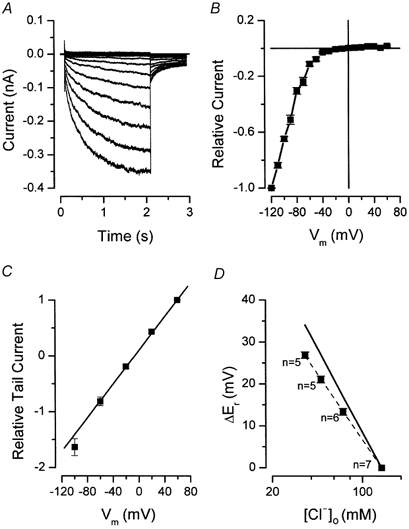
Figure 1
Figure 1. Inward rectifier chloride currents
A, whole-cell chloride currents recorded from +60 to −120 mV in 10 mV increments. A 5 s interval was allowed between sweeps. B, normalized current-voltage relationship. Current recorded at −120 mV was used to normalize each curve and then the normalized curves were averaged (n = 12). C, instantaneous current-voltage relationships determined from cells bathed in solutions with pH of 7.4 (n = 6). A prepulse to −100 mV was used to open the channels. Tail currents were generated by repolarizing the membrane to the indicated voltages and its magnitudes were normalized to that obtained at +60 mV. The continuous line is a linear regression. D, reversal potential shifts obtained from tail current experiments are plotted as a function of [Cl]o. The filled squares are experimental data and the continuous line reflects expected values for a chloride-selective channel. Experimental data were fitted by the Nernst equation with a slope of −45 mV.
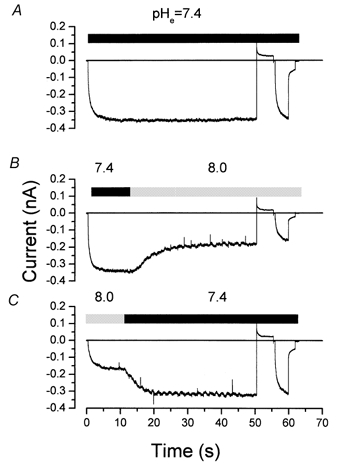
Figure 5
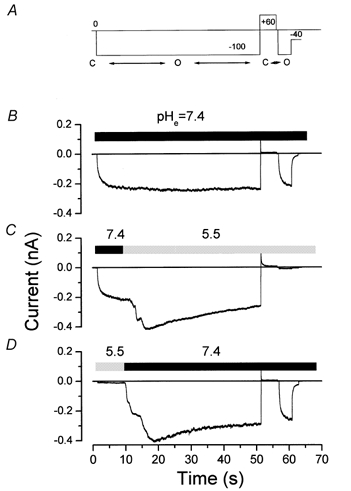
Figure 5. State-dependent inhibition of Clir by pHo 5.5
A, pulse protocol used to assess the effects of external H+ on open channels (first 50 s hyperpolarization) and after closing (second 4 s hyperpolarization). Two consecutive hyperpolarizations to −100 mV separated by a depolarization to +60 mV were used as stimuli. The first and longest hyperpolarization allowed the exchange of the bath solution while the channel was open. The second and shortest hyperpolarization evaluated the fraction of channels inhibited after a 5 s pulse to +60 mV that closes the channels. Closed to open confirmation transitions are indicated below the pulse protocol. Bath volume was about 0.2 ml, flow rate was about 4 ml−1, resulting in a typical time for solution exchange of 10-15 s. B, C and D depict traces obtained from the same cell. B shows a control record obtained at pH 7.4 with the protocol shown in A. C shows the effects of changing the bath pH from 7.4 to 5.5. D shows the reversibility of the inhibition by changing bath pH from 5.5 to 7.4.
Figure 2
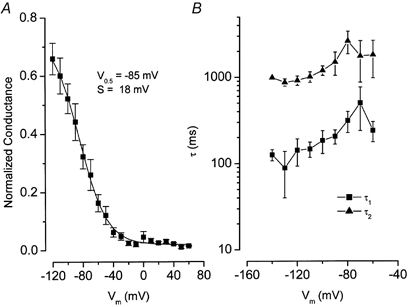
Figure 2. Macroscopic open probability and kinetics of Clir
A, the open probability as a function of Vm was estimated by calculating the macroscopic conductance using eqn (2) and normalized to the estimated gmax (see Methods). V0.5 and s parameters were determined by fitting the average normalized conductance curve with the Boltzmann function (eqn (3); n = 12). B, kinetics of Clir. Traces at each membrane potential were fitted with a two-exponential function to estimate both fast (▪, n = 9) and slow (▴, n = 9) time constants.
Figure 3
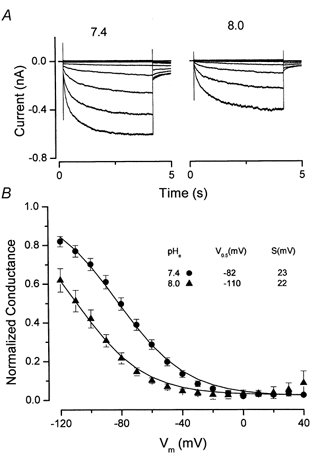
Figure 3. Shift in Clir activation induced by changes in pHo
A, cells were bathed in solutions with the pH adjusted to the indicated values. Control currents (pHo = 7.4) are shown in the left-hand panel and test currents are shown in the right-hand panel (pHo = 8.0). Membrane potential was changed from −120 to +40 mV in 20 mV steps. B, voltage dependency of channel activation at pH 7.4 (•, n = 5) and 8.0 (▴, n = 5). The analysis of these curves obtained from paired experiments was as described in Fig. 2B. The resulting average curves were fitted with the Boltzmann function to obtain the parameters V0.5 and s displayed in the inset.
Figure 4
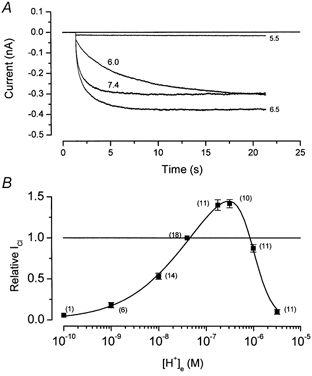
Figure 4. Bimodal regulation of Clir by pHo at −100 mV
A, recordings obtained from the same cell. External solutions of indicated pH were continuously perfused throughout the experiment. B, normalized current versus[H+]o relationship. Data like those shown in A obtained at −100 mV were normalized to the absolute current value (measured at the end of the pulse) obtained at pH 7.4. The values plotted at pH 6.0 and 5.5 were obtained using 20 or 50 s pulses. Number of observations are indicated in parenthesis. Fitting of data with eqn (4) is shown as continuous line. Parameters obtained from the fit are given in the text.
Figure 6
Figure 6. State-independent inhibition by pHo 8.0 at −100 mV
The protocol was as described in Fig. 5A. A, B and C show raw traces obtained from the same cell. A, control trace obtained from cell bathed in a solution with pH 7.4. B, current recorded while changing the bath solution pH from 7.4 to 8.0. C, current recorded while changing the bath solution pH from 8.0 to 7.4.
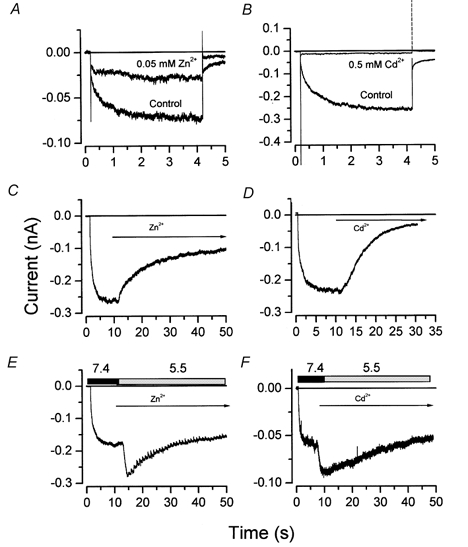
Figure 7
Figure 7. Low pHo interferes with Clir inhibition by Zn2+ and Cd2+
A and B, inhibition of Clir current by 0.05 mm Zn2+ and by 0.5 mm Cd2+, respectively, at −100 mV. Divalent cations were applied in a solution of pH 7.4 while the cell was held at 0 mV. C and D, inhibition of Clir current by 0.5 mm Zn2+ (n = 5) or 0.5 mm Cd2+ (n = 3), respectively, at pH 7.4 and −100 mV. E and F, lack of inhibition by 0.5 mm Zn2+ (n = 5) or 0.5 mm Cd2+ (n = 3), respectively, at pH 5.5 and −100 mV. The bath solution pH in A, B, C and D was 7.4 throughout the experiments. Rectangles in E and F indicate the exchange of the standard pH 7.4 bath solution containing no blocker with a pH 5.5 bath solution containing 0.5 mm of Zn2+ or Cd2+. The arrows in C, D, E and F indicate when the blockers were present.

References

    1. Arreola J, Park K, Melvin JE, Begenisich T. Three distinct chloride channels control anion movements in rat parotid acinar cells. Journal of Physiology. 1996;490:351–362. - PMC - PubMed
    1. Bennets B, Roberts ML, Bretag AH, Rychkov GY. Temperature dependence of human muscle ClC-1 chloride channel. Journal of Physiology. 2001;535:83–93. - PMC - PubMed
    1. Bösl MR, Stein V, Hubner C, Zdebik AA, Jordt SE, Mukhopadhyay AK, Davidoff MS, Holstein AF, Jentsch TJ. Male germ cells and photoreceptors, both dependent on close cell-cell interactions, degenerate upon ClC-2 Cl− channel disruption. EMBO Journal. 2001;20:1289–1299. - PMC - PubMed
    1. Carew MA, Thorn P. Identification of ClC-2-like chloride currents in pig pancreatic acinar cells. Pflügers Archiv. 1996;433:84–90. - PubMed
    1. Chen T-Y, Miller C. Non-equilibrium gating and voltage dependence of the ClC-0 Cl− channel. Journal of General Physiology. 1996;108:237–250. - PMC - PubMed

Publication types

MeSH terms

LinkOut - more resources