. 2002 May 20;195(10):1371-7.
doi: 10.1084/jem.20020128.

Locally up-regulated lymphotoxin alpha, not systemic tumor necrosis factor alpha, is the principle mediator of murine cerebral malaria

Affiliations

Locally up-regulated lymphotoxin alpha, not systemic tumor necrosis factor alpha, is the principle mediator of murine cerebral malaria

Christian R Engwerda et al. J Exp Med. .

Abstract

Cerebral malaria (CM) causes death in children and nonimmune adults. TNF-alpha has been thought to play a key role in the development of CM. In contrast, the role of the related cyto-kine lymphotoxin alpha (LTalpha) in CM has been overlooked. Here we show that LTalpha, not TNFalpha, is the principal mediator of murine CM. Mice deficient in TNFalpha (B6.TNFalpha-/-) were as susceptible to CM caused by Plasmodium berghei (ANKA) as C57BL/6 mice, and died 6 to 8 d after infection after developing neurological signs of CM, associated with perivascular brain hemorrhage. Significantly, the development of CM in B6.TNFalpha-/- mice was not associated with increased intracellular adhesion molecule (ICAM)-1 expression on cerebral vasculature and the intraluminal accumulation of complement receptor 3 (CR3)-positive leukocytes was moderate. In contrast, mice deficient in LTalpha (B6.LTalpha-/-) were completely resistant to CM and died 11 to 14 d after infection with severe anemia and hyperparasitemia. No difference in blood parasite burden was found between C57BL/6, B6.TNFalpha-/-, and B6.LTalpha-/- mice at the onset of CM symptoms in the two susceptible strains. In addition, studies in bone marrow (BM) chimeric mice showed the persistence of cerebral LTalpha mRNA after irradiation and engraftment of LTalpha-deficient BM, indicating that LTalpha originated from a radiation-resistant cell population.


Figures

Figure 1.
Figure 1.
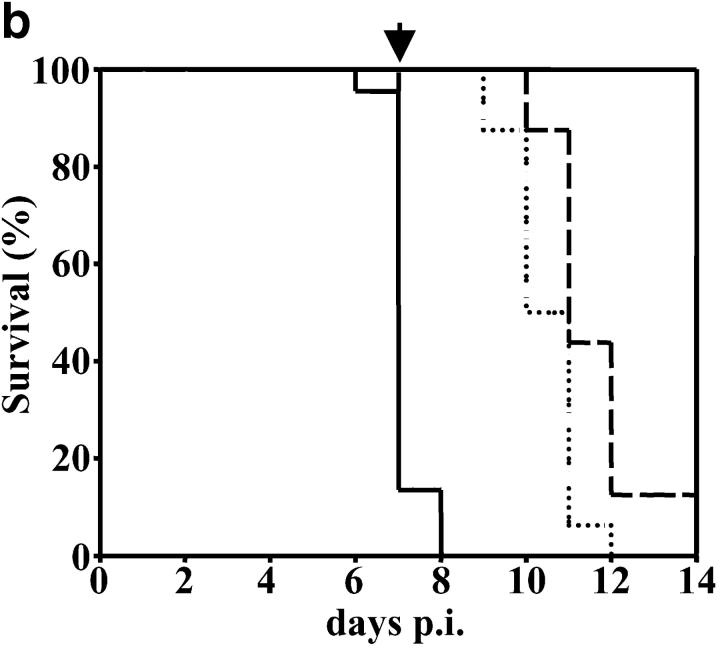
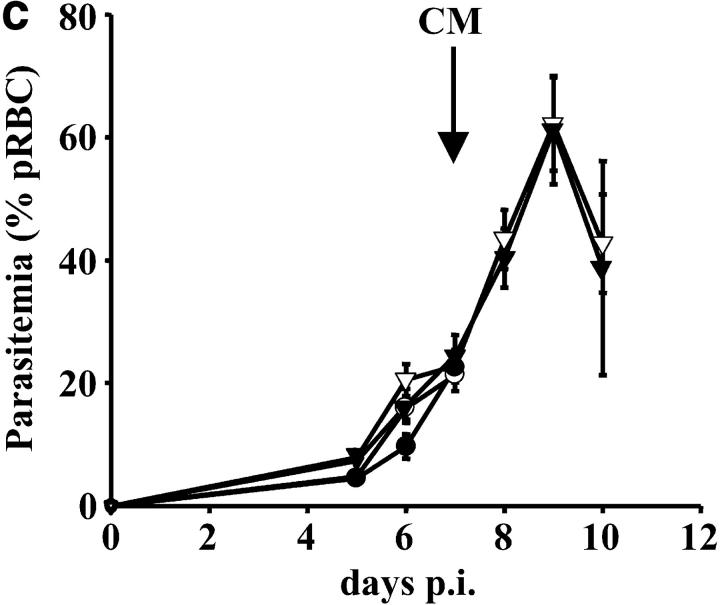
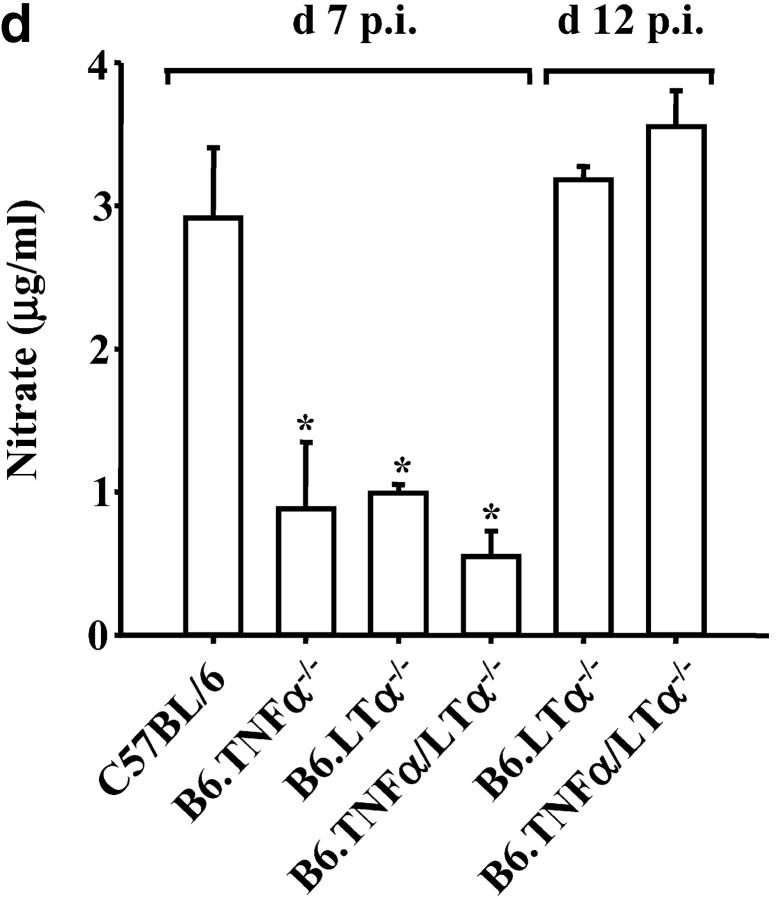
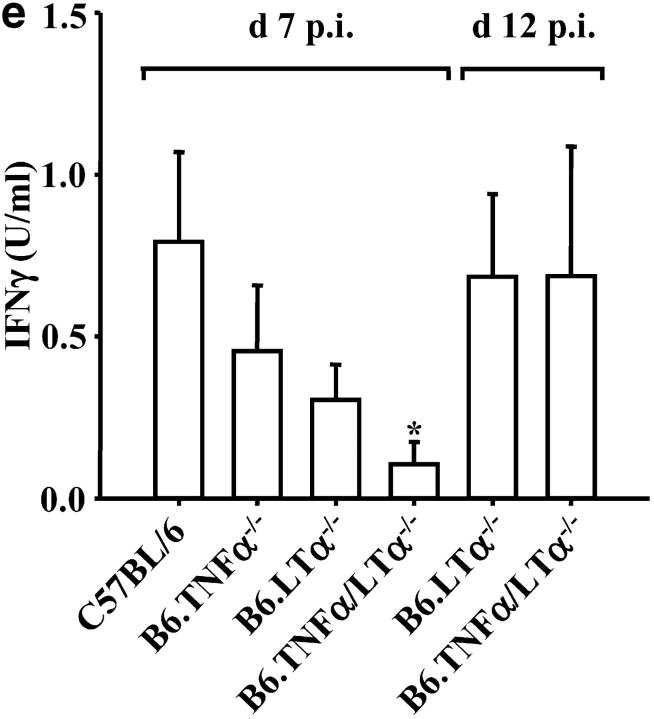
In the absence of LTα the early death of P. berghei ANKA-parasitized C57BL/6 mice is prevented. (a) LTα mRNA is up-regulated in brains of C57BL/6 mice with CM, as indicated by real-time RT-PCR (n = 3 mice per group). (b) Survival curves of C57BL/6 (solid line), B6.TNFα−/− (overlapping C57BL/6 mice and indicated by arrow), B6.LTα−/− (dashed line), and B6.TNF/LTα−/− (dotted line) mice infected with P. berghei (ANKA). Results represent pooled data from three independent groups of mice (n = 5 to 11 per group) in experiments conducted on three separate occasions (total of n = 16–22 mice per group). Differences in survival between C57BL/6 or B6.TNFα−/− mice and mice deficient in LTα were statistically different (χ2 = 39.39, P < 0.0001). (c) Parasitemia over the course of P. berghei infection in C57BL/6 (filled circle), B6.TNFα−/− (open circle), B6.LTα−/− (filled triangle), and B6.TNF/LTα−/− (open triangle) mice. Arrow indicates the time point (day 7) that CM developed in C57BL/6 and B6.TNFα−/− mice. Data shown are from one experiment that is representative of the four performed. (d) Serum nitrate and (e) serum IFN-γ levels at day 7 and 12 postinfection (p.i.), as indicated. Statistically significant differences of P < 0.05 are indicated (*). Data shown are from one experiment that is representative of the three performed.
Figure 1.
Figure 1.
In the absence of LTα the early death of P. berghei ANKA-parasitized C57BL/6 mice is prevented. (a) LTα mRNA is up-regulated in brains of C57BL/6 mice with CM, as indicated by real-time RT-PCR (n = 3 mice per group). (b) Survival curves of C57BL/6 (solid line), B6.TNFα−/− (overlapping C57BL/6 mice and indicated by arrow), B6.LTα−/− (dashed line), and B6.TNF/LTα−/− (dotted line) mice infected with P. berghei (ANKA). Results represent pooled data from three independent groups of mice (n = 5 to 11 per group) in experiments conducted on three separate occasions (total of n = 16–22 mice per group). Differences in survival between C57BL/6 or B6.TNFα−/− mice and mice deficient in LTα were statistically different (χ2 = 39.39, P < 0.0001). (c) Parasitemia over the course of P. berghei infection in C57BL/6 (filled circle), B6.TNFα−/− (open circle), B6.LTα−/− (filled triangle), and B6.TNF/LTα−/− (open triangle) mice. Arrow indicates the time point (day 7) that CM developed in C57BL/6 and B6.TNFα−/− mice. Data shown are from one experiment that is representative of the four performed. (d) Serum nitrate and (e) serum IFN-γ levels at day 7 and 12 postinfection (p.i.), as indicated. Statistically significant differences of P < 0.05 are indicated (*). Data shown are from one experiment that is representative of the three performed.
Figure 1.
Figure 1.
In the absence of LTα the early death of P. berghei ANKA-parasitized C57BL/6 mice is prevented. (a) LTα mRNA is up-regulated in brains of C57BL/6 mice with CM, as indicated by real-time RT-PCR (n = 3 mice per group). (b) Survival curves of C57BL/6 (solid line), B6.TNFα−/− (overlapping C57BL/6 mice and indicated by arrow), B6.LTα−/− (dashed line), and B6.TNF/LTα−/− (dotted line) mice infected with P. berghei (ANKA). Results represent pooled data from three independent groups of mice (n = 5 to 11 per group) in experiments conducted on three separate occasions (total of n = 16–22 mice per group). Differences in survival between C57BL/6 or B6.TNFα−/− mice and mice deficient in LTα were statistically different (χ2 = 39.39, P < 0.0001). (c) Parasitemia over the course of P. berghei infection in C57BL/6 (filled circle), B6.TNFα−/− (open circle), B6.LTα−/− (filled triangle), and B6.TNF/LTα−/− (open triangle) mice. Arrow indicates the time point (day 7) that CM developed in C57BL/6 and B6.TNFα−/− mice. Data shown are from one experiment that is representative of the four performed. (d) Serum nitrate and (e) serum IFN-γ levels at day 7 and 12 postinfection (p.i.), as indicated. Statistically significant differences of P < 0.05 are indicated (*). Data shown are from one experiment that is representative of the three performed.
Figure 1.
Figure 1.
In the absence of LTα the early death of P. berghei ANKA-parasitized C57BL/6 mice is prevented. (a) LTα mRNA is up-regulated in brains of C57BL/6 mice with CM, as indicated by real-time RT-PCR (n = 3 mice per group). (b) Survival curves of C57BL/6 (solid line), B6.TNFα−/− (overlapping C57BL/6 mice and indicated by arrow), B6.LTα−/− (dashed line), and B6.TNF/LTα−/− (dotted line) mice infected with P. berghei (ANKA). Results represent pooled data from three independent groups of mice (n = 5 to 11 per group) in experiments conducted on three separate occasions (total of n = 16–22 mice per group). Differences in survival between C57BL/6 or B6.TNFα−/− mice and mice deficient in LTα were statistically different (χ2 = 39.39, P < 0.0001). (c) Parasitemia over the course of P. berghei infection in C57BL/6 (filled circle), B6.TNFα−/− (open circle), B6.LTα−/− (filled triangle), and B6.TNF/LTα−/− (open triangle) mice. Arrow indicates the time point (day 7) that CM developed in C57BL/6 and B6.TNFα−/− mice. Data shown are from one experiment that is representative of the four performed. (d) Serum nitrate and (e) serum IFN-γ levels at day 7 and 12 postinfection (p.i.), as indicated. Statistically significant differences of P < 0.05 are indicated (*). Data shown are from one experiment that is representative of the three performed.
Figure 1.
Figure 1.
In the absence of LTα the early death of P. berghei ANKA-parasitized C57BL/6 mice is prevented. (a) LTα mRNA is up-regulated in brains of C57BL/6 mice with CM, as indicated by real-time RT-PCR (n = 3 mice per group). (b) Survival curves of C57BL/6 (solid line), B6.TNFα−/− (overlapping C57BL/6 mice and indicated by arrow), B6.LTα−/− (dashed line), and B6.TNF/LTα−/− (dotted line) mice infected with P. berghei (ANKA). Results represent pooled data from three independent groups of mice (n = 5 to 11 per group) in experiments conducted on three separate occasions (total of n = 16–22 mice per group). Differences in survival between C57BL/6 or B6.TNFα−/− mice and mice deficient in LTα were statistically different (χ2 = 39.39, P < 0.0001). (c) Parasitemia over the course of P. berghei infection in C57BL/6 (filled circle), B6.TNFα−/− (open circle), B6.LTα−/− (filled triangle), and B6.TNF/LTα−/− (open triangle) mice. Arrow indicates the time point (day 7) that CM developed in C57BL/6 and B6.TNFα−/− mice. Data shown are from one experiment that is representative of the four performed. (d) Serum nitrate and (e) serum IFN-γ levels at day 7 and 12 postinfection (p.i.), as indicated. Statistically significant differences of P < 0.05 are indicated (*). Data shown are from one experiment that is representative of the three performed.
Figure 2.
Figure 2.
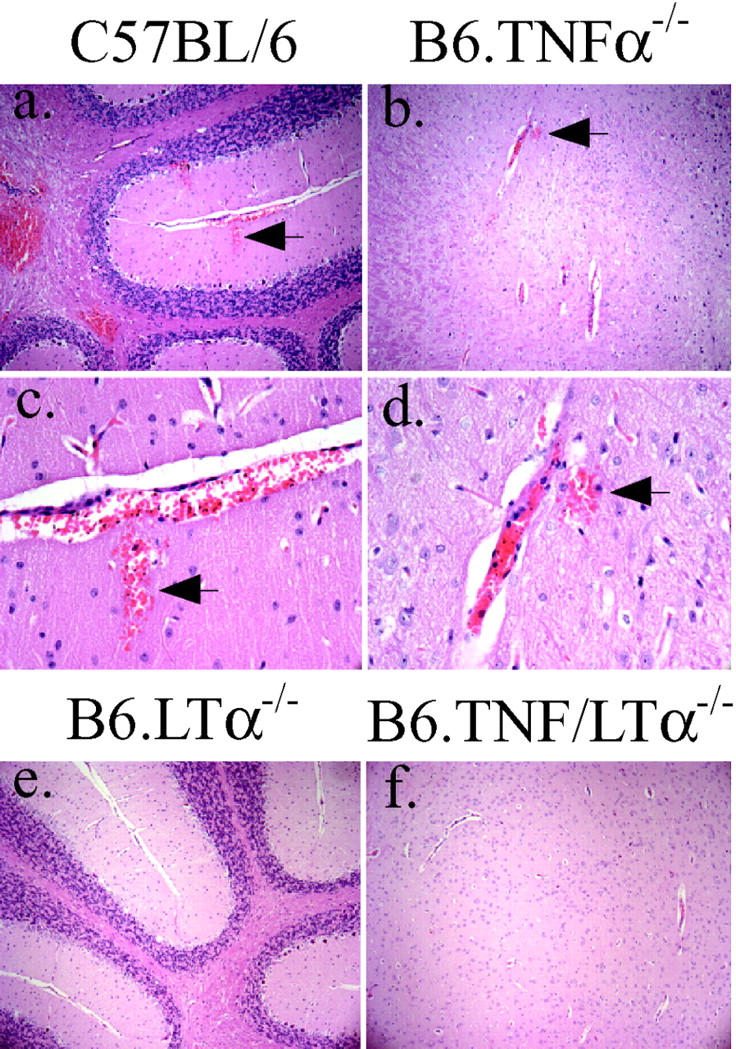
Perivascular hemorrhages are present in C57BL/6 and B6.TNFα−/− mice that develop CM. Sections (3 μM) were prepared from formol saline-fixed brain tissue and stained with hematoxylin and eosin. Magnifications of ×100 (a and b) and ×400 (c and d) are shown for C57BL/6 and B6.TNFα−/− mice that died with CM. Areas within the cerebellum (a, c, and e) and cerebrum (b, d, and f) are shown. Arrows highlight sites of perivascular hemorrhage. These hemorrhages were not observed in LTα-deficient mice (e and f; original magnification: ×100). These data are representative of material obtained in four experiments (at least 25 microscope fields from 12 or more samples from each mouse strain were examined).
Figure 3.
Figure 3.
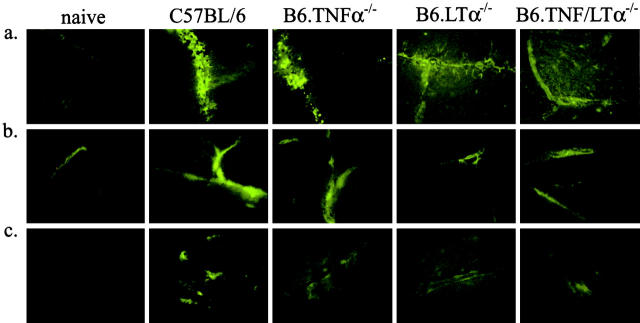
Comparative immunohistochemical analysis of brain sections taken from P. berghei-infected mice when C57BL/6 and B6.TNFα−/− mice developed CM (day 7 after infection). Brain cryosections (6 μM) were stained with (a) anti-P. berghei antibodies, (b) anti-ICAM-1, and (c), anti CR3 (5C6) mAbs with fluorescent secondary reagents. Original magnification is ×400. The samples are representative of material from four experiments.
Figure 4.
Figure 4.
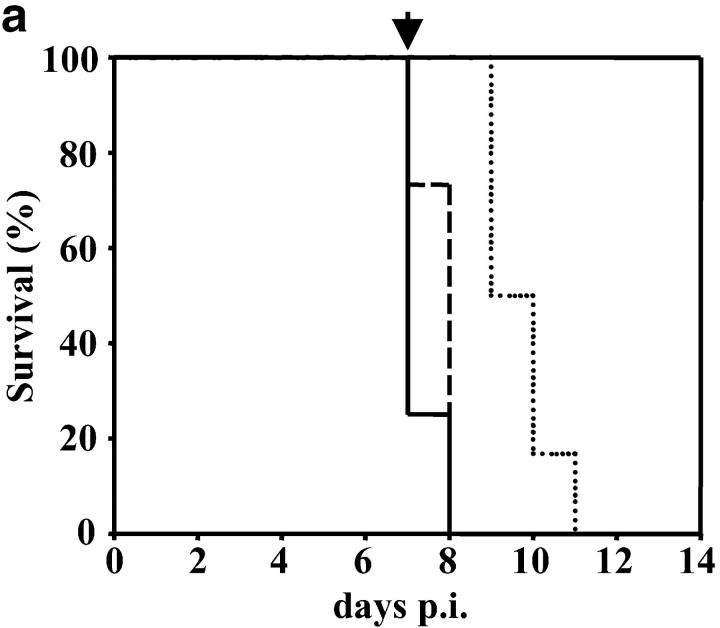
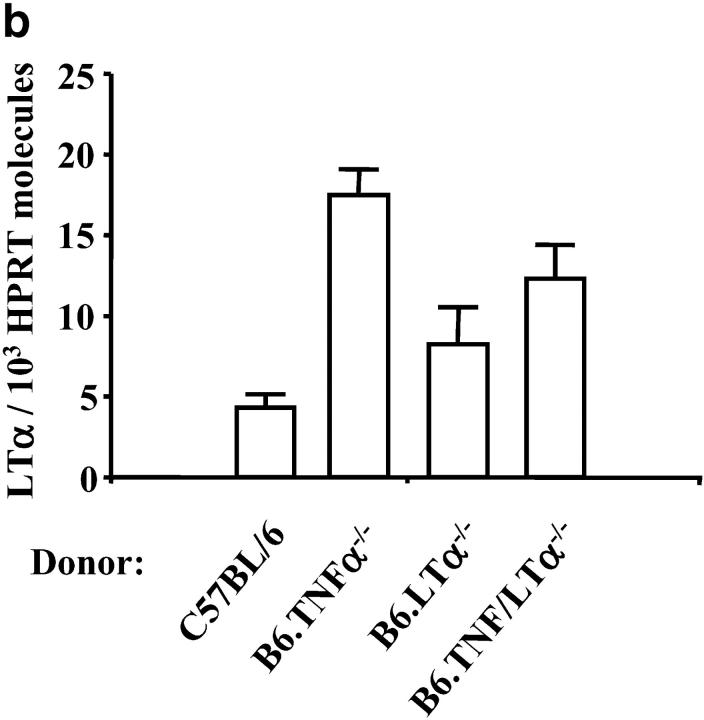
LTα is produced by a radiation-resistant cell population in the brain. (a) Survival curves of chimeric B6.Ly5.1 mice engrafted with BM from C57BL/6 (solid line), B6.TNFα−/− (overlapping C57BL/6 mice and indicated by arrow), B6.LTα−/− (dashed line), and B6.TNF/LTα−/− (dotted line) mice infected with P. berghei. Results represent pooled data from three independent groups of mice (n = 4–6 per group) in experiments conducted on three separate occasions (total of n = 12–16 mice per group). Differences in survival between B6.Ly5.1 mice engrafted with BM from C57BL/6 or B6.TNFα−/− mice and mice deficient in LTα were statistically different (χ2 = 7.01, P < 0.01), as was the difference between mice engrafted with BM from B6.LTα−/− and B6.TNF/LTα−/− mice (χ2 = 23.83, P < 0.0001). (b) LTα mRNA is detected by real-time RT-PCR in the brain of all chimeric B6.Ly5.1 mice following P. berghei infection (brain tissue collected at time of death). The source of engrafted BM is indicated. (c) Survival curve of chimeric B6.Ly5.1 mice engrafted with BM from C57BL/6, B6.TNFα−/− or B6.LTα−/− mice (all groups overlap; solid line), and chimeric B6.TNF/LTα−/− mice engrafted with BM from C57BL/6 (dotted line), B6.TNFα−/− (dashed line), or B6.LTα−/− (dashed and dotted line) mice (n = 4 per group). Differences in survival between B6.Ly5.1 mice engrafted with BM from C57BL/6 and B6.TNF/LTα−/− mice engrafted with BM from C57BL/6, B6.TNFα−/−, or B6.LTα−/− mice were statistically different (χ2 = 15, P < 0.0001), as was the increased survival time of B6.TNF/LTα−/− mice engrafted with BM from B6.TNFα−/− mice over all other groups (χ2 = 6.628, P < 0.01).
Figure 4.
Figure 4.
LTα is produced by a radiation-resistant cell population in the brain. (a) Survival curves of chimeric B6.Ly5.1 mice engrafted with BM from C57BL/6 (solid line), B6.TNFα−/− (overlapping C57BL/6 mice and indicated by arrow), B6.LTα−/− (dashed line), and B6.TNF/LTα−/− (dotted line) mice infected with P. berghei. Results represent pooled data from three independent groups of mice (n = 4–6 per group) in experiments conducted on three separate occasions (total of n = 12–16 mice per group). Differences in survival between B6.Ly5.1 mice engrafted with BM from C57BL/6 or B6.TNFα−/− mice and mice deficient in LTα were statistically different (χ2 = 7.01, P < 0.01), as was the difference between mice engrafted with BM from B6.LTα−/− and B6.TNF/LTα−/− mice (χ2 = 23.83, P < 0.0001). (b) LTα mRNA is detected by real-time RT-PCR in the brain of all chimeric B6.Ly5.1 mice following P. berghei infection (brain tissue collected at time of death). The source of engrafted BM is indicated. (c) Survival curve of chimeric B6.Ly5.1 mice engrafted with BM from C57BL/6, B6.TNFα−/− or B6.LTα−/− mice (all groups overlap; solid line), and chimeric B6.TNF/LTα−/− mice engrafted with BM from C57BL/6 (dotted line), B6.TNFα−/− (dashed line), or B6.LTα−/− (dashed and dotted line) mice (n = 4 per group). Differences in survival between B6.Ly5.1 mice engrafted with BM from C57BL/6 and B6.TNF/LTα−/− mice engrafted with BM from C57BL/6, B6.TNFα−/−, or B6.LTα−/− mice were statistically different (χ2 = 15, P < 0.0001), as was the increased survival time of B6.TNF/LTα−/− mice engrafted with BM from B6.TNFα−/− mice over all other groups (χ2 = 6.628, P < 0.01).
Figure 4.
Figure 4.
LTα is produced by a radiation-resistant cell population in the brain. (a) Survival curves of chimeric B6.Ly5.1 mice engrafted with BM from C57BL/6 (solid line), B6.TNFα−/− (overlapping C57BL/6 mice and indicated by arrow), B6.LTα−/− (dashed line), and B6.TNF/LTα−/− (dotted line) mice infected with P. berghei. Results represent pooled data from three independent groups of mice (n = 4–6 per group) in experiments conducted on three separate occasions (total of n = 12–16 mice per group). Differences in survival between B6.Ly5.1 mice engrafted with BM from C57BL/6 or B6.TNFα−/− mice and mice deficient in LTα were statistically different (χ2 = 7.01, P < 0.01), as was the difference between mice engrafted with BM from B6.LTα−/− and B6.TNF/LTα−/− mice (χ2 = 23.83, P < 0.0001). (b) LTα mRNA is detected by real-time RT-PCR in the brain of all chimeric B6.Ly5.1 mice following P. berghei infection (brain tissue collected at time of death). The source of engrafted BM is indicated. (c) Survival curve of chimeric B6.Ly5.1 mice engrafted with BM from C57BL/6, B6.TNFα−/− or B6.LTα−/− mice (all groups overlap; solid line), and chimeric B6.TNF/LTα−/− mice engrafted with BM from C57BL/6 (dotted line), B6.TNFα−/− (dashed line), or B6.LTα−/− (dashed and dotted line) mice (n = 4 per group). Differences in survival between B6.Ly5.1 mice engrafted with BM from C57BL/6 and B6.TNF/LTα−/− mice engrafted with BM from C57BL/6, B6.TNFα−/−, or B6.LTα−/− mice were statistically different (χ2 = 15, P < 0.0001), as was the increased survival time of B6.TNF/LTα−/− mice engrafted with BM from B6.TNFα−/− mice over all other groups (χ2 = 6.628, P < 0.01).

References

    1. Miller, L.H., M.F. Good, and G. Milon. 1994. Malaria pathogenesis. Science. 264:1878–1883. - PubMed
    1. Grau, G.E., T.E. Taylor, M.E. Molyneux, J.J. Wirima, P. Vassalli, M. Hommel, and P.H. Lambert. 1989. Tumor necrosis factor and disease severity in children with falciparum malaria. N. Engl. J. Med. 320:1586–1591. - PubMed
    1. Kwiatkowski, D., A.V. Hill, I. Sambou, P. Twumasi, J. Castracane, K.R. Manogue, A. Cerami, D.R. Brewster, and B.M. Greenwood. 1990. TNF concentration in fatal cerebral, non-fatal cerebral, and uncomplicated Plasmodium falciparum malaria. Lancet. 336:1201–1204. - PubMed
    1. de Kossodo, S., and G.E. Grau. 1993. Role of cytokines and adhesion molecules in malaria immunopathology. Stem Cells. 11:41–48. - PubMed
    1. Medana, I.M., N.H. Hunt, and G. Chaudhri. 1997. Tumor necrosis factor-alpha expression in the brain during fatal murine cerebral malaria: evidence for production by microglia and astrocytes. Am. J. Pathol. 150:1473–1486. - PMC - PubMed

Publication types

MeSH terms