


The genomes of sheeppox and goatpox viruses
- PMID: 12021338
- PMCID: PMC136203
- DOI: 10.1128/jvi.76.12.6054-6061.2002
The genomes of sheeppox and goatpox viruses
Abstract
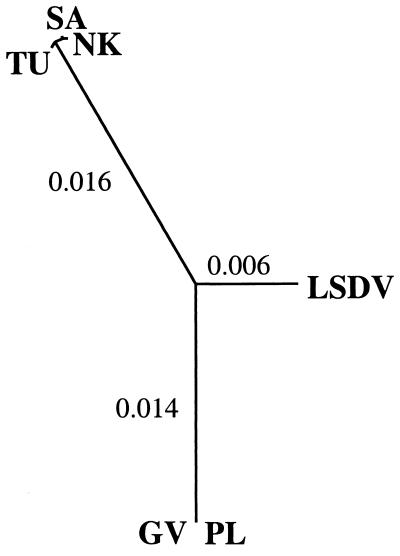
Sheeppox virus (SPPV) and goatpox virus (GTPV), members of the Capripoxvirus genus of the Poxviridae, are etiologic agents of important diseases of sheep and goats in northern and central Africa, southwest and central Asia, and the Indian subcontinent. Here we report the genomic sequence and comparative analysis of five SPPV and GTPV isolates, including three pathogenic field isolates and two attenuated vaccine viruses. SPPV and GTPV genomes are approximately 150 kbp and are strikingly similar to each other, exhibiting 96% nucleotide identity over their entire length. Wild-type genomes share at least 147 putative genes, including conserved poxvirus replicative and structural genes and genes likely involved in virulence and host range. SPPV and GTPV genomes are very similar to that of lumpy skin disease virus (LSDV), sharing 97% nucleotide identity. All SPPV and GTPV genes are present in LSDV. Notably in both SPPV and GTPV genomes, nine LSDV genes with likely virulence and host range functions are disrupted, including a gene unique to LSDV (LSDV132) and genes similar to those coding for interleukin-1 receptor, myxoma virus M003.2 and M004.1 genes (two copies each), and vaccinia virus F11L, N2L, and K7L genes. The absence of these genes in SPPV and GTPV suggests a significant role for them in the bovine host range. SPPV and GTPV genomes contain specific nucleotide differences, suggesting they are phylogenetically distinct. Relatively few genomic changes in SPPV and GTPV vaccine viruses account for viral attenuation, because they contain 71 and 7 genomic changes compared to their respective field strains. Notable genetic changes include mutation or disruption of genes with predicted functions involving virulence and host range, including two ankyrin repeat proteins in SPPV and three kelch-like proteins in GTPV. These comparative genomic data indicate the close genetic relationship among capripoxviruses, and they suggest that SPPV and GTPV are distinct and likely derived from an LSDV-like ancestor.
Figures
References
-
- Adams, J., R. Kelso, and L. Cooley. 2000. The kelch repeat superfamily of proteins: propellers of cell function. Trends Cell. Biol. 10:17-24. - PubMed
Publication types
MeSH terms
Associated data
- Actions
- Actions
- Actions
- Actions
- Actions
LinkOut - more resources
Full Text Sources
Other Literature Sources
