


Effect of light treatment on sleep and circadian rhythms in demented nursing home patients
- PMID: 12028210
- PMCID: PMC2764401
- DOI: 10.1046/j.1532-5415.2002.50060.x
Effect of light treatment on sleep and circadian rhythms in demented nursing home patients
Abstract
Objectives: To determine whether fragmented sleep in nursing home patients would improve with increased exposure to bright light.
Design: Randomized controlled trial.
Setting: Two San Diego-area nursing homes.
Participants: Seventy-seven (58 women, 19 men) nursing home residents participated. Mean age +/- standard deviation was 85.7 +/- 7.3 (range 60-100) and mean Mini-Mental State Examination was 12.8 +/- 8.8 (range 0-30).
Interventions: Participants were assigned to one of four treatments: evening bright light, morning bright light, daytime sleep restriction, or evening dim red light.
Measurements: Improvement in nighttime sleep quality, daytime alertness, and circadian activity rhythm parameters.
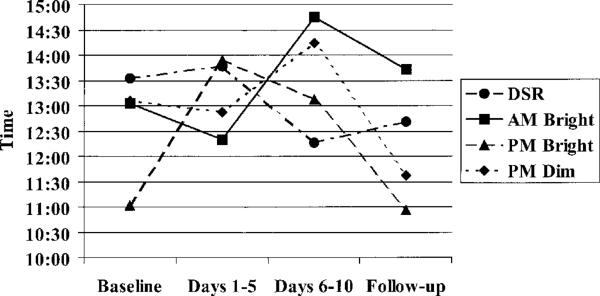
Results: There were no improvements in nighttime sleep or daytime alertness in any of the treatment groups. Morning bright light delayed the peak of the activity rhythm (acrophase) and increased the mean activity level (mesor). In addition, subjects in the morning bright light group had improved activity rhythmicity during the 10 days of treatment.
Conclusion: Increasing exposure to morning bright light delayed the acrophase of the activity rhythm and made the circadian rhythm more robust. These changes have the potential to be clinically beneficial because it may be easier to provide nursing care to patients whose circadian activity patterns are more socially acceptable.
Figures
References
-
- Ancoli-Israel S, Klauber MR, Jones DW, et al. Variations in circadian rhythms of activity, sleep and light exposure related to dementia in nursing home patients. Sleep. 1997;20:18–23. - PubMed
-
- Pollak CP, Perlick D, Linsner JP, et al. Sleep problems in the community elderly as predictors of death and nursing home placement. J Community Health. 1990;15:123–135. - PubMed
-
- Walsh JK, Engelhardt CL. The direct economic costs of insomnia in the United States for 1995. Sleep. 1999;22:S386–S393. - PubMed
-
- Swaab DF, Fliers E, Partiman TS. The suprachiasmatic nucleus of the human brain in relation to sex, age and senile dementia. Brain Res. 1985;342:37–44. - PubMed
Publication types
MeSH terms
Grants and funding
LinkOut - more resources
Full Text Sources
Medical
