


Identification of 86 candidates for small non-messenger RNAs from the archaeon Archaeoglobus fulgidus
- PMID: 12032318
- PMCID: PMC124276
- DOI: 10.1073/pnas.112047299
Identification of 86 candidates for small non-messenger RNAs from the archaeon Archaeoglobus fulgidus
Abstract
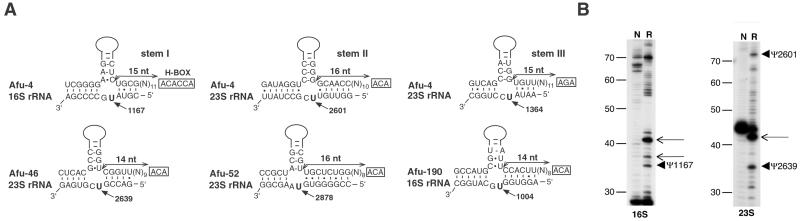
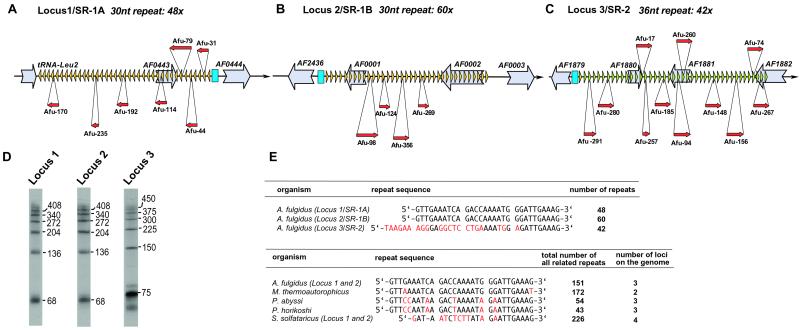
In a specialized cDNA library from the archaeon Archaeoglobus fulgidus we have identified a total of 86 different expressed RNA sequences potentially encoding previously uncharacterized small non-messenger RNA (snmRNA) species. Ten of these RNAs resemble eukaryotic small nucleolar RNAs, which guide rRNA 2'-O-methylations (C/D-box type) and pseudouridylations (H/ACA-box type). Thereby, we identified four candidates for H/ACA small RNAs in an archaeal species that are predicted to guide a total of six rRNA pseudouridylations. Furthermore, we have verified the presence of the six predicted pseudouridines experimentally. We demonstrate that 22 snmRNAs are transcribed from a family of short tandem repeats conserved in most archaeal genomes and shown previously to be potentially involved in replicon partitioning. In addition, four snmRNAs derived from the rRNA operon of A. fulgidus were identified and shown to be generated by a splicing/processing pathway of pre-rRNAs. The remaining 50 RNAs could not be assigned to a known class of snmRNAs because of the lack of known structure and/or sequence motifs. Regarding their location on the genome, only nine were located in intergenic regions, whereas 33 were complementary to an ORF, five were overlapping an ORF, and three were derived from the sense orientation within an ORF. Our study further supports the importance of snmRNAs in all three domains of life.
Figures
References
Publication types
MeSH terms
Substances
Associated data
- Actions
- Actions
- Actions
- Actions
- Actions
- Actions
- Actions
- Actions
- Actions
- Actions
- Actions
- Actions
- Actions
- Actions
- Actions
- Actions
- Actions
- Actions
- Actions
- Actions
- Actions
- Actions
- Actions
- Actions
- Actions
- Actions
- Actions
- Actions
- Actions
- Actions
- Actions
- Actions
- Actions
- Actions
- Actions
- Actions
- Actions
- Actions
- Actions
- Actions
- Actions
- Actions
- Actions
- Actions
- Actions
- Actions
- Actions
- Actions
- Actions
- Actions
- Actions
- Actions
- Actions
- Actions
- Actions
- Actions
- Actions
- Actions
- Actions
- Actions
- Actions
- Actions
- Actions
- Actions
- Actions
- Actions
- Actions
- Actions
- Actions
- Actions
- Actions
- Actions
- Actions
- Actions
- Actions
- Actions
- Actions
- Actions
- Actions
- Actions
- Actions
- Actions
- Actions
- Actions
- Actions
- Actions
LinkOut - more resources
Full Text Sources
Other Literature Sources
