. 2002 May 28;99(11):7675-80.
doi: 10.1073/pnas.112210499.

Inorganic polyphosphate is essential for long-term survival and virulence factors in Shigella and Salmonella spp

Affiliations

Inorganic polyphosphate is essential for long-term survival and virulence factors in Shigella and Salmonella spp

Kwang-Seo Kim et al. Proc Natl Acad Sci U S A. .

Abstract

The importance of inorganic polyphosphate (poly P) and poly P kinase (PPK), the enzyme principally responsible for its synthesis, has been established previously for stationary-phase survival of Escherichia coli and virulence in Pseudomonas aeruginosa. The gene (ppk) that encodes PPK is highly conserved among many bacterial pathogens, including Shigella and Salmonella spp. In view of the phylogenetic similarity of the enteropathogens and the frequency with which virulence factors are expressed in stationary phase, the ppk gene of pathogenic Shigella flexneri, Salmonella enterica serovar Dublin, and Salmonella enterica serovar typhimurium have been cloned and deleted. In some of these mutants lacking ppk, the phenotypes included features indicative of decreased virulence such as: (i) growth defects, (ii) defective responses to stress and starvation, (iii) loss of viability, (iv) polymyxin sensitivity, (v) intolerance to acid and heat, and (vi) diminished invasiveness in epithelial cells. Thus PPK may prove, as it has with P. aeruginosa, to be an attractive target for antibiotics, with low toxicity because PPK is not found in higher eukaryotes.


Figures

Figure 1
Figure 1
Growth studies. WT and mutant S. flexneri were grown aerobically at 37°C in LB medium. Samples were analyzed for growth (OD540) and viability (cfu/ml).
Figure 2
Figure 2
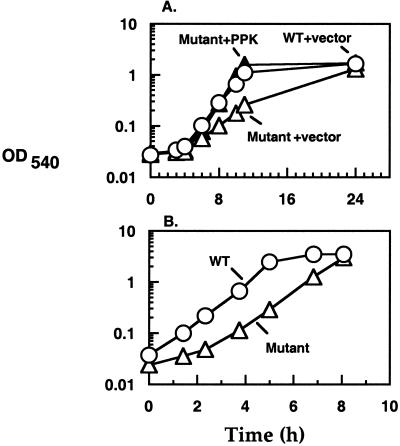
Growth after downshift. (A) S. typhimurium WT complemented with vector, and mutant with either vector or vector containing ppk gene, were grown aerobically at 37°C in LB for about 20 h. The cultures were then diluted (1:100) into prewarmed (37°C) Mops-buffered minimal medium with 2 mM Pi (26) and incubated aerobically at 37°C; growth was monitored by OD540. (B) The S. dublin WT and mutant diluted in Mops medium in a similar way were compared.
Figure 3
Figure 3
Long-term survival. WT and mutants of S. typhimurium (A) and S. dublin (B) were tested. Long-term survival in LB was assayed as described (3).
Figure 4
Figure 4
Heat-shock survival. WT and mutants of Salmonella spp. and S. flexneri were grown overnight (≈16 h) in LB. The stationary-phase cells were washed and diluted in 0.9% NaCl to a cell density of about 5 × 10³ per ml. Samples (2 ml) in glass tubes were prewarmed to 55°C and 0.1-ml samples were plated directly on LB for viable cell numbers.
Figure 5
Figure 5
Polymyxin B resistance. In ppk mutant of S. typhimurium, resistance is restored after complementation with PPK. For induction of PPK, cells were grown to an OD540 of 0.8 in LB to which 1 mM isopropyl β-D-thiogalactopyranoside (IPTG) was added and incubated further aerobically at 37°C for 3 h. Cells were washed, diluted in sterile 0.85% saline to about 5 × 10³ cells per ml, and exposed for 1 h at 37°C to various concentrations of polymyxin B. Survivors were measured by plating on LB.
Figure 6
Figure 6
Invasion and growth in epithelial cells and survival in macrophages. The gentamycin-protection assays were as described (28). (B) WT and mutant of S. typhimurium were grown overnight in LB to stationary phase. The cells were diluted in PBS and opsonized for 30 min in PBS containing 20% normal mouse serum. They were added to 2.5 × 10⁵ macrophage RAW 264.7 cells (ATCC TIB-71) seeded in 24-well tissue culture plates at a multiplicity of infection of 10:1 and incubated at 37°C for 30 min. Infected monolayers were then treated with gentamycin (100 μg/ml) for 90 min and were lysed or further incubated for 4 and 24 h in the presence of 10 μg/ml gentamycin. Infected cells were then washed twice with PBS and lysed with 1% Triton X-100 in PBS and plated on LB for measurement of cfu. (A) HEp-2 (ATCC CCL-23) epithelial cells were maintained in RPMI medium 1640 supplemented with 10% FCS. Gentamycin protection assays were as described above except that WT and mutant S. typhimurium were grown under an invasive condition [overnight in LB static culture, diluted 1:50 in LB-high-salt (0.3 M NaCl) medium followed by static incubation at 37°C for 4.5 h]. Bacteria were inoculated into 8 × 10⁴ HEp-2 cells seeded in 24-well tissue-culture plates at a multiplicity of infection of 10:1 for 30 min.

References

    1. Kulaev I S. The Biochemistry of Inorganic Polyphosphates. New York: Wiley; 1979. - PubMed
    1. Kornberg A, Rao N N, Ault-Riché D. Annu Rev Biochem. 1999;68:89–125. - PubMed
    1. Rao N N, Kornberg A. J Bacteriol. 1996;178:1394–1400. - PMC - PubMed
    1. Crooke E, Akiyama M, Rao N N, Kornberg A. J Biol Chem. 1994;269:6290–6295. - PubMed
    1. Tzeng C-M, Kornberg A. Mol Microbiol. 1998;29:381–382. - PubMed

Publication types

MeSH terms

Associated data

LinkOut - more resources