. 2002 May 28;99(11):7740-5.
doi: 10.1073/pnas.092157999.

Molecular dissection of hippocampal theta-burst pairing potentiation

Affiliations

Molecular dissection of hippocampal theta-burst pairing potentiation

D A Hoffman et al. Proc Natl Acad Sci U S A. .

Abstract

Long-term potentiation (LTP) of synaptic efficacy in the hippocampus is frequently induced by tetanic stimulation of presynaptic afferents or by pairing low frequency stimulation with postsynaptic depolarization. Adult (P42) GluR-A(-/-) mice largely lack these forms of LTP. LTP in wt mice can also be induced by coincident pre- and postsynaptic action potentials, where an initial rapid component is expressed but a substantial fraction of the potentiation develops with a delayed time course. We report here that this stimulation protocol, delivered at theta frequency (5 Hz), induces LTP in GluR-A(-/-) mice in which the initial component is substantially reduced. The remaining GluR-A independent component differs from the initial component in that its expression develops over time after induction and its induction is differentially dependent on postsynaptic intracellular Ca(2+) buffering. Thus, in adult mice, theta-burst pairing evokes two forms of synaptic potentiation that are induced simultaneously but whose expression levels vary inversely with time. The two components of synaptic potentiation could be relevant for different forms of information storage that are dependent on hippocampal synaptic transmission such as spatial reference and working memory.


Figures
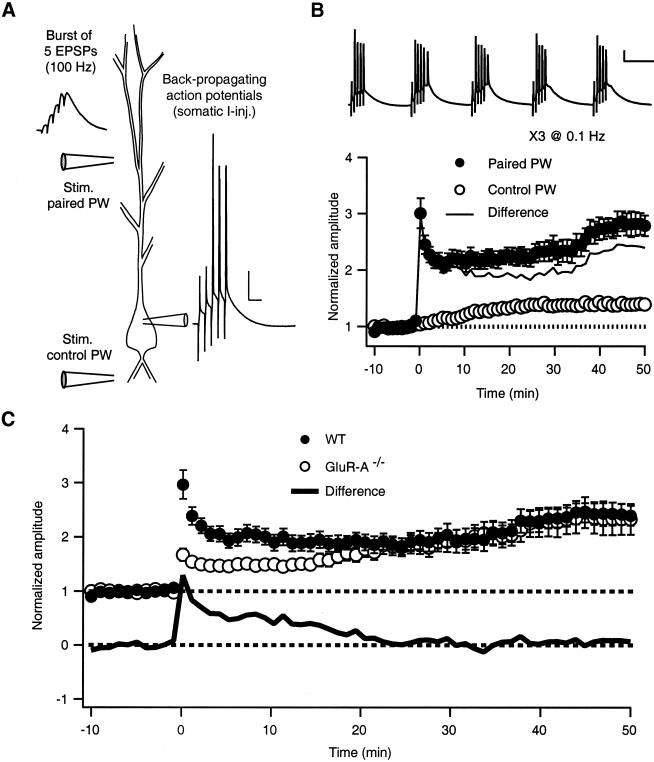
Figure 1
Figure 1
Theta-burst pairing induces LTP in hippocampal CA3-CA1 synapses of wt and GluR-A−/− mice. (A) The TBP protocol consisted of coincident EPSPs delivered via a glass field stimulating electrode (Left trace) and postsynaptic APs (1–2 nA, 2 ms somatic current injection, Right trace) paired five times at 100 Hz. A second stimulating electrode was used for a control pathway and thus not stimulated during the TBP protocol. Scale bar = 20 mV, 20 ms (B) Five paired bursts were given at 5 Hz to constitute the train shown (Top trace; note complex spiking in the second and third paired bursts). Scale bar = 20 mV, 100 ms. Three trains (0.1 Hz) of paired stimulation resulted in a potentiation with a complex time course in the paired pathway in wt mice (filled circles). A small but significant potentiation in the control pathway (open circles) was also consistently observed. Subtraction of the two pathways gives the solid line. (C) TBP in slices from GluR-A−/− mice (open circles) resulted in a long-lasting, robust potentiation of synaptic inputs, which was identical to wt (filled circles) about 25 min postpairing. GluR-A−/− mice, however, lack the large, rapidly expressed component of TBP potentiation found in WT mice. Subtracting the GluR-A−/− curve from the wt curve gives the difference component shown below (solid line). The GluR-A subunit-sensitive component is induced immediately after pairing but is transient, reaching baseline about 25 min postinduction.
Figure 2
Figure 2
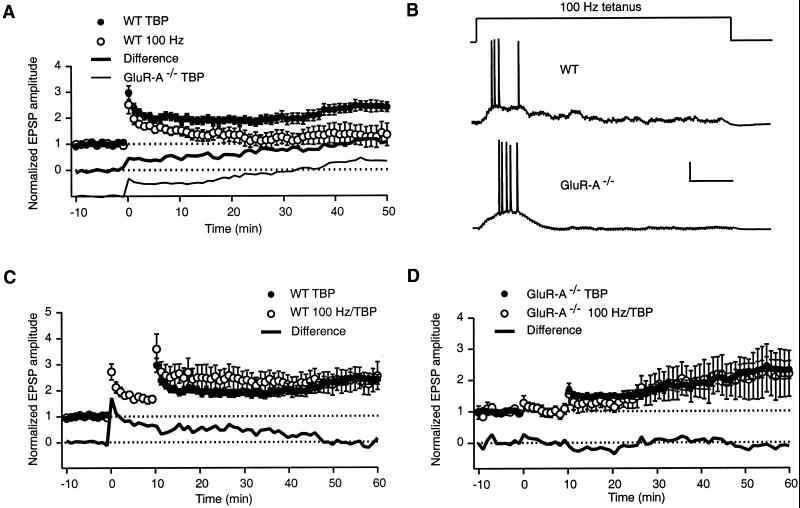
The GluR-A subunit-dependent component of TBP potentiation is predominantly induced by 100-Hz tetanus. (A) In whole-cell recordings from WT mice a 1-s, 100-Hz tetanus induced a large initial potentiation (open circles) that decayed with time. A small amount of potentiation remained 50 min posttetanus. Subtracting this trace from that found with TBP in wt mice (filled circles) gives the difference component shown below (bold line). The GluR-A-dependent component of TBP potentiation (from GluR-A−/− mice) is shown below for comparison (light line). (B) Examples of voltage recordings during 100-Hz tetanus in WT (Upper trace) and GluR-A−/− (Lower trace) mice. The number of spikes recorded during 100-Hz tetanus was not significantly different between wt (16 ± 5, n = 16) and GluR-A−/− experiments (8 ± 6, n =8, P > 0.3). Scale bar = 25 mV, 200 ms. (C) Delivery of the 100-Hz tetanus 10 min before TBP did not occlude TBP potentiation (open circles). Subtracting this trace from TBP alone (filled circles) results in the difference trace shown below (bold line). (D) In GluR-A−/− mice, no significant potentiation was found 10 min after 100-Hz tetanus stimulation (open circles). Subsequent TBP in the same cells resulted in a potentiation nearly identical to TBP alone (filled circles). The difference trace is shown below (bold line).
Figure 3
Figure 3
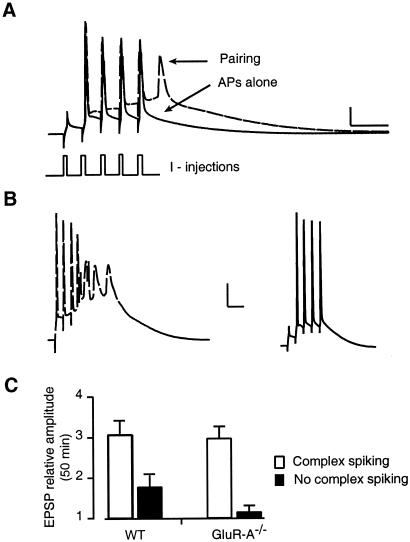
Initiation of GluR-A-independent potentiation depends on complex spiking during TBP. (A; bold trace) Voltage recording in response to postsynaptic current injections (I-injections) used to elicit back-propagating APs. In the same cell, pairing the current injections with EPSPs resulted in an extra, putative calcium spike (dashed line). Scale bar = 20 mV, 20 ms. (B) TBP resulted in complex spiking in 60% (18/30) of wt and 67% (18/27) of GluR-A−/− experiments under normal recording conditions (Left, dashed trace). The remaining experiments showed no observable extra spiking in the somatic recordings (Right, bold trace). Scale bar = 20 mV, 20 ms. (C) Summary data of TBP potentiation recorded in wt and GluR-A−/− mice for a 5-min period ending 50 min postpairing. The data are divided into groups where complex spiking was observed during the pairing (open bars, n = 12, 9 for wt and GluR-A−/−, respectively) and those where no complex spiking was recorded in the soma (filled bars, n = 7, 5).
Figure 4
Figure 4
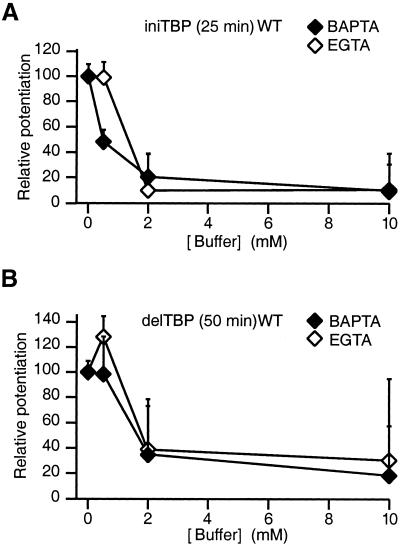
Comparison of intracellularly loaded BAPTA and EGTA effectiveness in reducing ini- and delTBP potentiation in wt mice. (A) IniTBP potentiation measured 20–25 min after pairing. All values are relative to wt experiments with no exogenous buffers loaded. The interpolated half-effective concentration of EGTA (≈1.5 mM, open diamonds) is 3-fold higher than that for BAPTA (≈0.5 mM, filled diamonds). (B) DelTBP potentiation measured 45–50 min after stimulation in wt mice. The interpolated half-effective concentrations of EGTA (≈1.5 mM, open diamonds) and BAPTA (≈1.5 mM, filled diamonds) in reducing delTBP potentiation are not significantly different. The half-effective concentration of BAPTA (≈1.5 mM) for the delTBP potentiation block is higher than that for the iniTBP potentiation block (≈0.5 mM BAPTA, Fig. 4A).

References

    1. Malenka R C, Nicoll R A. Science. 1999;285:1870–1874. - PubMed
    1. Chen H X, Otmakhov N, Lisman J. J Neurophysiol. 1999;82:526–532. - PubMed
    1. Liao D, Hessler N A, Malinow R. Nature (London) 1995;375:400–404. - PubMed
    1. Gustafsson B, Wigstrom H, Abraham W C, Huang Y Y. J Neurosci. 1987;7:774–780. - PMC - PubMed
    1. Magee J C, Johnston D. Science. 1997;275:209–213. - PubMed

Publication types

Substances