. 2002 Jul;71(1):66-73.
doi: 10.1086/341125. Epub 2002 May 24.

A novel member of a zinc transporter family is defective in acrodermatitis enteropathica

Affiliations

A novel member of a zinc transporter family is defective in acrodermatitis enteropathica

Kun Wang et al. Am J Hum Genet. 2002 Jul.

Abstract

The rare inherited condition acrodermatitis enteropathica (AE) results from a defect in the absorption of dietary zinc. Recently, we used homozygosity mapping in consanguineous Middle Eastern kindreds to localize the AE gene to an approximately 3.5-cM region on 8q24. In this article, we identify a gene, SLC39A4, located in the candidate region and, in patients with AE, document mutations that likely lead to the disease. The gene encodes a histidine-rich protein, which we refer to as "hZIP4," which is a member of a large family of transmembrane proteins, some of which are known to serve as zinc-uptake proteins. We show that Slc39A4 is abundantly expressed in mouse enterocytes and that the protein resides in the apical membrane of these cells. These findings suggest that the hZIP4 transporter is responsible for intestinal absorption of zinc.


Figures
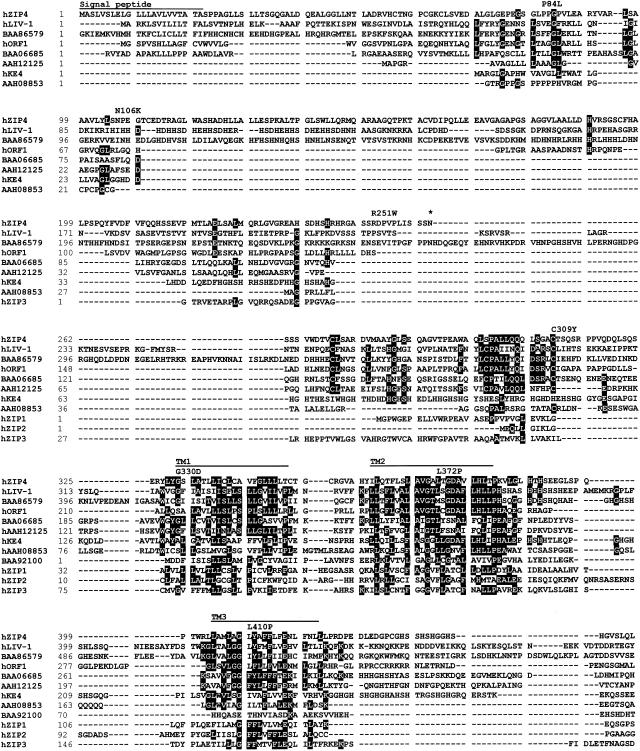
Figure  1
Figure 1
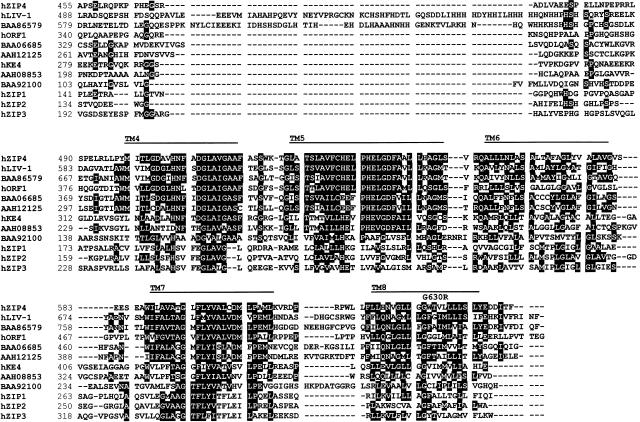
Sequence alignment of human ZIP4 and other human zinc transporters and related proteins. hZIP4 was used as a query to identify all human members of the ZIP family in public databases. All resulting human sequences are aligned according to their relatedness. Residues with ⩾50% identity are shaded black. Putative transmembrane (TM) domains are indicated by the horizontal lines, as is the putative signal-peptide sequence (predicted by the CBS SignalP V1.1 World Wide Web Prediction Server; also see Nielsen et al. 1997). A potential N-glycosylation site is indicated by an asterisk (*). Locations of amino acid changes found in patients with AE are noted above the hZIP4 sequence. Common polymorphisms, found in the process of sequencing DNA samples from patients and control subjects, include A272G (resulting in T58A), A440G (resulting in T114A), G1169A (resulting in A357T), and C2041T (resulting in F647F). Sequence records for the proteins shown in panel A—hZIP4 (accession number XP_035362); hLIV-1 (accession number XP_029402), in which hORF1 is derived from the nucleotide sequence (accession number AC023500); hKE4 (accession number CAA20238); hZIP1 (accession number XP_001483); hZIP2 (accession number XP_007499); and hZIP3 (accession number AAH05869)—are available at the National Center for Biotechnology Information Web site.
Figure  1
Figure 1
Sequence alignment of human ZIP4 and other human zinc transporters and related proteins. hZIP4 was used as a query to identify all human members of the ZIP family in public databases. All resulting human sequences are aligned according to their relatedness. Residues with ⩾50% identity are shaded black. Putative transmembrane (TM) domains are indicated by the horizontal lines, as is the putative signal-peptide sequence (predicted by the CBS SignalP V1.1 World Wide Web Prediction Server; also see Nielsen et al. 1997). A potential N-glycosylation site is indicated by an asterisk (*). Locations of amino acid changes found in patients with AE are noted above the hZIP4 sequence. Common polymorphisms, found in the process of sequencing DNA samples from patients and control subjects, include A272G (resulting in T58A), A440G (resulting in T114A), G1169A (resulting in A357T), and C2041T (resulting in F647F). Sequence records for the proteins shown in panel A—hZIP4 (accession number XP_035362); hLIV-1 (accession number XP_029402), in which hORF1 is derived from the nucleotide sequence (accession number AC023500); hKE4 (accession number CAA20238); hZIP1 (accession number XP_001483); hZIP2 (accession number XP_007499); and hZIP3 (accession number AAH05869)—are available at the National Center for Biotechnology Information Web site.
Figure  2
Figure 2
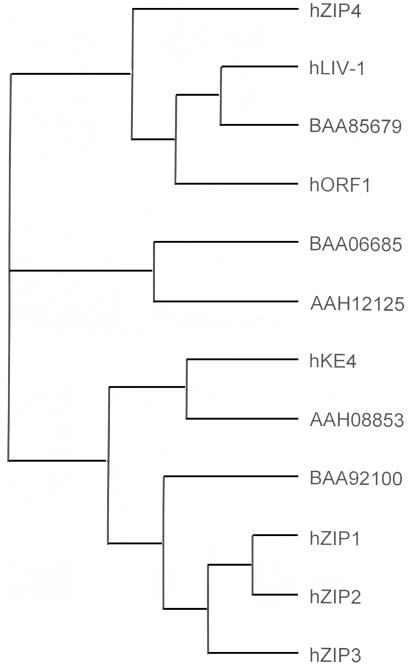
Tree made by TreeView (Page 1996), demonstrating that hZIP4 falls within the LIV-1 subfamily of the human sequences.
Figure  3
Figure 3
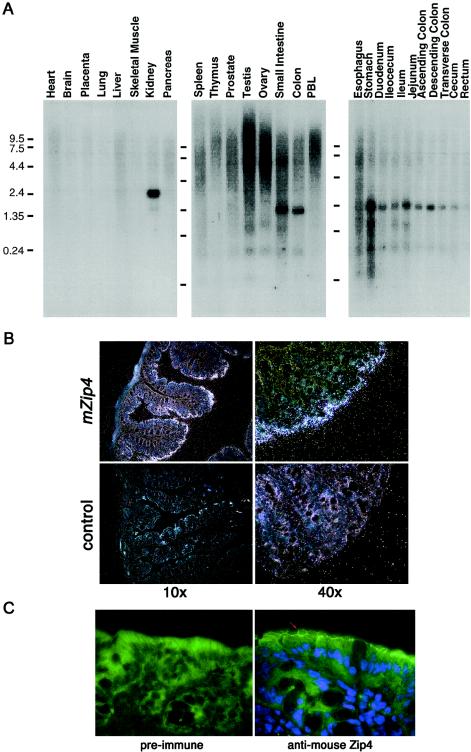
Tissue distribution of SLC39A4 expression. A, Hybridization of human SLC39A4 probes to Clontech human MTN blots and digestive-system northern blots. A 2.2-kb mRNA species was present at high levels in kidney and also in small intestine, colon, and most of the intestinal tract. The horizontal lines indicate the position of the molecular-weight markers in each blot. B, In situ hybridization of murine Slc39A4 antisense on adult mouse colon sections, at 10× and 40× magnification. Hybridization to the antisense probe is abundant in the enterocyte, whereas no hybridization is detected in the control (i.e., sense) probe. C, Immunohistochemical localization of mouse Zip4 to the apical membrane of the enterocyte in mouse colon. The red arrow indicates the apical surface, and the blue staining indicates nuclei stained with DAPI. Only nonspecific binding is seen with the preimmune sera. An identical result was obtained on paraffin-embedded tissue visualized with diamobenzidine (data not shown).

References

Electronic-Database Information

    1. CBS SignalP V1.1 World Wide Web Prediction Server, http://www.cbs.dtu.dk/services/SignalP/
    1. HUGO Gene Nomenclature Committee, http://www.gene.ucl.ac.uk/nomenclature
    1. National Center for Biotechnology Information, http://www.ncbi.nlm.nih.gov/ (for hORF1 nucleotide record [accession numbers BAA86579 and AC023500], hKE4 [accession numbers BAA06685, AAH12125, and CAA20238], hLIV-1 [accession number XP_029402], hZIP1 [accession numbers AAH08853, AC023500, and XP_001483], hZIP2 [accession number XP_007499], hZIP3 [accession number AAH05869], and hZIP4a [accession number XP_035362])
    1. New GENSCAN Web Server at MIT, The, http://genes.mit.edu/GENSCAN.html
    1. Online Mendelian Inheritance in Man (OMIM), http://www.ncbi.nlm.nih.gov/Omim/ (for AE [MIM 201100])

References

    1. Barnes PM, Moynahan EJ (1973) Zinc deficiency in acrodermatitis enteropathica: multiple dietary intolerance treated with synthetic diet. Proc R Soc Med 66:327–329 - PMC - PubMed
    1. Burge C, Karlin S (1997) Prediction of complete gene structures in human genomic DNA. J Mol Biol 268:78–94 - PubMed
    1. Felsenstein J (1989) PHYLIP—phylogeny inference package (version 3.2). Cladistics 5:164–166
    1. Gaither LA, Eide D (2000) Functional expression of the human hZIP2 zinc transporter. J Biol Chem 275:5560–5564 - PubMed
    1. ——— (2001a) Eukaryotic zinc transporters and their regulation. Biometals 14:251–270 - PubMed

Publication types

MeSH terms