Case Reports
. 2002 Jul;71(1):198-203.
doi: 10.1086/341357. Epub 2002 May 24.

Chronic infantile neurological cutaneous and articular syndrome is caused by mutations in CIAS1, a gene highly expressed in polymorphonuclear cells and chondrocytes

Affiliations
Case Reports

Chronic infantile neurological cutaneous and articular syndrome is caused by mutations in CIAS1, a gene highly expressed in polymorphonuclear cells and chondrocytes

Jérôme Feldmann et al. Am J Hum Genet. 2002 Jul.

Abstract

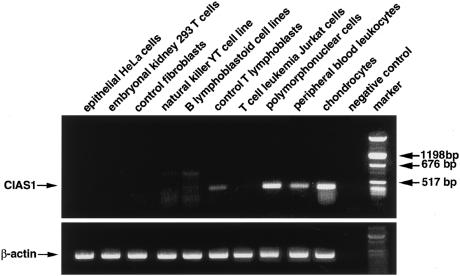
Chronic infantile neurological cutaneous and articular (CINCA) syndrome is a severe chronic inflammatory disease of early onset, characterized by cutaneous symptoms, central-nervous-system involvement, and arthropathy. In the present study, we report, in seven unrelated patients with CINCA syndrome, distinct missense mutations within the nucleotide-binding site of CIAS1, a gene encoding cryopyrin and previously shown to cause Muckle-Wells syndrome and familial cold urticaria. Because of the severe cartilage overgrowth observed in some patients with CINCA syndrome and the implications of polymorphonuclear cell infiltration in the cutaneous and neurological manifestations of this syndrome, the tissue-specific expression of CIAS1 was evaluated. A high level of expression of CIAS1 was found to be restricted to polymorphonuclear cells and chondrocytes. These findings demonstrate that CIAS1 missense mutations can result in distinct phenotypes with only a few overlapping symptoms and suggest that this gene may function as a potential inducer of apoptosis.


Figures
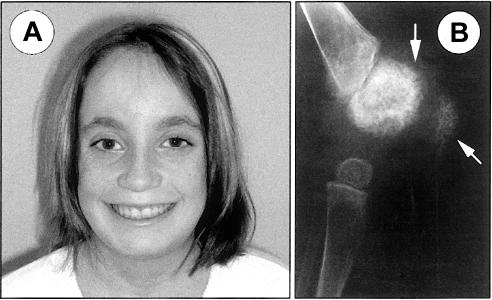
Figure  1
Figure 1
Typical CINCA syndrome features. A, Facial appearance of patient 6 at age 12 years, with characteristic frontal bossing and protruding eyes. B, Radiological bone and joint modifications. Bilateral severe bone deformities of the knees of patient 7 at age 2.5 years, resulting in hard bony enlargement without any suggestion of synovial thickening on palpation. Arrows show the growth cartilage burst and increased irregular patellar opacity.
Figure  2
Figure 2
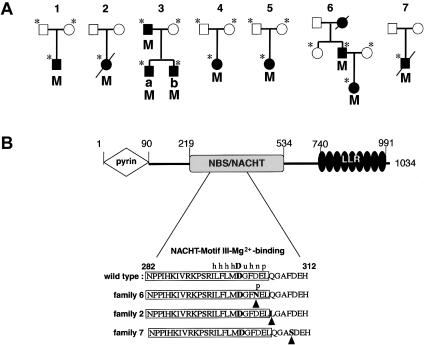
A, Mutation segregation in pedigrees of families with CINCA. Square symbols denote males; circles denote females; affected individuals are denoted by blackened symbols, and segregating CIAS1 mutations are denoted by the capital letter M. In each pedigree, family members from whom DNA samples were available for analysis are marked by an asterisk. Autosomal dominant inheritance of CINCA is suggested by the segregation observed in families 3 and 6. B, Mutation locations on CIAS1 in three patients and domain structure of CIAS1. Residues 1–90 form the N-terminal pyrin domain, residues 219–534 form the NBS/NACHT domain, and residues 740–991 form the C-terminal leucine rich repeats. Shown at the bottom is the sequence of the NBS domain around the consensus motif-III Mg2+-binding site (boxed) found in the NACHT subfamily of NTPases (following Koonin and Aravind 2000) with the mutations (arrowheads) found in three families with CINCA. h = hydrophobic residues; u = tiny residues; n = negatively charged residues; p = polar residues.
Figure  3
Figure 3
Semiquantitative RT-PCR of CIAS1 mRNA expression in various tissues with β-actin levels shown below. RNAs (50ng) from each tissue was reverse transcribed and PCR amplified by a one-step RT-PCR using the following oligonucleotides: 5′-TTGAAGAGGAGTGGATGGGTT-3′ (sense on exon 2) and 5′-GATGGGTGGGTTTGGGTC-3′ (antisense on exon 3), which predict a 507-bp product of CIAS1. β-actin oligonucleotides, 5′- TACCACTGGCATCGTGATGGACT-3′ (sense on exon 2) and 5′-TCCTTCTGCATCCTGTCGGCAAT-3′ (antisense on exon 3), were used in the same conditions as a control for RNA integrity and RT efficiency. A negative control containing no input RNA was also included.

References

Electronic-Database Information

    1. GenBank, http://www.ncbi.nlm.nih.gov/Genbank/ (for CIAS1 [accession number AF427617])
    1. Online Mendelian Inheritance in Man (OMIM), http://www.ncbi.nlm.nih.gov/Omim/ (for FMF [MIM 249100], TNF-receptor–associated periodic syndrome [MIM 142680], HID [MIM 260920], MWS [MIM 191900], and FCAS [MIM 120100])

References

    1. Cuisset L, Drenth JP, Berthelot JM, Meyrier A, Vaudour G, Watts RA, Scott DG, Nicholls A, Pavek S, Vasseur C, Beckmann JS, Delpech M, Grateau G (1999) Genetic linkage of the Muckle-Wells syndrome to chromosome 1q44. Am J Hum Genet 65:1054–1059 - PMC - PubMed
    1. Drenth JP, Cuisset L, Grateau G, Vasseur C, van de Velde-Visser SD, de Jong JG, Beckmann JS, van der Meer JW, Delpech M (1999) Mutations in the gene encoding mevalonate kinase cause hyper-IgD and periodic fever syndrome. International Hyper-IgD Study Group. Nat Genet 22:178–181 - PubMed
    1. Falcon-Perez JM, Martinez-Burgos M, Molano J, Mazon MJ, Eraso P (2001) Domain interactions in the yeast ATP binding cassette transporter Ycf1p: intragenic suppressor analysis of mutations in the nucleotide binding domains. J Bacteriol 183:4761–4770 - PMC - PubMed
    1. French FMF Consortium, The (1997) A candidate gene for familial Mediterranean fever. Nat Genet 17:25–31 - PubMed
    1. Hassink SG, Goldsmith DP (1983) Neonatal onset multisystem inflammatory disease. Arthritis Rheum 26:668–673 - PubMed

Publication types

MeSH terms