. 2002 Jun 11;99(12):8213-8.
doi: 10.1073/pnas.122224799. Epub 2002 May 28.

Specificity requirements for selection and effector functions of CD25+4+ regulatory T cells in anti-myelin basic protein T cell receptor transgenic mice

Affiliations

Specificity requirements for selection and effector functions of CD25+4+ regulatory T cells in anti-myelin basic protein T cell receptor transgenic mice

Shohei Hori et al. Proc Natl Acad Sci U S A. .

Abstract

CD25(+)4(+) regulatory T cells (T(reg)) play an indispensable role in preventing autoimmunity. Little is known, however, about the antigen specificities required for their development and effector functions. Mice transgenic for an anti-myelin basic protein (MBP) T cell antigen receptor (TCR) spontaneously develop experimental autoimmune encephalomyelitis (EAE) when deficient for the RAG-1 gene (T/R(-)), whereas RAG-1-competent transgenic animals (T/R(+)) remain healthy, protected by CD4(+) T(reg)-expressing endogenous TCRs. We have now investigated the role and specificity of CD25(+)4(+) T(reg) in this system. The results show that T/R(+) animals contain MBP-specific suppressive CD25(+)4(+) cells, whereas T/R(-) do not. Adoptive transfer of CD25(+)4(+) cells from nontransgenic or T/R(+) donors into T/R(-) mice prevented the development of EAE. Surprisingly, transfer of nontransgenic CD25(+)4(+) cells purified from T/R(+) donors conferred only a limited protection, possibly because of their restricted repertoire diversity that we demonstrate here. Absence of transgenic CD25(+)4(+) cells in animals deficient for endogenous TCRalpha chains and analyses of endogenous TCR gene expression in subsets of CD4(+) cells from T/R(+) mice demonstrate that development of transgenic MBP-specific CD25(+)4(+) T(reg) depends on the coexpression of endogenous TCRalpha chains. Taken together, these results indicate that specificity to MBP is required for effector functions but is not sufficient for thymic selection/commitment of CD25(+)4(+) T(reg) preventing EAE.


Figures
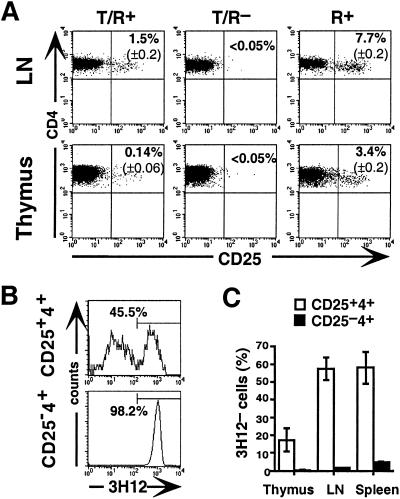
Figure 1
Figure 1
A CD25+4+ T cell population is generated in T/R+ but not in T/R mice. (A) Expression of CD25 on CD4+ LN cells and CD4+8 thymocytes from 6- to 7-week-old T/R+, T/R, and R+ litters, determined by flow cytometry. The number in the upper right quadrant of each profile refers to the mean (±SD.) percentage of CD4+ cells expressing CD25 (n = 3 in each group). (B) Expression of Tg-TCR on CD25+ and CD254+ LN cells, determined by flow cytometry with anti-clonotype mAb, 3H12. (C) Representation of 3H12 cells in each lymphoid organ. Mean ± SD (n = 3).
Figure 2
Figure 2
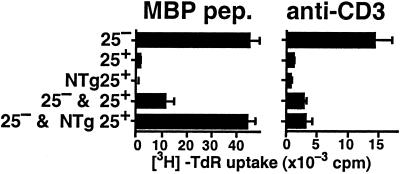
Tg CD25+4+ cells from T/R+ mice exhibit MBP Ac1–17 peptide-specific suppressive activity in vitro. CD254+ cells (2.5 × 10⁴) sorted from T/R+ mice were cultured for 3 days with 2.5 × 10⁴ antigen-presenting cells and 3 μM MBP Ac1–17 peptide (pep) (Left) or 1 μg/ml of anti-CD3 mAb (Right) in the presence or absence of 2.5 × 10⁴ 3H12CD25+4+ or total CD25+4+ cells sorted from T/R+ cells.
Figure 3
Figure 3
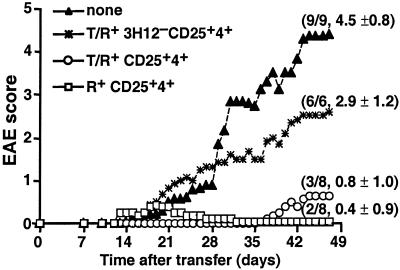
Adoptive transfer of CD25+4+ cells from T/R+ or R+ mice protects T/R mice from EAE; the protection by T/R+ CD25+4+ cells depends on the Tg subset. Sort-purified CD4+ populations were transferred into 30- to 32-day-old T/R mice (2 × 10⁵ cells per mouse). EAE level was scored for 7 weeks after transfer as described in Materials and Methods. The mean score of each group is plotted over time. The numbers in parentheses indicate the final number of mice that developed EAE per total number of animals analyzed, and individual maximum EAE score (mean ± SD). Group comparisons for the maximum EAE score during the observation period were statistically significant by the Mann-Whitney test: [None vs. R+CD25+], P < 0.01; [None vs. T/R+ CD25+], P < 0.01; [T/R+CD25+ vs. T/R+3H12CD25+], P < 0.02.
Figure 4
Figure 4
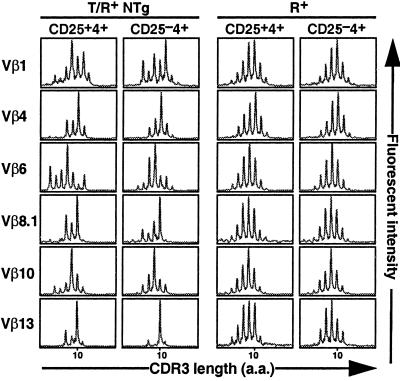
Immunoscope analysis of TCRβ rearrangements reveals oligoclonality of the NTg populations of CD25+ and CD254+ cells from T/R+ mice. cDNA made from total RNA extracted from the sorted CD4+ T cell subpopulations (1 × 10⁵) was subjected to PCR amplification with the indicated Vβ- and a Cβ-specific primer. The PCR products were subjected to run-off reactions with a nested fluorescent Cβ-specific primer and their CDR3 length profiles determined. Results are representative of 3 T/R+ and 2 R+ mice.
Figure 5
Figure 5
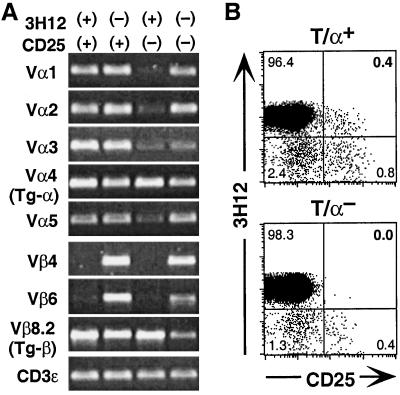
Tg CD25+4+ cells require expression of endogenous TCRα chains for their development. (A) Tg CD4+ cells coexpressing endogenous TCRα chains are enriched in the CD25+ subset. cDNA was synthesized from the indicated sorted T/R+ CD4+ subpopulations (1 × 10⁵ with ≥97% purity), and semiquantitative PCR analyses were conducted with a Cα (or Cβ-)-specific and a Vα (or Vβ-)-specific primer, or with CD3ɛ-specific primers as a control. (B) Absence of the Tg CD25+4+ T cell population in TCR Cα−/− background (T/α) but not in Cα+/− (T/α+) littermates. LN cells were stained for CD25, CD4, and Tg-TCR (3H12) and gated on the CD4+ population. The results are representative of four animals in each group.

References

    1. Le Douarin N, Corbel C, Bandeira A, Thomas-Vaslin V, Modigliani Y, Coutinho A, Salaun J. Immunol Rev. 1996;149:35–53. - PubMed
    1. Modigliani Y, Bandeira A, Coutinho A. Immunol Rev. 1996;149:155–120. - PubMed
    1. Waldmann H, Cobbold S. Annu Rev Immunol. 1998;16:619–644. - PubMed
    1. Coutinho A, Hori S, Carvalho T, Caramalho I, Demengeot J. Immunol Rev. 2001;181:89–98. - PubMed
    1. Mason D, Powrie F. Curr Opin Immunol. 1998;10:649–655. - PubMed

Publication types

MeSH terms