Comparative Study
. 2002 May;14(5):979-92.
doi: 10.1105/tpc.001040.

Arabidopsis RAR1 exerts rate-limiting control of R gene-mediated defenses against multiple pathogens

Affiliations
Comparative Study

Arabidopsis RAR1 exerts rate-limiting control of R gene-mediated defenses against multiple pathogens

Paul R Muskett et al. Plant Cell. 2002 May.

Abstract

We have identified the Arabidopsis ortholog of barley RAR1 as a component of resistance specified by multiple nucleotide binding/Leu-rich repeat resistance (R) genes recognizing different bacterial and oomycete pathogen isolates. Characterization of partially and fully defective rar1 mutations revealed that wild-type RAR1 acts as a rate-limiting regulator of early R gene-triggered defenses, determining the extent of pathogen containment, hypersensitive plant cell death, and an oxidative burst at primary infection sites. We conclude that RAR1 defense signaling function is conserved between plant species that are separated evolutionarily by 150 million years. RAR1 encodes a protein with two zinc binding (CHORD) domains that are highly conserved across eukaryotic phyla, and the single nematode CHORD-containing homolog, Chp, was found previously to be essential for embryo viability. An absence of obvious developmental defects in null Arabidopsis rar1 mutants favors the notion that, in contrast, RAR1 does not play a fundamental role in plant development.


Figures
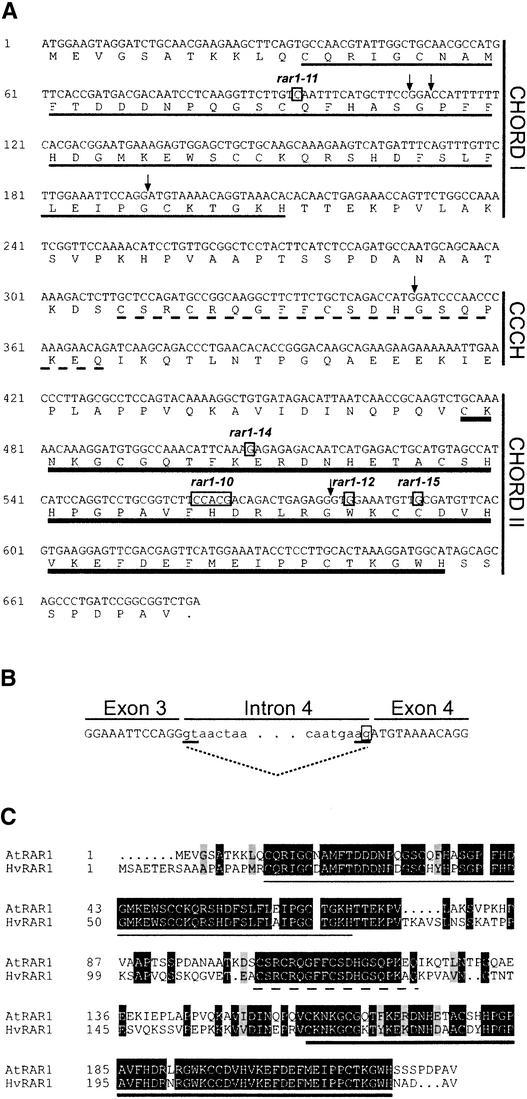
Figure 1.
Figure 1.
Sequence Analysis of Wild-Type and Mutant Alleles of Arabidopsis RAR1. (A) Coding region and deduced amino acid sequence of RAR1 in accession Ler. Arrows mark the positions of introns 1 to 5. The CHORD I, CHORD II, and CCCH domains are indicated by thin, thick, and broken underlines, respectively. Nucleotide changes in rar1-10, rar1-11, rar1-12, rar1-14, and rar1-15 are boxed. (B) Scheme of the intron 3 splice site defect in rar1-13. The sequence at the exon 3–intron 3–exon 4 boundary is shown. Intron sequences are displayed in lowercase letters, and exon sequences are displayed in uppercase letters. The 5′ and 3′ splice sites of intron 3 are underlined, and splicing of the wild-type RNA is shown with a dotted line. The nucleotide change in rar1-13 is boxed. (C) Amino acid sequence alignment of Arabidopsis (At) and barley (Hv) RAR1. The proteins have 60% identity. Identical and similar residues are displayed in black and gray boxes, respectively. The CHORD I, CHORD II, and CCCH domains are underlined as in (A).
Figure 2.
Figure 2.
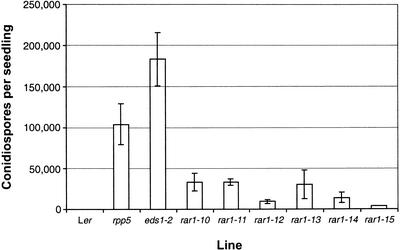
Asexual Sporulation of Peronospora Noco2 on Wild-Type and Mutant Plants. Production of conidiospores on Ler, rpp5, eds1-2, and six independent rar1 mutants (rar1-11 to rar1-15) was determined 7 days after inoculation. The data and standard error values shown are from three replicate samples per line in a single experiment. Similar results were observed in an independent experiment.
Figure 3.
Figure 3.
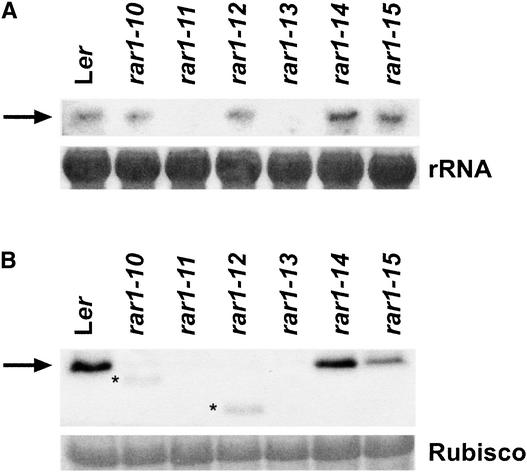
Molecular Characterization of the rar1 Mutants. (A) RNA gel blot analysis of RAR1 transcript levels. Total RNA (20 μg) from 4-week-old healthy Ler and rar1 mutant seedlings was probed with a genomic RAR1 DNA fragment. Equal loading was determined by visualization of rRNA on the filter with methylene blue. (B) Immunoblot analysis of RAR1 protein. Total soluble protein extracts (50 μg) prepared from the same material used for the RNA analysis shown in (A) were probed with polyclonal anti-RAR1 antisera. Asterisks indicate truncated products detected in rar1-10 and rar1-12. Equal loading was determined by Ponceau S staining of the filter. Similar results were obtained in a second independent experiment.
Figure 4.
Figure 4.
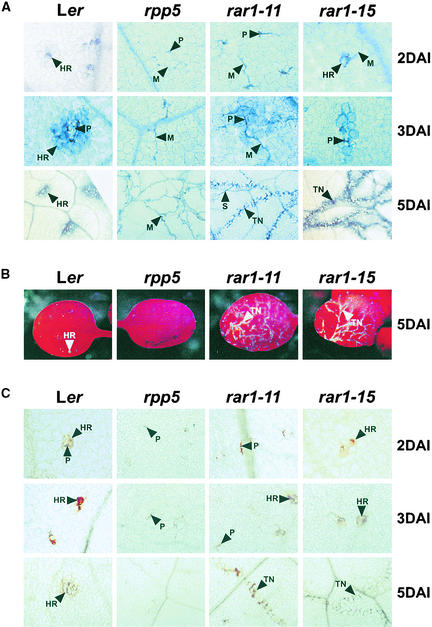
Host Responses and Peronospora Development in rar1 Mutants. The images shown are representative of three independent experiments using at least eight leaves per time point for Ler, rpp5, rar1-11, and rar1-15 seedlings after inoculation with Noco2. (A) Leaves were stained with lactophenol trypan blue at 2, 3, and 5 days after inoculation to reveal necrotic plant cells and pathogen structures. (B) Cell death–associated autofluorescence viewed under UV light 5 days after Noco2 inoculation. (C) H2O2 accumulation at plant–pathogen interaction sites monitored by 3,3-diaminobenzidine staining of leaves at the same times as in (A). DAI, days after inoculation; HR, hypersensitive response; M, mycelium; P, penetration site; S, sporangiophore; TN, trailing necrosis. Magnification ×200 (2 and 3 days after inoculation) and ×100 (5 days after inoculation).
Figure 5.
Figure 5.
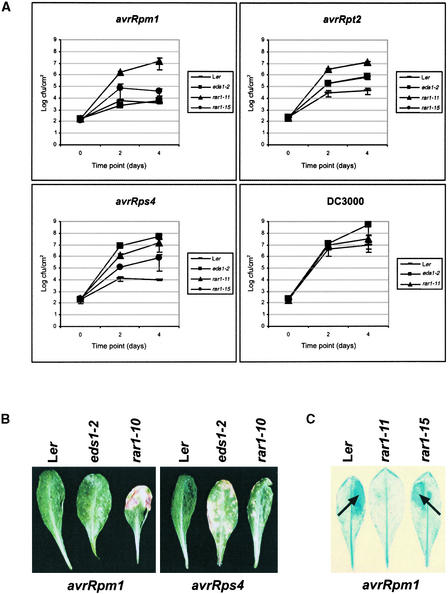
Bacterial Growth and Disease Symptom Formation on rar1 Leaves. (A) Growth of Pseudomonas strain DC3000 expressing avrRpm1, avrRps2, or avrRps4 or containing an empty vector (DC3000) was measured over 4 days in leaves of Ler, eds1-2, rar1-11, and rar1-15. Data shown are averages of two independent experiments ±se. cfu, colony-forming units. (B) Disease symptoms in Ler, eds1-2, and rar1-10 caused by Pseudomonas expressing either avrRpm1 or avrRps4 at 5 days after leaves were dipped in bacterial suspensions (5 × 10⁷ colony-forming units/mL). (C) HR development (arrows) in leaves of Ler, rar1-11, and rar1-15 after hand infiltration of 5 × 10⁶ colony-forming units/mL DC3000/avrRpm1 and staining at 16 hr with lactophenol trypan blue.
Figure 6.
Figure 6.
Effect of rar1 on Pathogen-Induced PR1 Transcript Accumulation. Leaves of 5-week-old Ler, eds1-2, and rar1-10 plants were hand infiltrated with Pseudomonas DC3000 expressing avrRpm1 or DC3000 containing an empty vector in 10 mM MgCl2 or with 10 mM MgCl2 alone. Total RNA was extracted at 0, 6, 12, 24, 48, and 72 hr after infection, and 20-μg samples were probed on gel blots with a genomic PR1 DNA fragment. Equal loading was determined by visualization of rRNA on the filter with methylene blue (bottom gel). Three independent experiments gave similar results.

References

    1. Aarts, N., Metz, M., Holub, E., Staskawicz, B.J., Daniels, M.J., and Parker, J.E. (1998). Different requirements for EDS1 and NDR1 by disease resistance genes define at least two R gene-mediated signaling pathways in Arabidopsis. Proc. Natl. Acad. Sci. USA 95, 10306–10311. - PMC - PubMed
    1. Austin, M., Muskett, P.R., Kahn, K., Feys, B.J., Jones, J.D.G., and Parker, J.E. (2002). Regulatory role of SGT1 in early R gene-mediated plant defences. Science 295, 2077–2080. - PubMed
    1. Azevedo, C., Sadanandom, A., Kitagawa, K., Freialdenhoven, A., Shirasu, K., and Schulze-Lefert, P. (2002). The RAR1 interactor SGT1, an essential component of R gene-triggered disease resistance. Science 295, 2073–2076. - PubMed
    1. Bent, A.F., Kunkel, B.N., Dahlbeck, D., Brown, K.L., Schmidt, R., Giraudat, J., Leung, J., and Staskawicz, B.J. (1994). RPS2 of Arabidopsis thaliana: A leucine-rich repeat class of plant disease resistance protein. Science 265, 1856–1860. - PubMed
    1. Botella, M.A., Parker, J.E., Frost, L.N., Bittner-Eddy, P.D., Beynon, J.L., Daniels, M.J., Holub, E.B., and Jones, J.D.G. (1998). Three genes of the Arabidopsis RPP1 complex resistance locus recognize distinct Peronospora parasitica avirulence determinants. Plant Cell 10, 1847–1860. - PMC - PubMed

Publication types

MeSH terms

Substances