


Profile of Salmonella enterica subsp. enterica (subspecies I) serotype 4,5,12:i:- strains causing food-borne infections in New York City
- PMID: 12037044
- PMCID: PMC130705
- DOI: 10.1128/JCM.40.6.1924-1929.2002
Profile of Salmonella enterica subsp. enterica (subspecies I) serotype 4,5,12:i:- strains causing food-borne infections in New York City
Abstract
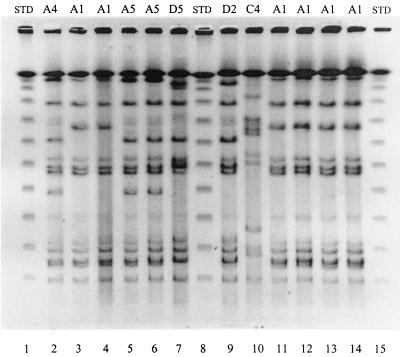
Strains of newly emerging Salmonella enterica subsp. enterica (subspecies I) serotype 4,5,12:i:- causing food-borne infections, including a large food poisoning outbreak (n = 86) characterized by persistent diarrhea (14% bloody), abdominal pain, fever, and headache, were examined. The organisms were found in the stool samples from the patients. The biochemical profile of the organisms is consistent with that of S. enterica subsp. I serotypes, except for decreased dulcitol (13%) and increased inositol (96%) utilization. Twenty-eight percent of the strains showed resistance to streptomycin, sulfonamides, or tetracycline only; all three antimicrobial agents; or these agents either alone or in combination with ampicillin, trimethoprim, and trimethoprim-sulfamethoxazole. None of the serotype 4,5,12:i:- strains showed resistance or decreased susceptibility to chloramphenicol or ciprofloxacin. On pulsed-field gel electrophoresis (PFGE), the strains showed 11 or 12 resolvable genomic fragments with 18 banding patterns and three PFGE profile (PFP) clusters (i.e., PFP/A, PFP/B, and PFP/C). Seventy-five percent of the isolates fingerprinted were closely related (zero to three band differences; similarity [Dice] coefficient, 86 to 100%); 63% of these were indistinguishable from each other (PFP/A(1)). PFP/A(1) was common to all strains from the outbreak and 11 hospital sources. Strains from six other hospitals shared clusters PFP/B and PFP/C. PFP/C(4), of the environmental isolate, was unrelated to PFP/A and PFP/B. Nine band differences (similarity coefficient, 61%) were noted between PFP/A(1) and PFP/E of the multidrug-resistant S. enterica subsp. enterica serotype Typhimurium definitive type 104 strains. Whether these emerging Salmonella strains represent a monophasic, Dul(-) variant of serotype Typhimurium or S. enterica subsp. enterica serotype Lagos or a distinct serotype of S. enterica subsp. I is not yet known. Some of the phenotypic and genotypic properties of the serotype 4,5,12:i:- strains are described here.
Figures
References
-
- Baron, E., S. Weissfeld, P. Fuselier, and D. Brenner. 1995. Classification and identification of bacteria, p. 249-265. In P. Murray et al. (ed.), Manual of clinical microbiology, 6th ed. American Society for Microbiology, Washington, D.C.
-
- Birren, B., and E. Lai. 1993. Pulse-field gel electrophoresis. A practical guide. Academic Press, Inc., New York, N.Y.
-
- Centers for Disease Control and Prevention. 2000. Salmonella surveillance: annual tabulation summary, 1999. Centers for Disease Control and Prevention, Atlanta, Ga.
-
- Cuff, W., R. Khakhria, D. Woodward, R. Ahmed. C. Clark, and F. Rodgers. 2000. Enteric pathogens identified in Canada: annual summary 1997. National Laboratory for Enteric Pathogens, The Canadian Science Centre for Human and Animal Health, Winnipeg, Manitoba, Canada.
-
- Dice, L. R. 1945. Measure of the amount of ecologic associations between species. Ecology 26:277-302.
MeSH terms
Substances
LinkOut - more resources
Full Text Sources
