. 2002 Jun;40(6):1947-57.
doi: 10.1128/JCM.40.6.1947-1957.2002.

Development of a sensitive and specific enzyme-linked immunosorbent assay for detecting and quantifying CMY-2 and SHV beta-lactamases

Affiliations

Development of a sensitive and specific enzyme-linked immunosorbent assay for detecting and quantifying CMY-2 and SHV beta-lactamases

Andrea M Hujer et al. J Clin Microbiol. 2002 Jun.

Abstract

Polyclonal rabbit antibodies against SHV-1 and CMY-2 beta-lactamases were produced and characterized, and enzyme-linked immunosorbent assays (ELISAs) were developed. Immunoblots revealed that the anti-SHV-1 antibody recognized SHV-1 but did not recognize TEM-1, K-1, OXA-1, or any AmpC beta-lactamase tested. The anti-CMY-2 antibody detected Escherichia coli CMY-2, Enterobacter cloacae P99, Klebsiella pneumoniae ACT-1, and the AmpC beta-lactamases of Enterobacter aerogenes, Morganella morganii, and Citrobacter freundii. No cross-reactivity of the anti-CMY-2 antibody was seen against laboratory strains of E. coli possessing TEM-1, SHV-1, K-1, or OXA-1 beta-lactamases. Operating conditions for performing ELISAs were optimized. Both anti-CMY-2 and anti-SHV-1 antibodies detected picogram quantities of purified protein in ELISAs. The reactivity of the anti-CMY-2 antibody was tested against a number of AmpC beta-lactamases by assaying known quantities of purified enzymes in ELISAs (AmpC beta-lactamases of M. morganii, C. freundii, E. coli, and E. cloacae). As the homology to CMY-2 beta-lactamase decreased, the minimum level needed for detection increased (e.g., 94% homology recognized at 1 ng/ml and 71% homology recognized at 10 ng/ml). The ELISAs were used to assay unknown clinical isolates for AmpC and SHV beta-lactamases, and the results were confirmed with PCR amplification of bla(AmpC) and bla(SHV) genes. Overall, we found that our ELISAs were at least 95% sensitive and specific for detecting SHV and AmpC beta-lactamases. The ELISA format can facilitate the identification of AmpC and SHV beta-lactamases and can be used to quantify relative amounts of beta-lactamase enzymes in clinical and laboratory isolates.


Figures
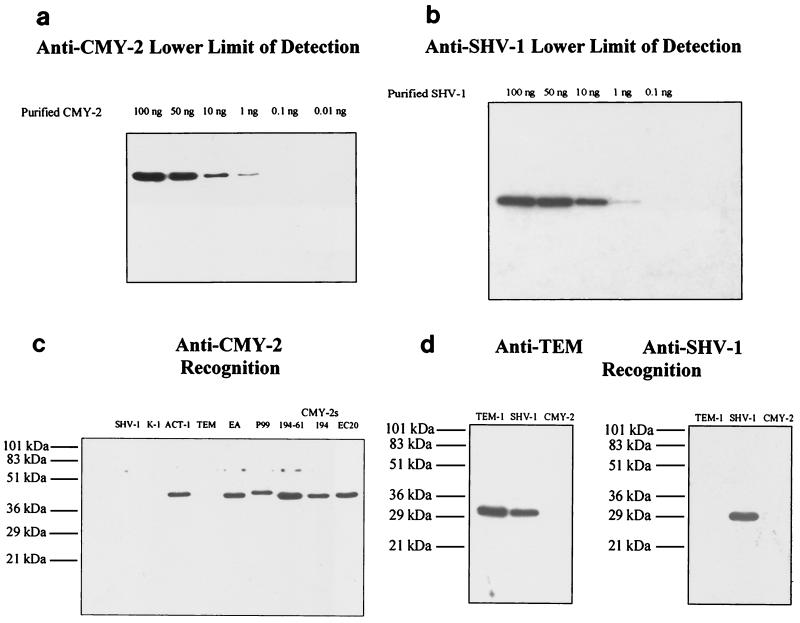
FIG. 1.
FIG. 1.
Immunoblotting. (a) Immunoblot of various amounts of purified CMY-2 β-lactamase probed with 1 μg of anti-CMY-2 antibody/ml. (b) Immunoblot of various amounts of purified SHV-1 β-lactamase probed with 1 μg of anti-SHV-1 antibody/ml. (c) Immunoblot of various β-lactamase-producing strains probed with 1 μg of anti-CMY-2 antibody/ml. Strains, listed from left to right, included E coli DH10B carrying plasmid pBC SK(−) with the SHV-1 β-lactamase, strains producing K-1 and ACT-1 β-lactamases, strain DH5α/pUC18 producing the TEM-1 β-lactamase, a cefepime-resistant E. aerogenes strain producing a β-lactamase (EA), and a strain expressing the P99 Amp C β-lactamase; in addition, E. coli J53-2-derived strains 194-61 and 194 and E. coli strain 20 (EC20) are clinical and laboratory strains producing CMY-2 β-lactamase. (d) Identical immunoblots of strains E. coli DH10B/pUC18 producing TEM-1 β-lactamase, E. coli DH10B/pBC SK(−) producing SHV-1 β-lactamase, and E. coli J53-2-derived 194-61 producing CMY-2 β-lactamase probed with anti-TEM antibody (1:100 dilution) or 1 μg of anti-SHV antibody/ml.
FIG. 2.
FIG. 2.
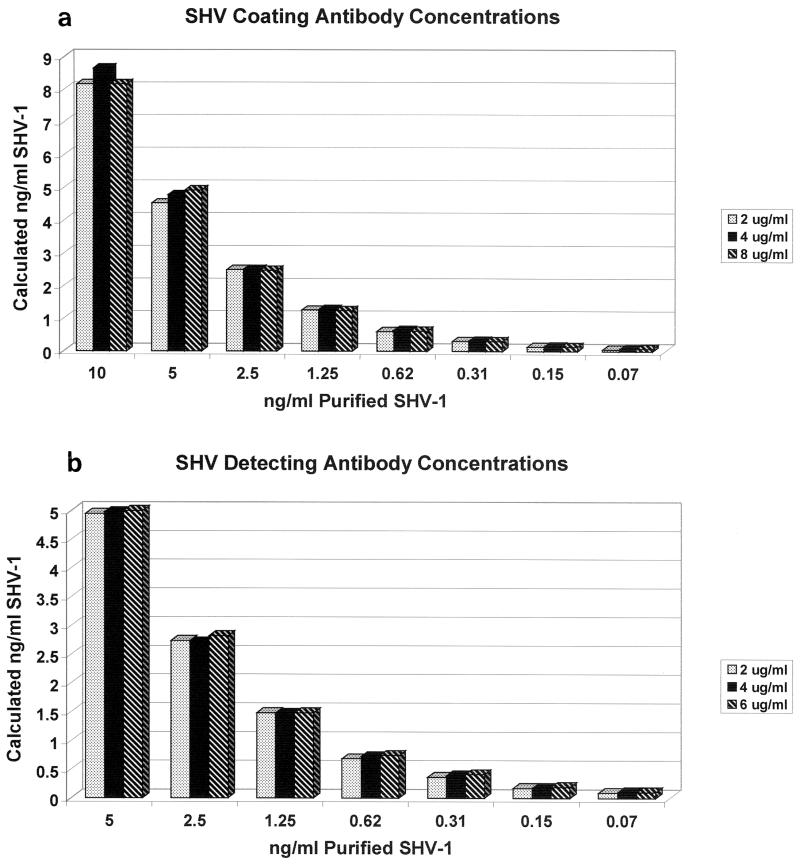
Effects of varying coating and detecting antibody concentrations in the SHV ELISA. Purified SHV-1 β-lactamase was diluted across a range of concentrations and run in triplicate for each detecting antibody concentration (2, 4, and 6 μg of biotinylated anti-SHV antibody/ml). A separate standard curve was generated for each detecting antibody concentration and was used to calculate SHV amounts in nanograms per milliliter. Values plotted are the means for triplicate samples. The sample range never exceeded 7% of the plotted value and was not included in the graph. The effect of varying the coating antibody concentration was examined in a similar manner.
FIG. 3.
FIG. 3.
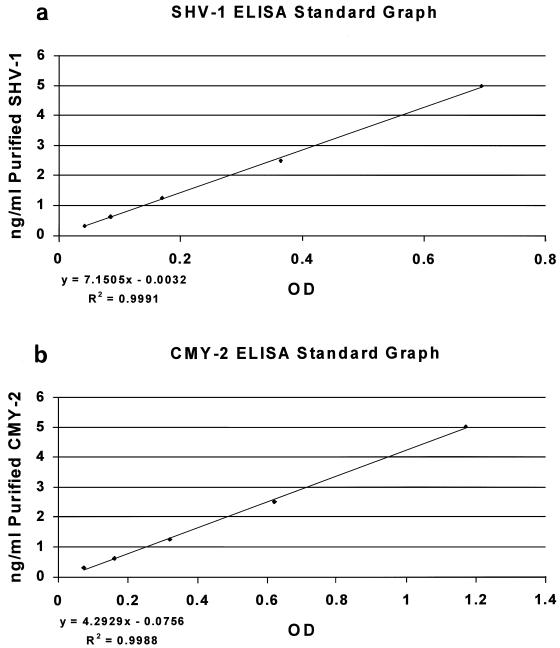
ELISA standard curves. Purified SHV-1 and CMY-2 β-lactamases at known concentrations were run in duplicate and used to generate a standard curve for every ELISA that was performed.
FIG. 4.
FIG. 4.
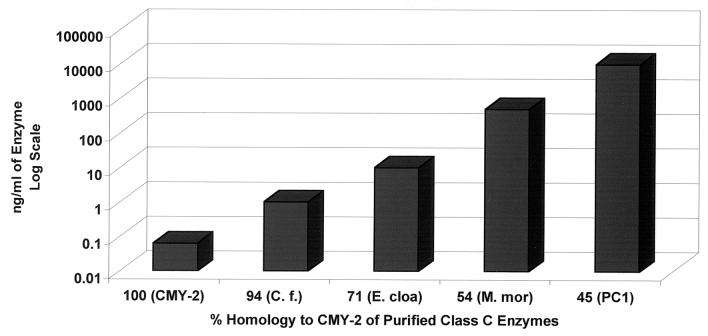
Minimum concentrations of various AmpC β-lactamases needed in order to be detected by the AmpC ELISA. By assaying known concentrations of the various purified enzymes, we demonstrated that as DNA sequence homology to CMY-2 decreased, the minimum concentration of the β-lactamase that could be reliably detected increased. Purified AmpC β-lactamases were CMY-2 from E. coli (CMY-2), C. freundii (C. f.), E. cloacae (E. cloa), M. morganii (M. mor), and S. aureus PC1 (PC1).
FIG. 5.
FIG. 5.
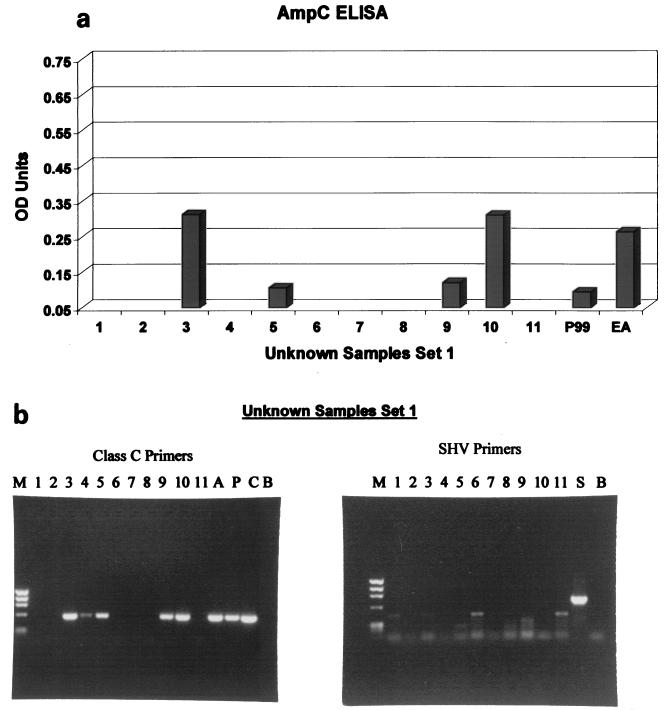
ELISA validation. (a) Eleven clinical isolates (set 1) were blindly screened with the AmpC ELISA. Shown are AmpC ELISA results and results for two positive controls (P99 β-lactamase and cefepime-resistant E. aerogenes [EA]). All unknown samples were diluted 1:5 with 0.1% BSA in PBS. (b) PCR analysis of 11 clinical isolates (set 1) with SHV primers and AmpC primers. PCR amplicons were run on a 1% ethidium bromide-stained agarose gel. Lanes: M, DNA sizing standard (φX174 replicative-form DNA HaeIII fragments); A, K. pneumoniae containing ACT-1 β-lactamase amplicons; P, P99 β-lactamase amplicons; C, 194-61 CMY-2 β-lactamase amplicons; B, blank; S, SHV β-lactamase amplicons.
FIG. 6.
FIG. 6.
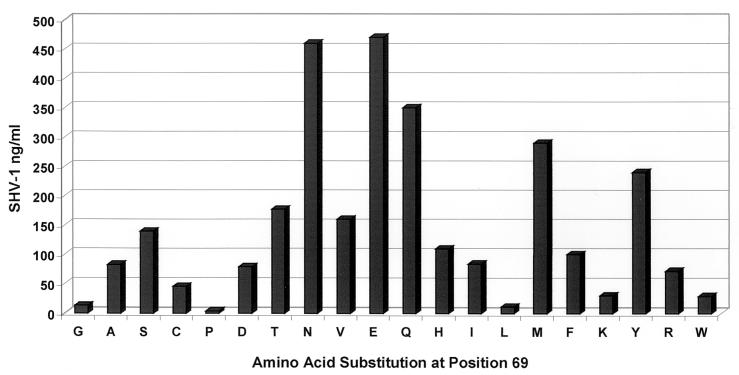
ELISA determination of SHV β-lactamase production. This graph illustrates the utility of the SHV ELISA for quantifying the effect of a particular amino acid substitution on β-lactamase production. Each measurement represents the median of four different experiments. In this case, the amino acid chosen for site saturation mutagenesis was at position 69 in SHV-1.

References

    1. Ambler, R. P., A. F. Coulson, J. M. Frere, J. M. Ghuysen, B. Joris, M. Forsman, R. C. Levesque, G. Tiraby, and S. G. Waley. 1991. A standard numbering scheme for the class A β-lactamases. Biochem. J. 276:269-270. - PMC - PubMed
    1. Barker, L. R., and J. C. Roberts. 1994. The diagnostic process, p. 8-10. In L. R. Barker, J. R. Burton, and P. D. Zieve (ed.), Principles of ambulatory medicine, 4th ed. The Williams & Wilkins Co., Baltimore, Md.
    1. Bauernfeind, A., Y. Chong, and K. Lee. 1998. Plasmid-encoded AmpC β-lactamases: how far have we gone 10 years after the discovery? Yonsei Med. J. 39:520-525. - PubMed
    1. Bibi, E. 1989. Purification of TEM-1 β-lactamase by immunoaffinity chromatography. Biochem. J. 263:309-311. - PMC - PubMed
    1. Bibi, E., and R. Laskov. 1990. Selection and application of antibodies modifying the function of β-lactamase. Biochim. Biophys. Acta 1035:237-241. - PubMed

Publication types

MeSH terms