. 2002 Jun;68(6):2644-50.
doi: 10.1128/AEM.68.6.2644-2650.2002.

Identification of opuC as a chill-activated and osmotically activated carnitine transporter in Listeria monocytogenes

Affiliations

Identification of opuC as a chill-activated and osmotically activated carnitine transporter in Listeria monocytogenes

Apostolos S Angelidis et al. Appl Environ Microbiol. 2002 Jun.

Abstract

The food-borne pathogen Listeria monocytogenes is notable for its ability to grow under osmotic stress and at low temperatures. It is known to accumulate the compatible solutes glycine betaine and carnitine from the medium in response to osmotic or chill stress, and this accumulation confers tolerance to these stresses. Two permeases that transport glycine betaine have been identified, both of which are activated by hyperosmotic stress and one of which is activated by low temperature. An osmotically activated transporter for carnitine, OpuC, has also been identified. We have isolated a Tn917-LTV3 insertional mutant that could not be rescued from hyperosmotic stress by exogenous carnitine. The mutant, LTS4a, grew indistinguishably from a control strain (DP-L1044) in the absence of stress or in the absence of carnitine, but DP-L1044 grew substantially faster under osmotic or chill stress in the presence of carnitine. LTS4a was found to be strongly impaired in KCl-activated as well as chill-activated carnitine transport. 13C nuclear magnetic resonance spectroscopy of perchloric acid extracts showed that accumulation of carnitine by LTS4a was negligible under all conditions tested. Direct sequencing of LTS4a genomic DNA with a primer based on Tn917-LTV3 yielded a 487-bp sequence, which allowed us to determine that the opuC operon had been interrupted by the transposon. It can be concluded that opuC encodes a carnitine transporter that can be activated by either hyperosmotic stress or chill and that the transport system plays a significant role in the tolerance of L. monocytogenes to both forms of environmental stress.


Figures

FIG. 1.
FIG. 1.
Site of insertion of Tn917-LTV3 into the opuC operon, based on a 487-bp sequence obtained by direct sequencing of the genomic DNA of mutant LTS4a with a 24-bp primer derived from the sequence of the transposon.
FIG. 2.
FIG. 2.
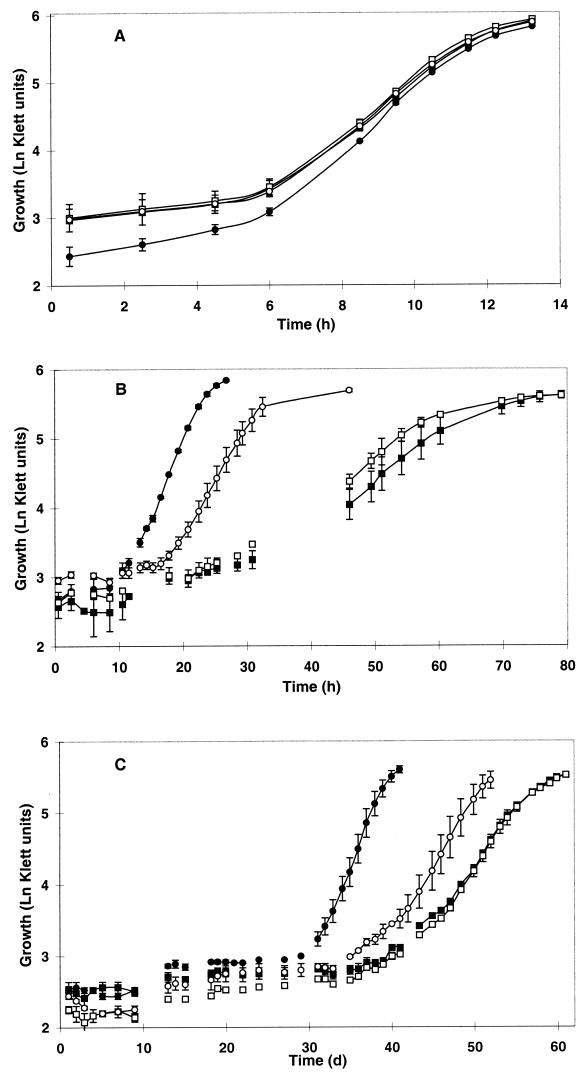
Growth characteristics of L. monocytogenes LTS4a and DP-L1044. Cultures of DP-L1044 (solid symbols) and the carnitine transport mutant LTS4a (open symbols) were grown in BHI medium and inoculated into Na+-deficient modified Pine's medium (1% inoculum). These cultures were grown to late log phase and used to inoculate (1%) Na+-deficient modified Pine's medium containing 1 mM carnitine (circles) or no carnitine (squares). Cultures were grown at 30°C without added KCl (A), at 30°C with 8% KCl (B), or at 7°C without added KCl (C). Error bars indicate ±1 standard deviation of triplicate values. d, days.
FIG. 3.
FIG. 3.
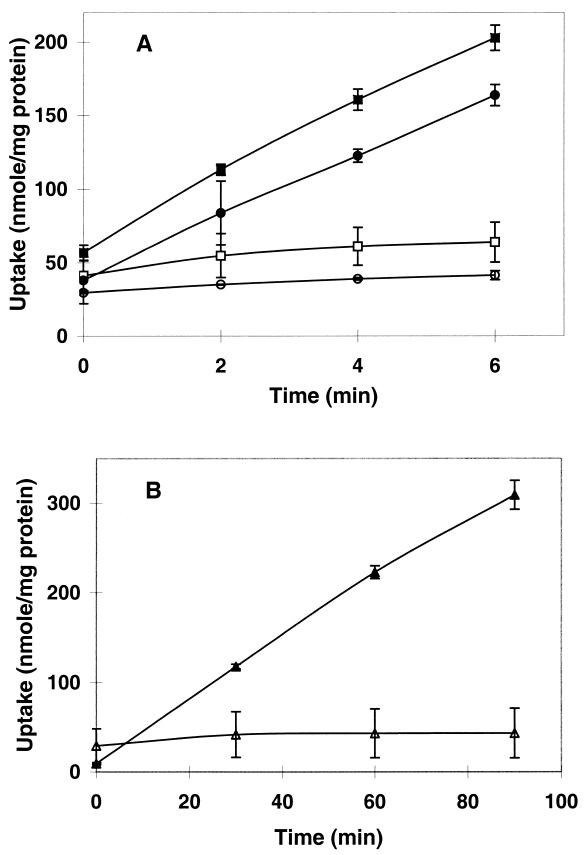
Carnitine transport activity of L. monocytogenes LTS4a and DP-L1044. Uptake of 100 mM [14C]carnitine was measured in DP-L1044 (solid symbols) and LTS4a (open symbols) grown to late log phase in Na+-deficient modified Pine's medium at 30°C with 4% KCl (circles) or 8% KCl (squares) (A) or at 7°C without added KCl (B). Transport was assayed as described in Materials and Methods. Error bars indicate ±1 standard deviation of triplicate values.
FIG. 4.
FIG. 4.
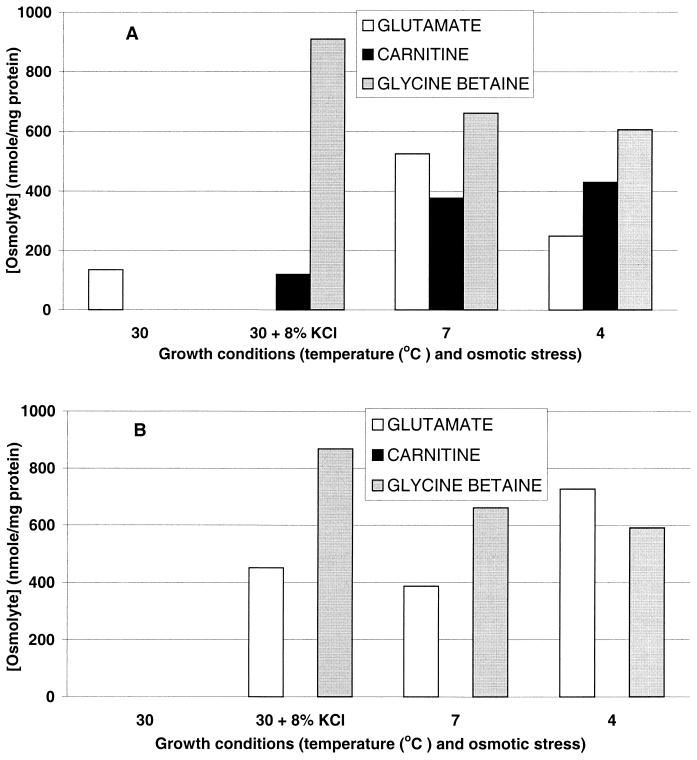
Compatible solute accumulation by L. monocytogenes DP-L1044 (A) and mutant L. monocytogenes LTS4a (B) during balanced growth in modified Pine's medium under different conditions of osmotic and cold stress. Cultures were harvested and washed, and cytoplasmic contents were extracted with perchloric acid. Alanine (50 mM) was added to each extract as an internal standard, and compatible solutes were quantitated by natural-abundance 13C-NMR spectroscopy.

References

    1. Altschul, S. F., T. L. Madden, A. A. Schäffer, J. Zhang, Z. Zhang, W. Miller, and D. J. Lipman. 1997. Gapped BLAST and PSI-BLAST: a new generation of protein database search programs. Nucleic Acids Res. 25:3389-3402. - PMC - PubMed
    1. Angelidis, A., L. Smith, and G. Smith. 2002. Elevated carnitine accumulation by Listeria monocytogenes impaired in glycine betaine transport is insufficient to restore wild-type cryotolerance in milk whey. Int. J. Food Microbiol. 75:1-9. - PubMed
    1. Beumer, R. R., M. C. Te Giffel, L. J. Cox, F. M. Rombouts, and T. Abee. 1994. Effect of exogenous proline, betaine, and carnitine on growth of Listeria monocytogenes in a minimal medium. Appl. Environ. Microbiol. 60:1359-1363. - PMC - PubMed
    1. Camilli, A., D. A. Portnoy, and P. Youngman. 1990. Insertional mutagenesis of Listeria monocytogenes with a novel Tn917 derivative that allows direct cloning of DNA flanking transposon insertions. J. Bacteriol. 172:3738-3744. - PMC - PubMed
    1. Cole, M., M. Jones, and C. Holyoak. 1990. The effect of pH, salt concentration and temperature on the survival and growth of Listeria monocytogenes. J. Appl. Microbiol. 69:63-72. - PubMed

Publication types

MeSH terms

Substances

LinkOut - more resources