. 2002 Jun;68(6):2924-33.
doi: 10.1128/AEM.68.6.2924-2933.2002.

oriC region and replication termination site, dif, of the Xanthomonas campestris pv. campestris 17 chromosome

Affiliations

oriC region and replication termination site, dif, of the Xanthomonas campestris pv. campestris 17 chromosome

Ming-Ren Yen et al. Appl Environ Microbiol. 2002 Jun.

Abstract

A 13-kb DNA fragment containing oriC and the flanking genes thdF, orf900, yidC, rnpA, rpmH, oriC, dnaA, dnaN, recF, and gyrB was cloned from the gram-negative plant pathogen Xanthomonas campestris pv. campestris 17. These genes are conserved in order with other eubacterial oriC genes and code for proteins that share high degrees of identity with their homologues, except for orf900, which has a homologue only in Xylella fastidiosa. The dnaA/dnaN intergenic region (273 bp) identified to be the minimal oriC region responsible for autonomous replication has 10 pure AT clusters of four to seven bases and only three consensus DnaA boxes. These findings are in disagreement with the notion that typical oriCs contain four or more DnaA boxes located upstream of the dnaA gene. The X. campestris pv. campestris 17 attB site required for site-specific integration of cloned fragments from filamentous phage phiLf replicative form DNA was identified to be a dif site on the basis of similarities in nucleotide sequence and function with the Escherichia coli dif site required for chromosome dimer resolution and whose deletion causes filamentation of the cells. The oriC and dif sites were located at 12:00 and 6:00, respectively, on the circular X. campestris pv. campestris 17 chromosome map, similar to the locations found for E. coli sites. Computer searches revealed the presence of both the dif site and XerC/XerD recombinase homologues in 16 of the 42 fully sequenced eubacterial genomes, but eight of the dif sites are located far away from the 6:00 point instead of being placed opposite the cognate oriC. The differences in the relative position suggest that mechanisms different from that of E. coli may participate in the control of chromosome replication.


Figures
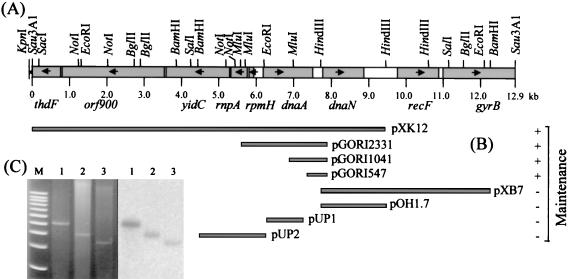
FIG. 1.
FIG. 1.
(A) Restriction map of the pXK130 insert, a Sau3A1 partial fragment, from X. campestris pv. campestris 17 containing oriC and the flanking genes. The restriction sites were deduced from the nucleotide sequence. The leftmost KpnI site was from the vector. (B) Deletion mapping of the oriC region. The oriC-containing fragments were obtained by either restriction enzyme digestion or PCR amplification and were cloned in the E. coli vector pOK12 (pXK12, pXB7, and pOH1.7) or pUC19G (pUP1, pUP2, pGORI2331, pGORI1041, and pGORI547), as described in Table 1. A plus or minus indicates that the plasmid was capable or incapable of autonomous replication in X. campestris pv. campestris 17, respectively. (C) Detection of minichromosomes in X. campestris pv. campestris 17. Plasmids pGORI2331 (lane 1), pGORI1041 (lane 2), and pGORI547 (lane 3) were extracted from the X. campestris pv. campestris 17 transformants and treated with EcoRI, which cut the vector once. The linearized plasmids were subjected to agarose gel electrophoresis (left panel) and were transferred by Southern blotting, followed by hybridization with labeled pGORI547 as the probe (right panel).
FIG. 2.
FIG. 2.
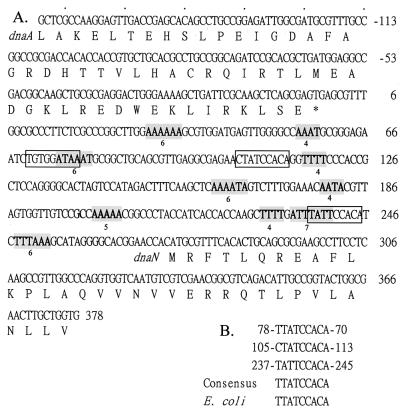
(A) Nucleotide sequence of the 547-bp fragment containing the X. campestris pv. campestris 17 oriC region. The base after the dnaA stop codon is counted as nt 1. Shown are the C terminus of dnaA, the 273-bp intergenic region, and the N terminus of dnaN. The three DnaA boxes are boxed, and the AT-rich clusters are shaded and in bold, each with an Arabic numeral to indicate the number of bases. (B) Nucleotide sequences of the three predicted X. campestris pv. campestris 17 DnaA boxes (the first one is the sequence on the complementary strand) and the consensus sequence of the E. coli DnaA box.
FIG. 3.
FIG. 3.
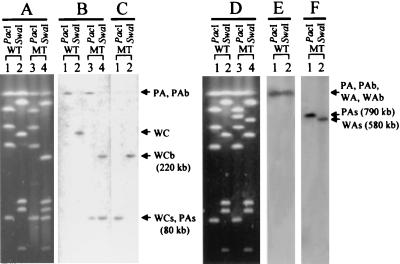
Southern hybridization of the SwaI and PacI fragments from the X. campestris pv. campestris chromosomes. The chromosomes from X. campestris pv. campestris 17 (wild type [WT] in panels A and D), the oriC-tagged mutant Xc17-ori (MT in panel A), and the dif-tagged mutant Xc17::KFSK (MT in panel D) were digested with SwaI or PacI as indicated above the lanes. The digests were subjected to PFGE (A and D). The DNA fragments were transferred onto nylon membranes and hybridized with the 32P-labeled probes. Both membranes were reused and washed before being probed with another probe. Probes used were pUEK1.3, carrying the 1.3-kb KpnI-EcoRI fragment which contains the C terminus of thdF gene and the N terminus of orf900 (B); pOH1.7, carrying the 1.7-kb HindIII fragment which contains the dnaN gene (C); the 345-bp fragment containing dif (E); and pBSU327, containing the recA gene (F). Designations of the important fragments and the hybridizing signals are indicated at the right-hand side of each set of panels.
FIG. 4.
FIG. 4.
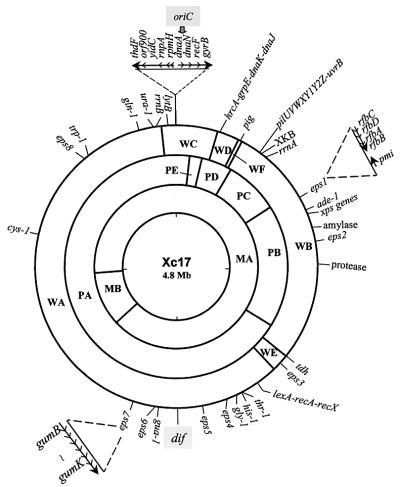
Improved chromosome map of Xanthomonas campestris pv. campestris 17. The map originally constructed bore 13 rare-cutting sites (PmeI, 2; PacI, 5; and SwaI, 6) and 23 genetic loci (42). Additional loci determined in this study include, in clockwise order, the oriC region; hrcA, grpE, dnaK, and dnaJ, the stress-responsive genes (47); pilUVWXY1Y2Z and uvrB, the type IV pilus biogenesis genes and DNA repair gene (13); xps gene cluster, the type II protein secretion gene cluster; the amylase gene; the protease gene; the dif site; and the lytB homologue. Arrows outside the circles represent the transcriptional directions. Gene location and transcriptional direction were determined by PFGE separation of the chromosomal digests in conjunction with Southern hybridization as described in this and other studies (13, 42).
FIG. 5.
FIG. 5.
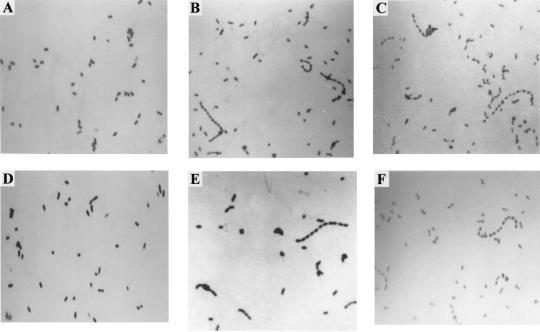
Effects of deletion and reinsertion of the dif site on the cell morphology of X. campestris pv. campestris. (A) Wild-type X. campestris pv. campestris 17; (B) NT1(Δ4445), deleted for the 4,445-bp FHR; (C) NT2(Δ345), deleted for the 345-bp HincII fragment within FHR; (D) NT1R(att51), the dif site reinserted near the original site; (E) Xc17NT1::HIMA, the dif site inserted in the himA gene; (F) Xc17NT1::XHC, the dif site inserted in the UDP-glucose dehydrogenase gene. Cells were observed under a light microscope.
FIG. 6.
FIG. 6.
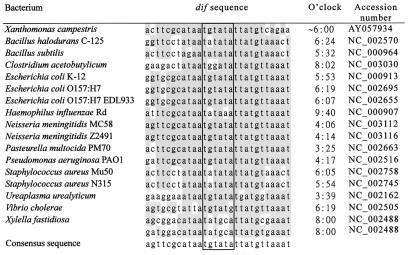
The dif sequences of the 17 eubacteria with known genome sequences (except for X. campestris pv. campestris 17) and their positions relative to the DnaA boxes of the cognate oriC at 12:00. The 6-nt central cores are boxed, and the conserved bases are shaded. Shown at the bottom is the consensus sequence derived from the alignments.
FIG. 7.
FIG. 7.
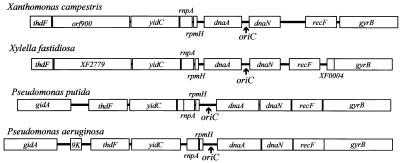
Conservation of the local gene order around the oriC region of X. campestris pv. campestris 17, X. fastidiosa (GenBank accession number NC_002488), P. putida (X62540), and P. aeruginosa (NC_002516).

References

    1. Bachmann, B. J. 1990. Linkage map of Escherichia coli K-12, edition 8. Microbiol. Rev. 54:130-197. - PMC - PubMed
    1. Blakely, G., S. Colloms, G. May, M. Burke, and D. Sherratt. 1991. Escherichia coli XerC recombinase is required for chromosomal segregation at cell division. New Biol. 3:789-798. - PubMed
    1. Blakely, G., G. May, R. McCulloch, L. K. Arciszewska, M. Burke, S. T. Lovett, and D. J. Sherratt. 1993. Two related recombinases are required for site-specific recombination at dif and cer in E. coli K12. Cell 75:351-361. - PubMed
    1. Bradbury, J. F. 1984. Genus II. Xanthomonas Dowson 1939:187.AL, p. 199. In N. R. Krieg and J. G. Holt (ed.), Bergey's manual of systematic bacteriology. Williams & Wilkins, Baltimore, Md.
    1. Clerget, M. 1991. Site-specific recombination promoted by a short DNA segment of plasmid R1 and by a homologous segment in the terminus region of the Escherichia coli chromosome. New Biol. 3:780-788. - PubMed

Publication types

LinkOut - more resources