Microbial methylation of metalloids: arsenic, antimony, and bismuth
- PMID: 12040126
- PMCID: PMC120786
- DOI: 10.1128/MMBR.66.2.250-271.2002
Microbial methylation of metalloids: arsenic, antimony, and bismuth
Abstract
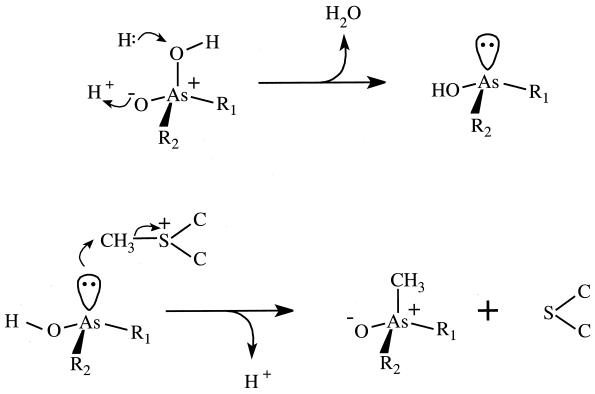
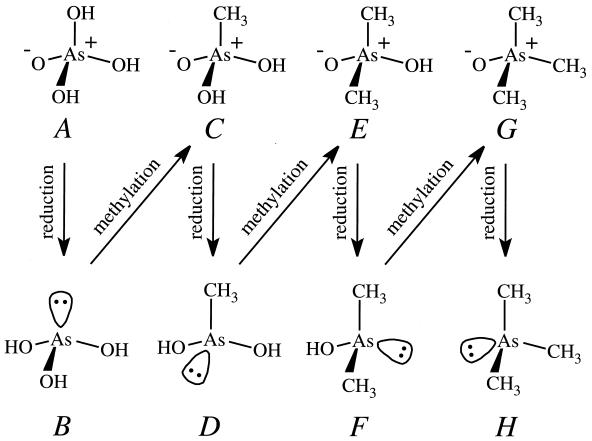
A significant 19th century public health problem was that the inhabitants of many houses containing wallpaper decorated with green arsenical pigments experienced illness and death. The problem was caused by certain fungi that grew in the presence of inorganic arsenic to form a toxic, garlic-odored gas. The garlic odor was actually put to use in a very delicate microbiological test for arsenic. In 1933, the gas was shown to be trimethylarsine. It was not until 1971 that arsenic methylation by bacteria was demonstrated. Further research in biomethylation has been facilitated by the development of delicate techniques for the determination of arsenic species. As described in this review, many microorganisms (bacteria, fungi, and yeasts) and animals are now known to biomethylate arsenic, forming both volatile (e.g., methylarsines) and nonvolatile (e.g., methylarsonic acid and dimethylarsinic acid) compounds. The enzymatic mechanisms for this biomethylation are discussed. The microbial conversion of sodium arsenate to trimethylarsine proceeds by alternate reduction and methylation steps, with S-adenosylmethionine as the usual methyl donor. Thiols have important roles in the reductions. In anaerobic bacteria, methylcobalamin may be the donor. The other metalloid elements of the periodic table group 15, antimony and bismuth, also undergo biomethylation to some extent. Trimethylstibine formation by microorganisms is now well established, but this process apparently does not occur in animals. Formation of trimethylbismuth by microorganisms has been reported in a few cases. Microbial methylation plays important roles in the biogeochemical cycling of these metalloid elements and possibly in their detoxification. The wheel has come full circle, and public health considerations are again important.
Figures

References
-
- Ackerman, D. 1912. Über das Vorkommen von Trigonellin und Nikotinsäure in Harn nach Verfütterung von Nikotinsäure. Z. Biol. 59:17-22.
-
- Agrifoglio, L. 1954. Bartolomeo Gosio. 1865-1944, p. 100-105. In Igienisti Italiani degli Ultimi Cento Anni. U. Hoepli, Milan, Italy.
-
- Andreae, M. O., J.-F. Asmodé, P. Foster, and L. Van't dack. 1981. Determination of antimony(III), antimony(V), and methylantimony species in natural waters by atomic absorption spectrometry with hydride generation. Anal. Chem. 53:1766-1771.
-
- Andreae, M. O., and P. N. Froelich. 1984. Arsenic, antimony, and germanium biogeochemistry in the Baltic Sea. Tellus 36:101-117.
Publication types
MeSH terms
Substances
LinkOut - more resources
Full Text Sources
Other Literature Sources
Molecular Biology Databases