. 2002 Jun 1;541(Pt 2):545-59.
doi: 10.1113/jphysiol.2001.015842.

Short-term synaptic plasticity, simulation of nerve terminal dynamics, and the effects of protein kinase C activation in rat hippocampus

Affiliations

Short-term synaptic plasticity, simulation of nerve terminal dynamics, and the effects of protein kinase C activation in rat hippocampus

Darrin H Brager et al. J Physiol. .

Abstract

Phorbol esters are hypothesised to produce a protein kinase C (PKC)-dependent increase in the probability of transmitter release via two mechanisms: facilitation of vesicle fusion or increases in synaptic vesicle number and replenishment. We used a combination of electrophysiology and computer simulation to distinguish these possibilities. We constructed a stochastic model of the presynaptic contacts between a pair of hippocampal pyramidal cells that used biologically realistic processes and was constrained by electrophysiological data. The model reproduced faithfully several forms of short-term synaptic plasticity, including short-term synaptic depression (STD), and allowed us to manipulate several experimentally inaccessible processes. Simulation of an increase in the size of the readily releasable vesicle pool and the time of vesicle replenishment decreased STD, whereas simulation of a facilitation of vesicle fusion downstream of Ca(2+) influx enhanced STD. Because activation of protein kinase C with phorbol ester enhanced STD of EPSCs in rat hippocampal slice cultures, we conclude that an increase in the sensitivity of the release process for Ca(2+) underlies the potentiation of neurotransmitter release by PKC.


Figures

Figure 2
Figure 2. Recovery from STD
A, STD and recovery of EPSC slope after 1 Hz (formula image, n = 4), 3 Hz (○, n = 5) and 10 Hz (•, n = 12) stimulation for 15 s. Lines show the exponential fits to 3 Hz (dashed) and 10 Hz (continuous) recovery data points. Inset: stimulation protocol for assessing recovery from STD. After tetanic stimulation, stimuli were delivered at 0.25 Hz, with the first stimulus offset by 1 s over 4 trials. B, recovery from STD (10 Hz, 15 s) before and after application of the A1 antagonist DPCPX. Lines show the exponential fits to vehicle (continuous) and DPCPX (dashed) data points. C, simulations of tetanic stimulation using a mechanism in which vesicle replenishment required 1 s, but was capacity limited (see text). Depression and recovery in response to 1 Hz (•) and 10 Hz (○) stimulation was consistent with EPSC data. The continuous line indicates exponential fit of recovery data. D, time constants of exponentials for recovery from simulated release (hatched bars) and EPSCs (open bars) induced with 3 and 10 Hz stimulation. *P < 0.01 vs. 10 Hz stimulation. Recovery of both EPSCs and simulated release is faster after 3 Hz stimulation than after 10 Hz stimulation.
Figure 1
Figure 1. Calcium dependence of release and paired-pulse behaviour of simulated Schaffer collateral synapses, constructed as described in the text
A, simulated quantal content as a function of the Ca2+ influx into the Ca2+ channel/synaptic vesicle microdomain. The data are well fitted by a power function (y è ∝ x2.9, continuous line). B, paired-pulse ratio as a function of interstimulus interval (ISI) with low Ca2+ conditions for the model (○) and for the data on unitary EPSCs reported by Debanne et al. (1996) (•). The effects of concomitant paired-pulse depression were minimised by calculating the paired-pulse ratio as the mean of all EPSC2s following a failure of release, divided by the mean of all EPSC1s (see Debanne et al. 1996). C, paired-pulse ratio as function of ISI with high Ca2+ conditions for the model (○) and for unitary EPSCs (Debanne et al. 1996) (•). The effects of concomitant paired-pulse facilitation were minimised by calculating the paired pulse ratio as the mean of all EPSC2s following the largest 10 % of all EPSC1s (see Debanne et al. 1996). D, mean quantal content of EPSC2 as a function of the quantal content of EPSC1 for a simulation of paired-pulse behaviour under control conditions (ISI = 75 ms). The data are well fitted by linear regression.
Figure 3
Figure 3. Short-term synaptic depression
A, brief depolarising current pulses were used to elicit presynaptic action potentials at 10 Hz in a single CA3 cell (upper trace) and a train of unitary EPSCs in a monosynaptically coupled postsynaptic CA1 cell (lower traces). Note that there was so much stochastic variability in the responses in two single trials in the same cell that a progressive decrease in EPSC amplitude (STD) was apparent only when the responses from 12 trials were averaged (bottom trace). B, STD of extracellularly evoked EPSCs in a CA1 cell elicited with 10 Hz extracellular stimulation of Schaffer collateral axons for 3 s. Unlike the unitary EPSCs in A, STD in the two trials was very similar. C, simulated change in release during 10 Hz stimulation for 3 s during two individual runs of the model. In order to more easily compare the simulated data with the unitary EPSCs in A, quantal postsynaptic responses were simulated with an α function and linear summation of the quanta released by the simulated presynaptic terminals was assumed. As for the unitary EPSCs in A, there was considerable variability in the responses in the two individual trials, but progressive STD was seen when 100 trials were averaged (lower trace). D, STD of extracellularly elicited EPSCs (n = 20 cells) and simulated release (average of 10 blocks of 10 individual trials) in response to 10 Hz stimulation for 15 s. STD in the model occurred with the same time course, and to the same extent, as STD of EPSCs.
Figure 4
Figure 4. Simulated STD results in changes in paired-pulse ratio and CV−2
A, both EPSCs (open bars) and simulated release (hatched bars) displayed a significant, transient increase in paired-pulse ratio after 10 Hz stimulation for 15 s (ISI = 60 ms). Pre-tetanus PPR for EPSCs was taken from the average of six responses at 0.1 Hz immediately prior to tetanic stimulation, recovery was taken 30 s post-tetanus. *P < 0.05. B, the decrease in CV−2 for both EPSCs (•) and simulated release (○) is correlated with the steady-state level of depression after 10 Hz stimulation for 15 s.
Figure 5
Figure 5. Frequency dependence of STD and of readily releasable vesicle pool depletion
A, change in simulated release during 3 Hz (○) and 10 Hz (•) stimulation for 15 s. B, frequency dependence of the steady-state level of EPSCs (•) and simulated release (○) in control release probability conditions. C, frequency dependence of the number of vesicles remaining in the RRP at the steady state of STD. D, correlation between the steady-state EPSC slope for various stimulation frequencies in electrophysiological experiments and the simulated steady-state RRP size in the model for the same stimulation frequencies.
Figure 6
Figure 6. Consequences of decreasing the time required for vesicle replenishment on simulated STD
A, change in simulated release during 10 Hz stimulation under control conditions (•) and after decreasing the replenishment time by 50 % (○). B, frequency dependence of the steady-state level of release during simulated STD with control (•) and fast (○) replenishment. Inset, fit of control (continuous line) and fast replenishment data (dashed line) with a Lorentzian function. The dotted line indicates frequency that produces 50 % depression. C, mean number of vesicles in RRP during simulated STD with control (•) and fast (○) replenishment. Exponential fits of the data for control (continuous line) and fast replenishment (dotted line) are shown in A (double) and C (single).
Figure 7
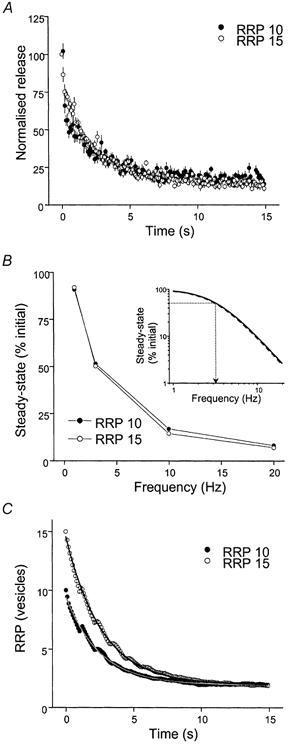
Figure 7. Consequences of increasing the initial RRP size on simulated STD
A, change in release during 10 Hz simulation for control terminals (10 vesicles in the RRP, •) and terminals in which the initial RRP size was increased to 15 vesicles (○). Control steady state = 13.4 ± 0.4 %; RRP15 steady state = 12.6 ± 0.6 %. B, frequency dependence of the steady-state level of release during simulated STD with 10 (•) and 15 (○) vesicles in the RRP. Inset, fit of control (continuous line) and RRP 15 data (dashed line) with a Lorentzian function. The dotted line indicates the frequency resulting in 50 % depression. C, mean number of vesicles in RRP during simulated STD with 10 (•) and 15 (○) vesicles in RRP. Exponential fits of the data for 10 (continuous line) and 15 vesicles in the RRP (dotted line) are shown in A (double) and C (single).
Figure 8
Figure 8. Effects of phorbol ester on STD of EPSCs and simulated release
A, change in simulated release during 10 Hz stimulation for control terminals (•, 10 vesicles in RRP and 1 s replenishment time) and terminals in which the initial RRP size was increased to 15 vesicles and the replenishment time was decreased to 0.5 s (○) in order to mimic the effects of phorbol ester described by Stevens & Sullivan (1998). Note that STD was reduced by this manipulation. B, change in simulated release during 10 Hz simulation for control terminals (•) and terminals in which Pterm was increased by 50 % (○) in order to mimic the effects of phorbol ester described by Wu & Wu (2001). Note that STD was enhanced by this manipulation. C, STD (10 Hz, 15 s stimulation) of EPSCs before (•) and after (○) application of 3 μM PDAc for 10 min. The enhancement of STD produced by PDAc is consistent with the predictions of an increase in Pterm on simulated STD. Inset: EPSCs before and after application of 3 μM PDAc for 10 min. Note the increase in EPSC1 amplitude and the decrease in PPR. Scale bars, 50 pA and 25 ms.

References

    1. Atluri PP, Regehr WG. Determinants of the time course of facilitation at the granule cell to Purkinje cell synapse. Journal of Neuroscience. 1996;16:5661–5671. - PMC - PubMed
    1. Betz WJ. Depression of transmitter release at the neuromuscular junction of the frog. Journal of Physiology. 1970;206:629–644. - PMC - PubMed
    1. Betz A, Ashery U, Rickmann M, Augustin I, Neher E, Südhof TC, Rettig J, Brose N. Munc13–1 is a presynaptic phorbol ester receptor that enhances neurotransmitter release. Neuron. 1998;21:123–136. - PubMed
    1. Capogna M, Fankhauser C, Gagliardini V, Gähwiler BH, Thompson SM. Excitatory synaptic transmission and its modulation by PKC is unchanged in the hippocampus of GAP-43-deficient mice. European Journal of Neuroscience. 1999;11:433–440. - PubMed
    1. Capogna M, McKinney RA, O'Connor V, Gähwiler BH, Thompson SM. Ca2+ or Sr2+ partially rescues synaptic transmission in hippocampal cultures treated with botulinum toxin A and C, but not tetanus toxin. Journal of Neuroscience. 1997;17:7190–7202. - PMC - PubMed

Publication types

LinkOut - more resources