


Chronotropic effects of nitric oxide in the denervated human heart
- PMID: 12042368
- PMCID: PMC2290318
- DOI: 10.1113/jphysiol.2001.015107
Chronotropic effects of nitric oxide in the denervated human heart
Abstract
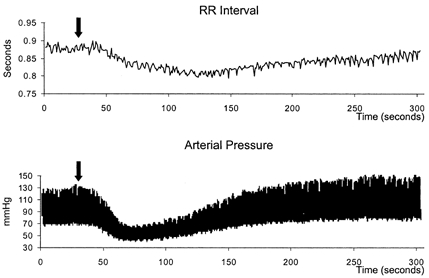
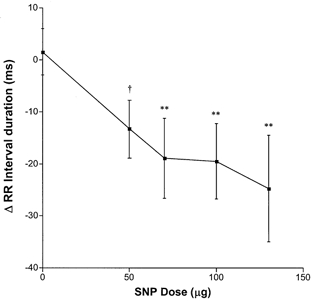
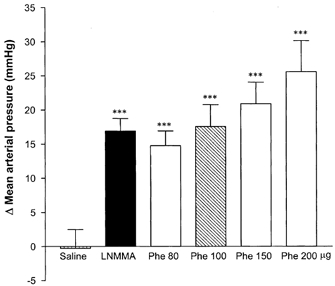
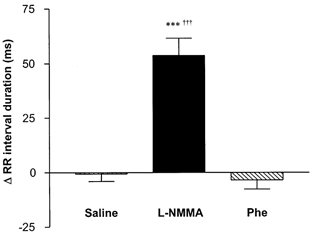
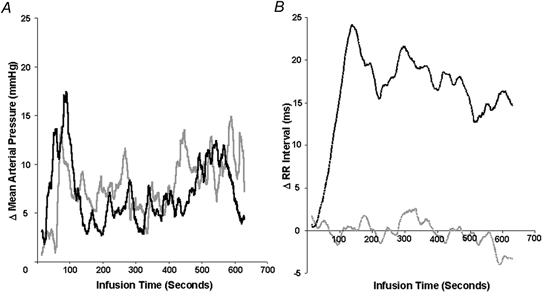
Nitric oxide synthase is expressed in the sino-atrial node and animal data suggests a direct role for nitric oxide on pacemaker activity. Study of this mechanism in intact humans is complicated by both reflex and direct effects of nitric oxide on cardiac autonomic control. Thus, we have studied the direct effects of nitric oxide on heart rate in human cardiac transplant recipients who possess a denervated donor heart. In nine patients, the chronotropic effects of systemic injection of the nitric oxide synthase inhibitor N(G)-monomethyl-L-arginine (L-NMMA) (3 mg kg(-1)) or increasing bolus doses of the nitric oxide donor, sodium nitroprusside (SNP), were studied. Injection of L-NMMA increased mean arterial pressure by 17 +/- 2 mmHg (mean +/- S.E.M.; P < 0.001) and also had a significant negative chronotropic effect, lengthening the R-R interval by 54 +/- 8 ms (P < 0.001). This bradycardia was not reflex in origin since injection of the non-NO-dependent vasoconstrictor, phenylephrine (100 microg) achieved a similar rise in mean arterial pressure (18 +/- 3 mmHg; P < 0.001) but failed to change R-R interval duration (Delta R-R = -3 +/- 4 ms). Furthermore, no change in levels of circulating adrenaline was observed with L-NMMA. Conversely, injection of sodium nitroprusside resulted in a positive chronotropic effect with a dose-dependent shortening of R-R interval duration, peak Delta R-R = -25 +/- 8 ms with 130 microg (P < 0.01). These findings indicate that nitric oxide exerts a tonic, direct, positive chronotropic influence on the denervated human heart. This is consistent with the results of animal experiments showing that nitric oxide exerts a facilitatory influence on pacemaking currents in the sino-atrial node.
Figures
References
-
- Arrowood JA, Minisi AJ, Goudreau E, Davis AB, King AL. Absence of parasympathetic control of heart rate after human orthotopic cardiac transplantation. Circulation. 1997;96:3492–3498. - PubMed
-
- Bengel FM, Ueberfuhr P, Schiepel N, Nekolla SG, Reichart B, Schwaiger M. Effect of sympathetic reinnervation on cardiac performance after heart transplantation. New England Journal of Medicine. 2001;345:731–738. - PubMed
-
- Bernardi L, Bianchini B, Spadacini G, Leuzzi S, Valle F, Marchesi E, Passino C, Calciati A, Vigano M, Rinaldi M, Martinelli L, Finardi G, Sleight P. Demonstrable cardiac reinnervation after human heart transplantation by carotid baroreflex modulation of RR interval. Circulation. 1995;92:2895–2903. - PubMed
-
- Chowdhary S, Nuttall SL, Coote JH, Townend JN. l-arginine augments cardiac vagal control in healthy human subjects. Hypertension. 2002;39:51–56. - PubMed
-
- Chowdhary S, Townend JN. Role of nitric oxide in the regulation of cardiovascular autonomic control. Clinical Science. 1999;97:5–17. - PubMed
Publication types
MeSH terms
Substances
LinkOut - more resources
Full Text Sources
