


Review
doi: 10.1105/tpc.010444.
Cytokinin signaling in Arabidopsis
Affiliations
- PMID: 12045269
- PMCID: PMC151247
- DOI: 10.1105/tpc.010444
Item in Clipboard
Review
Cytokinin signaling in Arabidopsis
Plant Cell.
2002.
No abstract available
Figures
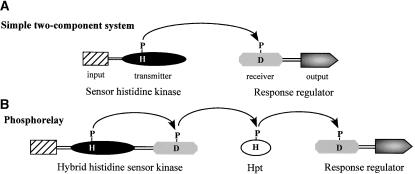
Two-Component Phosphotransfer Schemes. (A) A basic prokaryotic two-component system with a sensor His kinase and a response regulator. H and D represent the conserved phospho-accepting His and Asp residues involved in phosphorelay signaling. (B) A multistep phosphorelay system involving a hybrid sensor kinase, with input, transmitter, and receiver domains, a His-containing phosphotransfer protein (Hpt), and a response regulator.
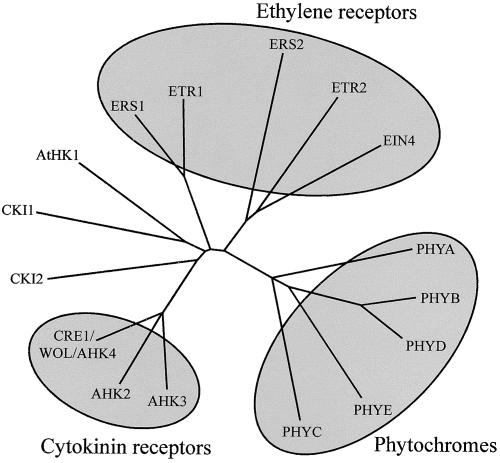
His Kinases in Arabidopsis. An unrooted phylogenetic tree of His kinase–related proteins derived using the amino acid sequences of the His kinase–like domains of these proteins (adapted from Schaller et al., 2002). Phytochrome, ethylene receptor, and cytokinin receptor families are indicated. For additional information about Arabidopsis His kinases and other Arabidopsis phosphorelay elements, including accession numbers, see http://www.bio.unc.edu/research/two-component/default.htm .
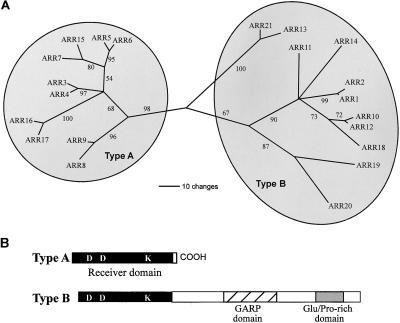
Type-A and Type-B Response Regulators in Arabidopsis. (A) An unrooted phylogenetic tree made using receiver domain sequences of type-A and type-B ARRs. Phylogenetic analysis was performed using the PAUP 4.0 program (Sinaur Associates, Sunderland, MA), with 10,000 bootstrap replicates to assess the reliability of the tree. The bootstrap values are indicated on the tree. (B) Domain structure of type-A and type-B ARRs. Both classes of ARRs contain receiver domains. Type-B ARRs have long C-terminal extensions that include a GARP domain and a Glu- and Pro-rich region.
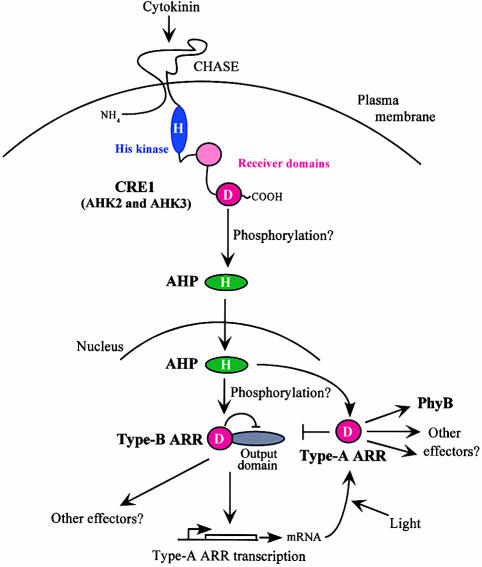
Model for Phosphorelay Signal Transduction in Cytokinin Signaling. Cytokinin binds to CRE1, and possibly other His kinase–like proteins such as AHK2 and AHK3, within the CHASE domain, which is flanked by predicted transmembrane domains. CRE1 is likely to be located in the plasma membrane and, by analogy to other histidine kinases, to act as a dimer (not shown in model). The binding of cytokinin activates the transmitter domain (blue), which autophosphorylates on a His (H). The phosphate then is transferred to an Asp residue (D) within the fused receiver domain (red). A second, degenerate receiver domain (pink) also is present. The phosphate then is likely to be transferred to an AHP protein, which translocates to the nucleus, where it activates type-B ARRs. The activated type-B ARRs increase the transcription of the type-A ARRs, which feed back to inhibit their own transcription (⊥). Light appears to increase ARR4 protein levels, as indicated by the arrow. The receiver domain of type-B ARRs inhibits the activity of the output domain (gray). The output of this signaling pathway is mostly unknown, although one likely target is PhyB. See text for additional details.
References
-
- Anantharaman, V., and Aravind, L. (2001). The CHASE domain: A predicted ligand-binding module in plant cytokinin receptors and other eukaryotic and bacterial receptors. Trends Biochem. Sci. 26 579–582. - PubMed
-
- Arabidopsis Genome Initiative. (2000). Analysis of the genome sequence of the flowering plant Arabidopsis thaliana. Nature 408 796–815. - PubMed
Publication types
MeSH terms
Substances
Grants and funding
LinkOut - more resources
Full Text Sources
Other Literature Sources
