. 2002 Jul;22(13):4535-43.
doi: 10.1128/MCB.22.13.4535-4543.2002.

c-Src-mediated phosphorylation of hnRNP K drives translational activation of specifically silenced mRNAs

Affiliations

c-Src-mediated phosphorylation of hnRNP K drives translational activation of specifically silenced mRNAs

Antje Ostareck-Lederer et al. Mol Cell Biol. 2002 Jul.

Abstract

hnRNPK and hnRNP E1/E2 mediate translational silencing of cellular and viral mRNAs in a differentiation-dependent way by binding to specific regulatory sequences. The translation of 15-lipoxygenase (LOX) mRNA in erythroid precursor cells and of the L2 mRNA of human papilloma virus type 16 (HPV-16) in squamous epithelial cells is silenced when either of these cells is immature and is activated in maturing cells by unknown mechanisms. Here we address the question of how the silenced mRNA can be translationally activated. We show that hnRNP K and the c-Src kinase specifically interact with each other, leading to c-Src activation and tyrosine phosphorylation of hnRNP K in vivo and in vitro. c-Src-mediated phosphorylation reversibly inhibits the binding of hnRNP K to the differentiation control element (DICE) of the LOX mRNA 3' untranslated region in vitro and specifically derepresses the translation of DICE-bearing mRNAs in vivo. Our results establish a novel role of c-Src kinase in translational gene regulation and reveal a mechanism by which silenced mRNAs can be translationally activated.


Figures

FIG. 1.
FIG. 1.
hnRNP K, but not hnRNP E1, is a substrate and activator of c-Src. HeLa cells were transiently transfected with His-tagged hnRNP K (A to G) or FLAG-tagged hnRNP E1 (H to N) and c-Src, the activated mutants Src(KP) and Src(Y527F), or the inactive autophosphorylation site mutant Src(Y416F). HeLa cell lysate was resolved by SDS-PAGE and analyzed in Western blot assays (lanes 1 to 8) with either anti-His (A), anti-hnRNP E1 (H), anti-c-Src (B and I), antiphosphotyrosine (p-Tyr) (C and J), or anti-Src(416) (D and K) antibodies. His-tagged hnRNP K was immunoprecipitated with an anti-His antibody (E to G) and FLAG-tagged hnRNP E1 with an anti-FLAG antibody (L to N), resolved by SDS-PAGE, and analyzed by Western blot assays with antibodies against the His tag (E) or the FLAG tag (L) to assess the amounts of precipitated hnRNP K and hnRNP E1, p-Tyr to analyze the Tyr phosphorylation status of hnRNP K and hnRNP E1 (F and M), or Src antibody to visualize coprecipitated c-Src (G and N). The increased background in panels H to N results from the necessity of exposing the Western blots significantly longer than those in panels A to G to discern the specific signals. wt, wild type.
FIG. 2.
FIG. 2.
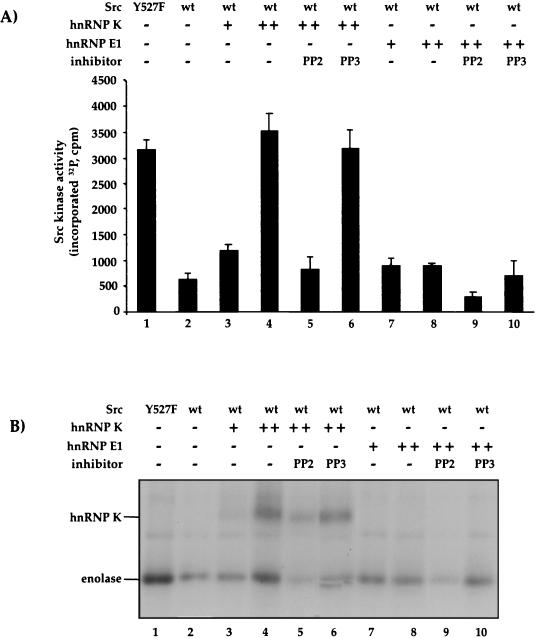
hnRNP K but not hnRNP E1 activates Src catalytic activity in vitro. Wild-type Src (wt) and the constitutively active Src(Y527F) mutant as a positive control were immunopurified from transfected human 293 HEK cells, and equal amounts were assayed with an excess of the substrate enolase in the presence of [γ-32P]ATP, incubated with increasing amounts (125 [+] and 375 [++] ng) of purified hnRNP K (lanes 3 and 4) or hnRNP E1 (lanes 7 and 8). The Src inhibitor PP2 (lanes 5 and 9) and the control PP3 (lanes 6 and 10) were added at a concentration of 1 μM. Phosphorylation of enolase and hnRNP K was analyzed by autoradiography (an example is shown in panel B). (A) The bars show the sum of the hnRNP K and enolase phosphorylation signals with the standard deviation observed in three repeat experiments.
FIG. 3.
FIG. 3.
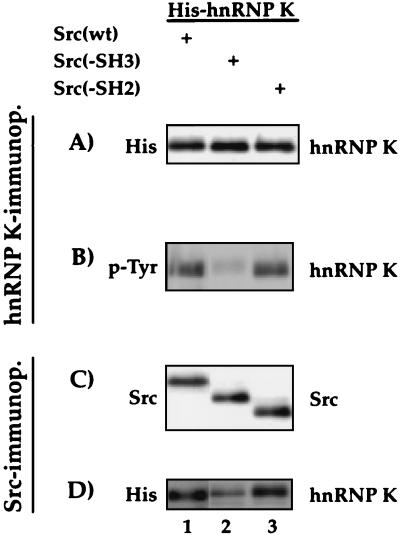
The SH3 domain of c-Src is important for the interaction with and phosphorylation of hnRNP K. HeLa cells were transfected with His-hnRNP K and c-Src, Src(−SH3), or Src(−SH2) expression vectors. The products of a His immunoprecipitation (A and B) or a Src immunoprecipitation (C and D) were analyzed after SDS-PAGE in Western blot assays using antibodies against the His-tag to detect the precipitated His-hnRNP K (A) and p-Tyr to examine Tyr phosphorylation of hnRNP K (B). After Src immunoprecipitation, c-Src expression was assessed with an anti-c-Src antibody (C) and the coprecipitated His-hnRNP K was detected with an anti-His antibody (D).
FIG. 4.
FIG. 4.
Tyr-phosphorylation of Y4F and Y6F His-hnRNP K mutants. (Top) Amino acid sequence of hnRNP K with the Tyr residues that are mutated to Phe residues in the His-hnRNP K mutants Y4F and Y6F underlined and numbered; the other 11 Tyr residues are underlined. (Bottom) HeLa cells were transfected with cDNAs coding for wild-type, Y4F, or Y6F His-hnRNP K, together with control plasmid, c-Src, or Src(Y416F). After immunoprecipitation with anti-His antibody, SDS-PAGE, and Western blotting, the levels of hnRNP K were determined with an anti-His antibody (A), the Tyr phosphorylation of hnRNP K was assayed with an antiphosphotyrosine antibody (p-Tyr) (B), and its interaction with Src was detected with an anti-Src antibody (C).
FIG. 5.
FIG. 5.
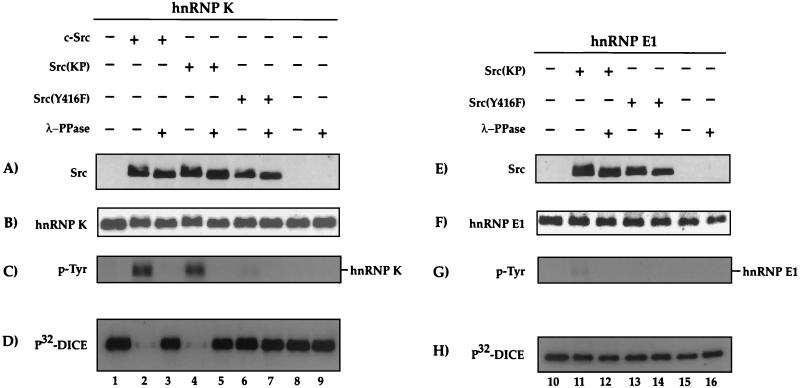
Tyr-phosphorylation of hnRNP K reversibly affects its DICE binding activity. His-hnRNP K (lanes 1 to 9) and His-hnRNP E1 (lanes 10 to 16) were in vitro phosphorylated with either c-Src (lanes 2 and 3), Src(KP) (lanes 4, 5, 11, and 12) or Src(Y416F) (lanes 6, 7, 13, and 14) immunopurified from transiently transfected or nontransfected (lanes 8, 9, 15, and 16) HeLa cells. Dephosphorylation was subsequently achieved by incubation with λ-phosphatase (λ-PPase) (lanes 3, 5, 7, 9, 12, 14, and 16). The reaction products were resolved by SDS-PAGE and analyzed in Western blot assays using either anti-Src antibody (A and E), anti-His antibody (hnRNP K and hnRNP E1) (B and F), or antiphosphotyrosine antibody (p-Tyr) (C and G). (D and H) DICE binding activity of hnRNPs K and E1 was examined with a 32P-labeled DICE probe by Northwestern blotting.
FIG. 6.
FIG. 6.
c-Src activates the translation of LUC-DICE mRNA silenced by hnRNP K. (A) HeLa cells were transiently cotransfected with LUC-DICE or LUC-NR expression vectors and expression plasmids coding for U1A (as a specificity control) or His-hnRNP K and for c-Src, the activated mutant Src(KP), or the inactive form Src(Y416F). SV40-beta-gal was also cotransfected, and β-galactosidase activity was used to correct for differences in transfection efficiency. Extracts were used to analyze the enzymatic activity of the expressed LUC protein. (B) LUC-DICE and His-hnRNP K expression vectors were cotransfected with or without c-Src, Src(KP), or Src(Y416F). After 16 h of transfection, the medium was changed to a low fetal bovine serum concentration (0.2%) for 24 h. Following serum starvation, fresh medium containing 10% fetal bovine serum was added for 4 h. Where indicated, 10 μM PP2 or PP3 was added for 2 h before addition of fresh medium including the indicated substances. From the HeLa cell lysate, His-hnRNP K was immunoprecipitated with an anti-His antibody. (Top) Proteins were resolved by SDS-PAGE and analyzed in Western blot assays using antibodies against phosphotyrosine (p-Tyr) and His tag. (Bottom) Extracts were analyzed in an enzymatic LUC activity assay.

References

    1. Alexandropoulos, K., and D. Baltimore. 1996. Coordinate activation of c-Src by SH3- and SH2-binding sites on a novel, p130 Cas-related protein, Sin. Genes Dev. 10:1341-1355. - PubMed
    1. Brasier, A. R., J. E. Tate, and J. F. Habener. 1989. Optimized use of the firefly luciferase assay as a reporter gene in mammalian cell lines. BioTechniques 7:1116-1122. - PubMed
    1. Brown, M. T., and J. A. Cooper. 1996. Regulation, substrates and functions of src. Biochim. Biophys. Acta 1287:121-149. - PubMed
    1. Burnham, M. R., P. J. Bruce-Staskal, M. T. Harte, C. L. Weidow, A. Ma, S. A. Weed, and A. H. Bouton. 2000. Regulation of c-Src activity and function by the adapter protein Cas. Mol. Cell. Biol. 20:5865-5878. - PMC - PubMed
    1. Collier, B., L. Goobar-Larsson, M. Sokolowski, and S. Schwartz. 1998. Translational inhibition in vitro of human papillomavirus type 16 L2 mRNA mediated through interaction with heterogenous ribonucleoprotein K and poly(rC)-binding protein 1 and 2. J. Biol. Chem. 273:22648-22656. - PubMed

Publication types

MeSH terms