


pfs-dependent regulation of autoinducer 2 production in Salmonella enterica serovar Typhimurium
- PMID: 12057938
- PMCID: PMC135139
- DOI: 10.1128/JB.184.13.3450-3456.2002
pfs-dependent regulation of autoinducer 2 production in Salmonella enterica serovar Typhimurium
Abstract
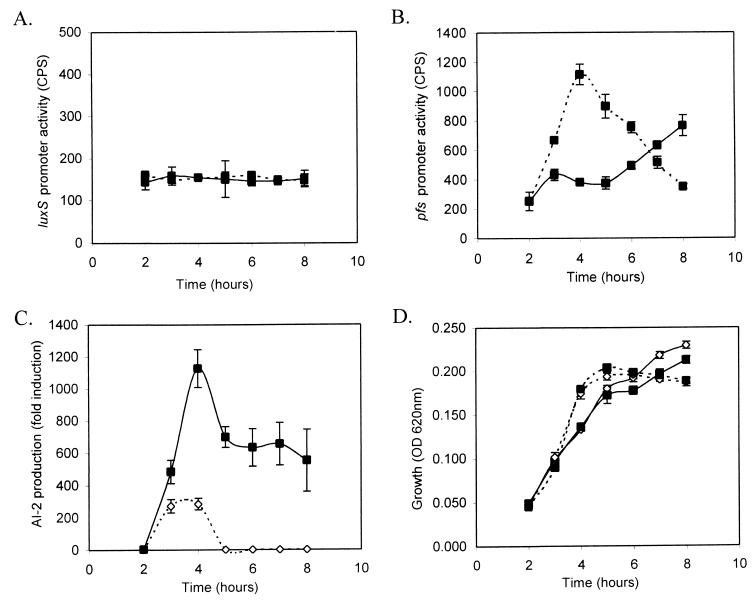
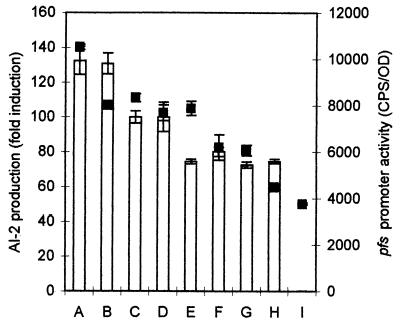
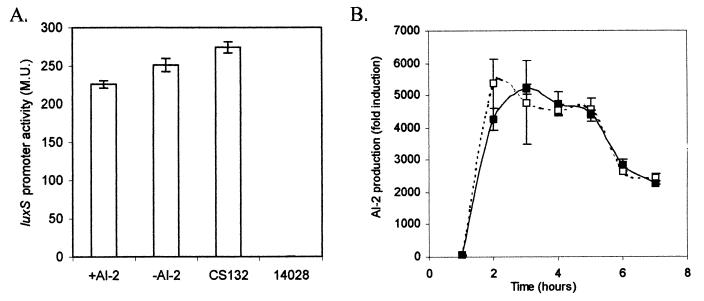
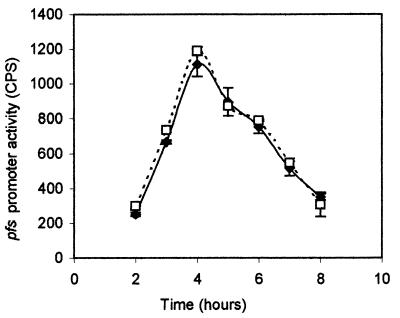
Bacterial intercellular communication provides a mechanism for signal-dependent regulation of gene expression to promote coordinated population behavior. Salmonella enterica serovar Typhimurium produces a non-homoserine lactone autoinducer in exponential phase as detected by a Vibrio harveyi reporter assay for autoinducer 2 (AI-2) (M. G. Surette and B. L. Bassler, Proc. Natl. Acad. Sci. USA 95:7046-7050, 1998). The luxS gene product mediates the production of AI-2 (M. G. Surette, M. B. Miller, and B. L. Bassler, Proc. Natl. Acad. Sci. USA 96:1639-1644, 1999). Environmental cues such as rapid growth, the presence of preferred carbon sources, low pH, and/or high osmolarity were found to influence the production of AI-2 (M. G. Surette and B. L. Bassler, Mol. Microbiol. 31:585-595, 1999). In addition to LuxS, the pfs gene product (Pfs) is required for AI-2 production, as well as S-adenosylhomocysteine (SAH) (S. Schauder, K. Shokat, M. G. Surette, and B. L. Bassler, Mol. Microbiol. 41:463-476, 2001). In bacterial cells, Pfs exhibits both 5'-methylthioadenosine (MTA) and SAH nucleosidase functions. Pfs is involved in methionine metabolism, regulating intracellular MTA and SAH levels (elevated levels of MTA and SAH are potent inhibitors of polyamine synthetases and S-adenosylmethionine dependent methyltransferase reactions, respectively). To further investigate regulation of AI-2 production in Salmonella, we constructed pfs and luxS promoter fusions to a luxCDABE reporter in a low-copy-number vector, allowing an examination of transcription of the genes in the pathway for signal synthesis. Here we report that luxS expression is constitutive but that the transcription of pfs is tightly correlated to AI-2 production in Salmonella serovar Typhimurium 14028. Neither luxS nor pfs expression appears to be regulated by AI-2. These results suggest that AI-2 production is regulated at the level of LuxS substrate availability and not at the level of luxS expression. Our results indicate that AI-2-dependent signaling is a reflection of metabolic state of the cell and not cell density.
Figures
References
-
- Bassler, B. L. 1999. How bacteria talk to each other: regulation of gene expression by quorum sensing. Curr. Opin. Microbiol. 2:582-587. - PubMed
-
- Bassler, B. L., M. Wright, and M. R. Silverman. 1994. Multiple signalling systems controlling expression of luminescence in Vibrio harveyi: sequence and function of genes encoding a second sensory pathway. Mol. Microbiol. 13:273-286. - PubMed
-
- Burgess, N. A., D. F. Kirke, P. Williams, K. Winzer, K. R. Hardie, N. L. Meyers, J. Aduse-Opoku, M. A. Curtis, and M. Camara. 2002. LuxS-dependent quorum sensing in Porphyromonas gingivalis modulates protease and haemagglutinin activities but is not essential for virulence. Microbiology 148:763-772. - PubMed
Publication types
MeSH terms
Substances
LinkOut - more resources
Full Text Sources
Other Literature Sources
Molecular Biology Databases
Miscellaneous
