. 2002 Jun 11;99(12):8265-70.
doi: 10.1073/pnas.082240999.

Targeted inactivation of CTNNB1 reveals unexpected effects of beta-catenin mutation

Affiliations

Targeted inactivation of CTNNB1 reveals unexpected effects of beta-catenin mutation

Timothy A Chan et al. Proc Natl Acad Sci U S A. .

Abstract

Inactivating mutations of the adenomatous polyposis coli gene (APC) or activating mutations of the beta-catenin gene (CTNNB1) initiate colorectal neoplasia. To address the biochemical and physiologic effects of mutant beta-catenin, we disrupted either the mutant or wild-type CTNNB1 allele in a human colorectal cancer cell line. Cells with only wild-type beta-catenin had decreased colony-forming ability when plated at low density, although their growth was similar to that of parental cells when passaged under routine conditions. Immunohistochemistry and cell-fractionation studies suggested that mutant beta-catenin activity was distinguished primarily by cellular localization and not by protein degradation. Surprisingly, we found mutant beta-catenin bound less well to E-cadherin than did wild-type beta-catenin, and the membranous localization of wild-type and mutant beta-catenin was accordingly distinct. These findings pose several challenges to current models of APC/beta-catenin function.


Figures
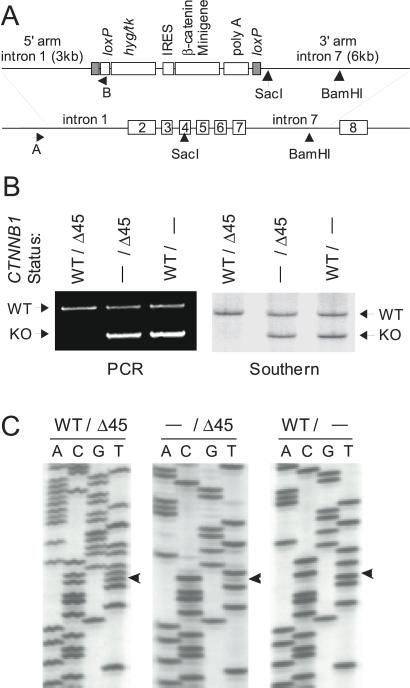
Figure 1
Figure 1
CTNNB1 targeting. (A) The upper map shows the targeting construct used to disrupt CTNNB1. The 5′ and 3′ arms were obtained from a human bacterial artificial chromosome library and ligated to a selection cassette flanked by two loxP sites. These loxP sites enabled the efficient removal of the cassette after successful targeting events. The β-catenin minigene encodes a S33Y mutant CTNNB1, and the primer site B was incorporated to facilitate rapid PCR identification of knockout (KO) cells. The lower map shows the regions of CTNNB1 that were targeted by the KO construct. (B) Rapid PCR screening was used to identify clones with successful targeting events at the CTNNB1 (PCR), and targeting events were confirmed by Southern analysis (Southern). The WT and KO alleles are labeled accordingly. (C) CTNNB1 was sequenced in KO clones. Parental HCT116 cells (WT/Δ45) possess both mutant (Δ45) and WT CTNNB1. WT KO clones (−/Δ45) possess only mutant CTNNB1, whereas mutant KO clones (WT/−) have only WT CTNNB1. The first base of codon 45 is labeled with an arrowhead.
Figure 2
Figure 2
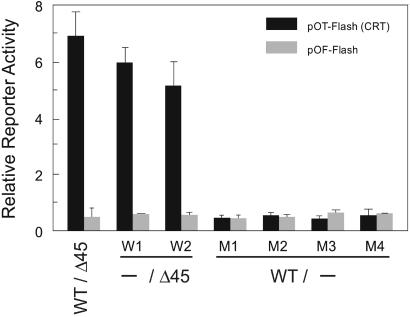
CRT in CTNNB1 KO cells. CRT was measured in cells with the indicated genotypes. Parental cells and WT KO clones (W1, W2) have mutant CTNNB1 and elevated CRT activity, whereas mutant KO clones (M1–M4) lack mutant CTNNB1 and have no measurable CRT. The graph shows the average of duplicate experiments with error bars corresponding to one standard deviation.
Figure 3
Figure 3
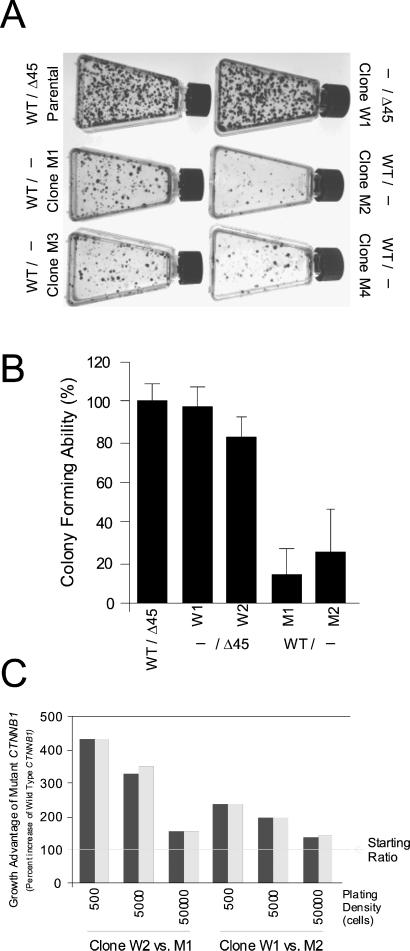
Deletion of mutant CTNNB1 results in decreased growth and survival. (A) Clones with the indicated CTNNB1 genotypes were diluted and plated in flasks. Clones without mutant CTNNB1 (M1–M4) had markedly decreased clonogenic survival compared with cells with mutant CTNNB1 (Parental, W1, W2). (B) Clones with the indicated CTNNB1 genotypes were diluted and plated in 96-well plates so that on average less than one cell grew per well. The numbers of colonies that grew for each cell type were then counted. Cells lacking mutant CTNNB1 had significantly decreased clonogenic survival. Data points are expressed as a percentage of the number of colonies obtained with the parental cell line (WT/Δ45). Data are expressed as the average of at least three experiments with error bars corresponding to one standard deviation. (C) Disrupted WT (W1, W2) or mutant (M1, M2) CTNNB1 cells were cocultured for 14 days. The growth advantage of the mutant CTNNB1-containing cells (W1, W2) was expressed as percentage increase in the fraction of mutant CTNBB1-containing cells as determined by sequencing. The increase is expressed relative to the starting ratio of mutant- to WT-containing cells (1:5, ≈17% mutant cells) and is indicated as 100%. Mixtures of cells were plated at 500, 5,000, or 50,000 cells per T25 flask as indicated. For example, the 430% growth increase indicates that the mutant CTNNB1-containing cells increased from ≈20% of the plated population to more than 85%. Paired bars represent the results of duplicate experiments. Similar behavior was observed in all four possible combinations of the two WT and mutant CTNNB1 KO clones tested.
Figure 4
Figure 4
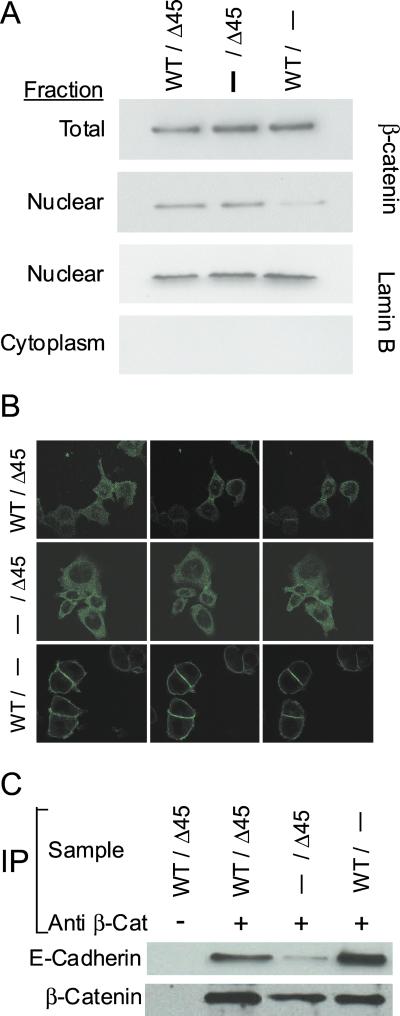
Mutant β-catenin displays abnormal subcellular localization and decreased binding to E-cadherin. (A) Cells with the indicated genotypes were fractionated and analyzed by Western blotting as indicated. The total amount of β-catenin is similar in parental, WT (−/Δ45), and mutant (WT/−) KO clones. WT β-catenin is largely excluded from the nuclear fraction, whereas mutant β-catenin is not. Western blot analysis of the nuclear protein lamin B controlled for the quality of the fractionation. (B) Parental (WT/Δ45), WT (−/Δ45), and mutant (WT/−) CTNNB1 KO cells were stained with anti-β-catenin antibody and imaged by using a confocal microscope. Confocal images at three different levels are shown for each cell type. (C) Lysates from KO cells were immunoprecipitated with anti-β-catenin antibody as indicated. The immunoprecipitated complexes were then analyzed by Western blotting using anti-E-cadherin antibody or anti-β-catenin. Mutant β-catenin has decreased binding to E-cadherin (compare −/Δ45 with WT/− and WT/Δ45).

References

    1. American Cancer Society. Cancer Facts & Figures. Atlanta, GA: Am. Cancer Soc.; 2001.
    1. Kinzler K W, Vogelstein B. In: The Genetic Basis of Human Cancer. Vogelstein B, Kinzler K W, editors. New York: McGraw–Hill; 2002. pp. 565–587.
    1. Rubinfeld B, Souza B, Albert I, Muller O, Chamberlain S H, Masiarz F R, Munemitsu S, Polakis P. Science. 1993;262:1731–1734. - PubMed
    1. Su L K, Vogelstein B, Kinzler K W. Science. 1993;262:1734–1737. - PubMed
    1. Morin P J, Sparks A B, Korinek V, Barker N, Clevers H, Vogelstein B, Kinzler K W. Science. 1997;275:1787–1790. - PubMed

Publication types