


Contribution of interleukin-11 and prostaglandin(s) in lipopolysaccharide-induced bone resorption in vivo
- PMID: 12065535
- PMCID: PMC128103
- DOI: 10.1128/IAI.70.7.3915-3922.2002
Contribution of interleukin-11 and prostaglandin(s) in lipopolysaccharide-induced bone resorption in vivo
Abstract
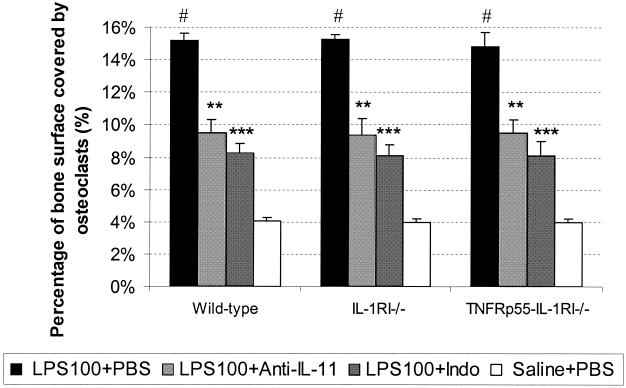
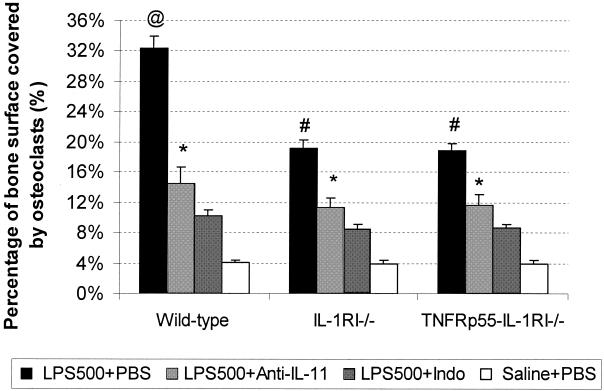
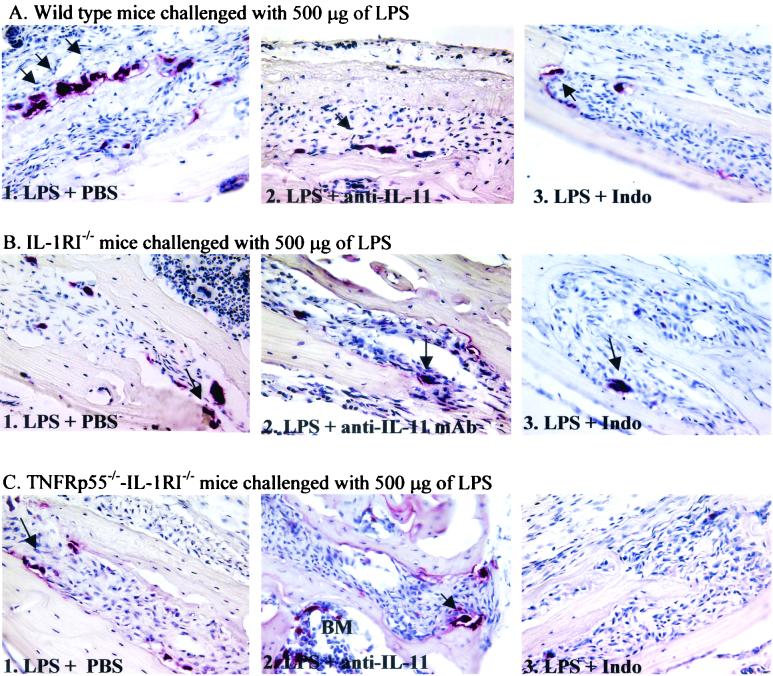
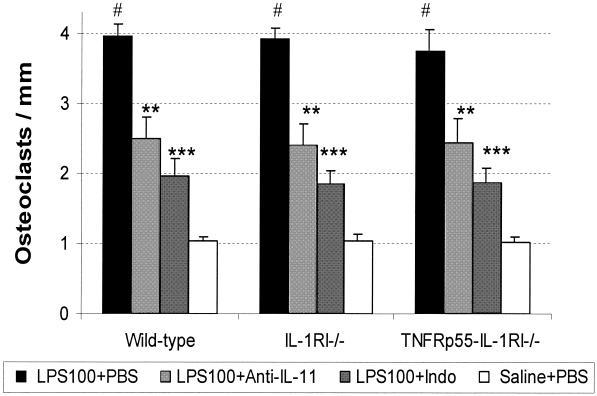
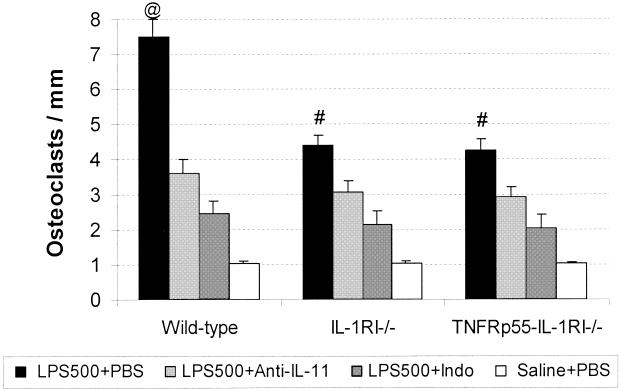
We previously demonstrated that interleukin-1 (IL-1) and tumor necrosis factor (TNF) activities only partially account for calvarial bone resorption induced by local application of lipopolysaccharide (LPS) in mice. The present study was undertaken to determine the role and relative contribution of IL-11 and prostaglandin(s) (PG[s]) in LPS-induced bone resorption in vivo. A one-time dose of LPS was injected into the subcutaneous tissue overlying calvaria of mice lacking IL-1 receptor type I (IL-1RI(-/-)), mice lacking TNF receptor p55 and IL-1RI (TNFRp55(-/-)-IL-1RI(-/-)), and wild-type mice. Mice were then treated with injections of anti-IL-11 monoclonal antibody (MAb), indomethacin, or phosphate-buffered saline (PBS) and sacrificed 5 days later. Histological sections stained for tartrate-resistant acid phosphatase (TRAP) were quantified by histomorphometric analysis. At low doses of LPS (100 microg/mouse), the percentages of bone surface covered by osteoclasts were found to be similar in three strains of mice. The increase was reduced by 37% with anti-IL-11 MAb and by 46% with indomethacin. At higher doses of LPS (500 microg/mouse), we found an eightfold increase in these percentages in wild-type mice and a fivefold increase in these percentages in IL-1RI(-/-) and TNFRp55(-/-)-IL-1RI(-/-) mice after normalizing with the value from the saline-PBS control group in the same strain of mice. The increase was reduced by 55 and 69% in wild-type mice and by 50 and 57% in IL-1RI(-/-) and TNFRp55(-/-)-IL-1RI(-/-) mice treated with anti-IL-11 MAb or indomethacin, respectively. Our findings suggest that in vivo, at low doses of LPS (100 microg/mouse), LPS-induced bone resorption is mediated by IL-11 and PGs, while at high doses of LPS (500 microg/mouse), it is mediated by IL-11, PGs, IL-1, and TNF signaling. IL-11 and PGs mediate LPS-induced bone resorption by enhancing osteoclastogenesis independently of the IL-1 or TNF signaling.
Figures
References
-
- Akatsu, T., N. Takahashi, N. Udagawa, K. Imamura, A. Yamaguchi, K. Sato, N. Nagata, and T. Suda. 1991. Role of prostaglandins in interleukin-1-induced bone resorption in mice in vitro. J. Bone Miner. Res. 6:183-189. - PubMed
-
- Arend, W. P., M. Malyak, M. F. Smith, Jr., T. D. Whisenand, J. L. Slack, J. E. Sims, J. G. Giri, and S. K. Dower. 1994. Binding of IL-1 alpha, IL-1 beta, and IL-1 receptor antagonist by soluble IL-1 receptors and levels of soluble IL-1 receptors in synovial fluids. J. Immunol. 153:4766-4774. - PubMed
-
- Athanasou, N. A. 1996. Cellular biology of bone-resorbing cells. J. Bone Joint Surg. Am. 78:1096-1112. - PubMed
-
- Boyce, B. F., T. B. Aufdemorte, I. R. Garrett, A. J. Yates, and G. R. Mundy. 1989. Effects of interleukin-1 on bone turnover in normal mice. Endocrinology 125:1142-1150. - PubMed
Publication types
MeSH terms
Substances
Grants and funding
LinkOut - more resources
Full Text Sources
Other Literature Sources
