. 2002 Jun 15;541(Pt 3):753-67.
doi: 10.1113/jphysiol.2001.015834.

Carrier-mediated uptake and release of taurine from Bergmann glia in rat cerebellar slices

Affiliations

Carrier-mediated uptake and release of taurine from Bergmann glia in rat cerebellar slices

L Barakat et al. J Physiol. .

Abstract

Taurine uptake is essential for the maintenance of millimolar intracellular concentrations of taurine, which is released during ischaemia and is thought to be neuroprotective. To determine whether Bergmann glia express functional transporters that can mediate both taurine uptake and efflux, whole-cell patch-clamp recordings were obtained from these cells in rat cerebellar slices. Taurine-induced inward currents can be pharmacologically separated into GABA(A) receptor and taurine transporter currents. In the presence of GABA receptor blockers, residual taurine currents averaged -28 pA at -70 mV and were strictly inwardly rectifying between -70 and +50 mV. These residual currents were also abolished by external Na+ removal and diminished by reduction of external Cl-, consistent with transport currents. Taurine transport currents were reduced by a taurine transporter inhibitor, guanidinoethyl sulphonate (GES). Other classical inhibitors reduced taurine transport currents with an order of potency (hypotaurine > beta-alanine > GES > GABA) similar to that reported for cloned rat taurine transporters. Following intracellular taurine perfusion during the recording, a progressively developing outward current could be observed at -50 mV but not at -70 mV. Intracellular perfusion of taurine also decreased taurine-induced inward currents at both holding potentials. Outward currents induced by intracellular taurine increased in amplitude with depolarization, activated near -50 mV, and were affected by GES. For the first time, these results demonstrate that taurine activates both GABA(A) receptors and Na+/Cl--dependent taurine transporters in Bergmann glia in slices. In addition, our data show that taurine transporters can work in reverse and can probably mediate taurine efflux under ischaemic conditions.


Figures
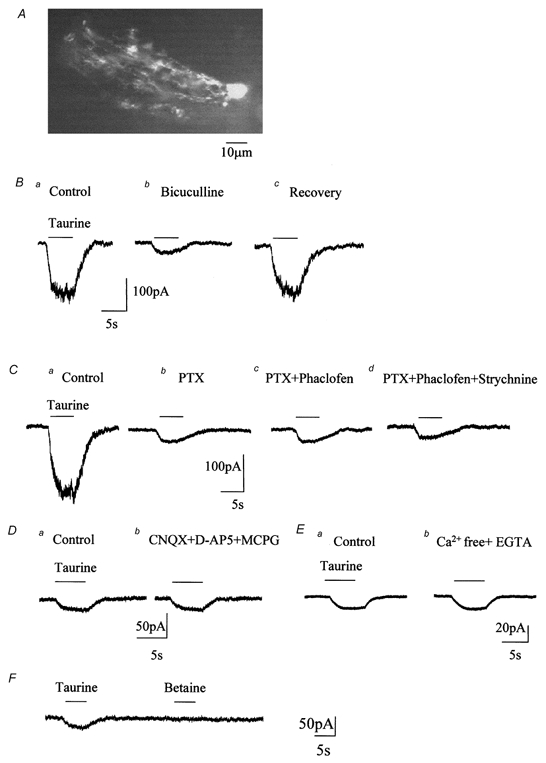
Figure 1
Figure 1. Taurine activates GABAA receptors and transporters in Bergmann glia in situ
A, photograph of a Lucifer Yellow-filled Bergmann glial cell in a 250 μm slice from a 16-day-old rat. B, a puff of taurine (1 mm) induced an inward current (a) reduced by bath application of 250 μM bicuculline (b), a blocker of GABAA receptors. C, taurine-induced currents were also reduced by picrotoxin (PTX, 500 μM, b), a blocker of GABAA/C receptors. The PTX-insensitive current was not affected by 100 μM phaclofen, a blocker of GABAB receptors (c). The residual current was not affected by 100 μM strychnine, a blocker of glycine receptors (d). D and E, the PTX-, phaclofen- and strychnine-insensitive currents were not affected by bath application of glutamate receptor blockers, including d-AP5 (50 μM), CNQX (20 μM) and (S)-α-methyl-4-carboxyphenylglycine (MCPG, 200 μM) to block AMPA/kainate, NMDA and metabotropic glutamate receptors, respectively (D) nor by a 0 Ca2+/EGTA extracellular solution (E). F, taurine and betaine (1 mm each) were pressure applied onto the same cell using a theta glass pipette. All the recordings were performed from a holding potential of −70 mV with a KCl-based internal solution.
Figure 3
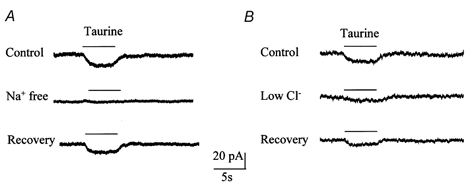
Figure 3. Ion dependence of taurine-induced currents in the presence of GABA and glycine receptor blockers
A, taurine-induced current was reversibly abolished by replacing external Na+ by choline. B, taurine-induced current was reversibly diminished by reduction of external Cl (11 mm instead of 136 mm).
Figure 2
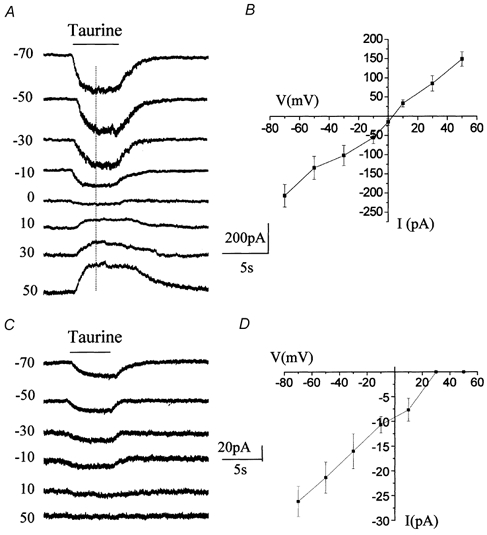
Figure 2. Voltage dependence of taurine-induced responses
A, taurine-induced inward currents recorded at distinct holding potentials in normal recording conditions (no GABA receptor blockers). The current reversed in polarity close to 0 mV. B, mean current-voltage curve of taurine-induced inward currents (n = 3) recorded without GABA receptor blockers. C, taurine-induced currents recorded at different holding potentials in the presence of GABAA/B/C and glycine receptor blockers in the bath. These currents inwardly rectified and did not reverse for positive membrane potentials. D, mean current-voltage curve of taurine-induced inward currents (n = 8) recorded with GABA and glycine receptor blockers.
Figure 4
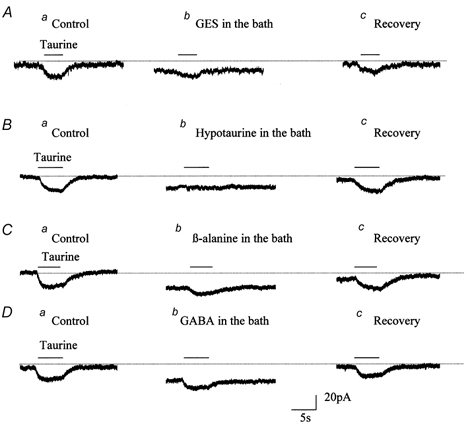
Figure 4. Pharmacological profile of taurine transport currents in Bergmann glia
Effect of distinct blockers of taurine transport, GES (A, 100 μM), hypotaurine (B, 100 μM), β-alanine (C, 100 μM), and GABA (D, 100 μM), on taurine-induced currents recorded in the presence of GABAA/B/C receptor blockers (500 μM PTX and 100 μM phaclofen) and a GLY receptor blocker (100 μM strychnine). For each treatment, data show the current induced by a 1 mm puff of taurine before (a), during (b), and after the washout (c) of the drug.
Figure 5
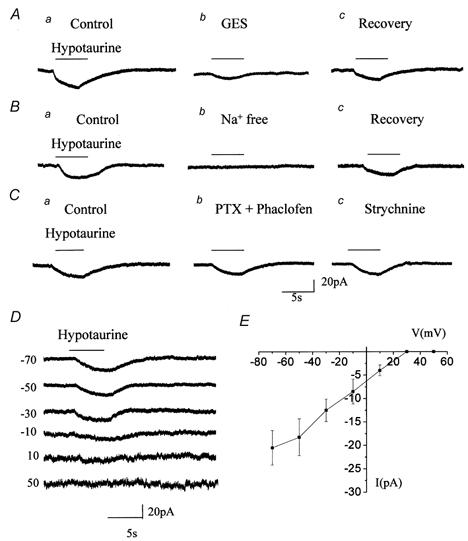
Figure 5. Pharmacology, voltage- and ion-dependence of hypotaurine-induced currents
A, B and C, hypotaurine-induced currents (a) were reversibly reduced by 100 μM GES (Ab), were abolished by replacing external Na+ with choline (Bb), but were not affected by bath application of 500 μM PTX with 100 μM phaclofen (Cb) or by 100 μM strychnine in the presence of PTX and phaclofen (Cc). D, records of hypotaurine-induced currents obtained at different holding potentials from −70 to +50 mV. E, mean current-voltage curve of hypotaurine-induced currents (n = 3). For all the recordings, hypotaurine was pressure-applied at 1 mm to cells recorded at −70 mV. Experiments in A, B and D were performed in the presence of GABAA/B/C receptor blockers (500 μM PTX and 100 μM phaclofen) and a GLY receptor blocker (100 μM strychnine).
Figure 6
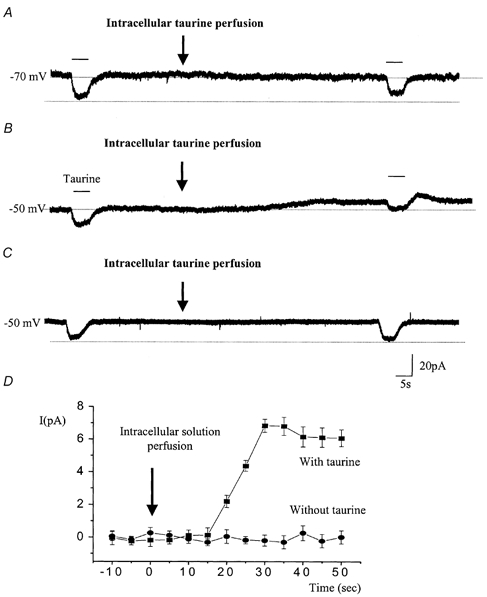
Figure 6. Intracellular taurine perfusion during the recording to study taurine transport reversal
A and B, 20 mm taurine was intracellularly perfused during the recording as indicated by the arrow, and 1 mm taurine was pressure-applied before and after intracellular taurine perfusion. Intracellular taurine perfusion induced an outward current in cells held at −50 mV (B) but not in those held at −70 mV (A). However, in both conditions the inward currents induced by a puff of taurine were diminished by intracellular taurine perfusion. C, a solution containing no taurine was intracellularly perfused during the recording (arrow) at −50 mV. Taurine (1 mm) was pressure-applied before and after intracellular taurine perfusion. D, plot of the mean current amplitude (±s.e.m.) as a function of the recording time for cells that were recorded at −50 mV and intracellularly perfused with either a solution containing taurine (n = 4, ▪) or a solution without taurine (n = 4, •). The baseline currents were considered as a zero current. These experiments were performed in the presence of GABAA/B/C receptor and GLY receptor blockers, as previously mentioned.
Figure 7
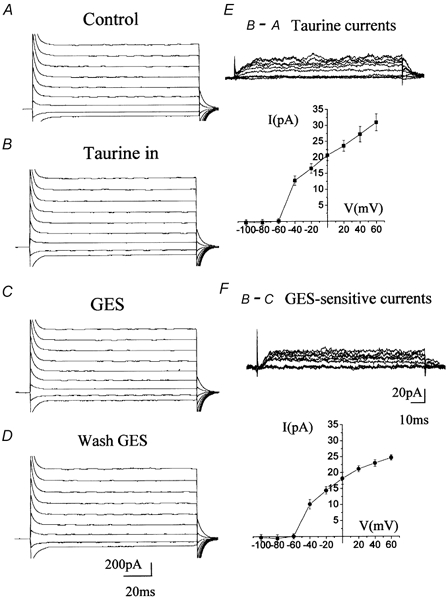
Figure 7. Voltage dependence of taurine transport reversal
Voltage step records for taurine efflux. A, B, C and D, current traces following 20 mV increment voltage steps of 150 ms applied from −100 to +0 mV from a holding potential of −70 mV under control conditions (A) and after intracellular perfusion of 20 mm taurine (B). Following intracellular taurine perfusion, the cells were recorded in the presence of GES (C) and following washout of GES (D). E, traces in A were subtracted from traces in B to reveal taurine efflux currents (top panel) and their respective I-V curve (lower panel). F, traces in C were subtracted from traces in B to illustrate the effect of GES and its magnitude by showing the respective I-V curve (lower panel). All these experiments were performed in the presence of GABAA/B/C receptor and GLY receptor blockers.

References

    1. Albrecht J, Bender AS, Norenberg MD. Ammonia stimulates the release of taurine from cultured astrocytes. Brain Research. 1994;660:288–292. - PubMed
    1. Almarghini K, Remy A, Tappaz M. Immunocyto-chemistry of the taurine biosynthesis enzyme, cysteine sulfinate decarboxylase, in the cerebellum: evidence for a glial localization. Neuroscience. 1991;43:111–119. - PubMed
    1. Andjelkovic AV, Kerkovich D, Shanley J, Pulliam L, Pachter JS. Expression of binding sites for β chemokines on human astrocytes. Glia. 1999;28:225–235. - PubMed
    1. Attwell D, Barbour B, Szatkowski M. Non-vesicular release of neurotransmitter. Neuron. 1993;11:401–407. - PubMed
    1. Barbour B, Brew H, Attwell D. Electrogenic uptake of glutamate and aspartate into glial cells isolated from the salamander (Ambystoma) retina. Journal of Physiology. 1991;436:169–193. - PMC - PubMed

Publication types

LinkOut - more resources