. 2002 Jun 15;541(Pt 3):849-62.
doi: 10.1113/jphysiol.2002.019612.

Intermittent ATP release from nerve terminals elicits focal smooth muscle Ca2+ transients in mouse vas deferens

Affiliations

Intermittent ATP release from nerve terminals elicits focal smooth muscle Ca2+ transients in mouse vas deferens

Keith L Brain et al. J Physiol. .

Abstract

A confocal Ca2+ imaging technique has been used to detect ATP release from individual sympathetic varicosities on the same nerve terminal branch. Varicose nerve terminals and smooth muscle cells in mouse vas deferens were loaded with the Ca2+ indicator Oregon Green 488 BAPTA-1. Field (nerve) stimulation evoked discrete, focal increases in [Ca2+] in smooth muscle cells adjacent to identified varicosities. These focal increases in [Ca2+] have been termed 'neuroeffector Ca2+ transients' (NCTs). NCTs were abolished by alpha,beta-methylene ATP (1 microM), but not by nifedipine (1 microM) or prazosin (100 nM), suggesting that NCTs are generated by Ca2+ influx through P2X receptors without a detectable contribution from L-type Ca2+ channels or alpha(1)-adrenoceptor-mediated pathways. Action potential-evoked ATP release was highly intermittent (mean probability 0.019 +/- 0.002; range 0.001-0.10) at 1 Hz stimulation, even though there was no failure of action potential propagation in the nerve terminals. Twenty-eight per cent of varicosities failed to release transmitter following more than 500 stimuli. Spontaneous ATP release was very infrequent (0.0014 Hz). No Ca2+ transient attributable to noradrenaline release was detected even in response to 5 Hz stimulation. There was evidence of local noradrenaline release as the alpha(2)-adrenoceptor antagonist yohimbine increased the probability of occurrence of NCTs by 55 +/- 21 % during trains of stimuli at 1 Hz. Frequency-dependent facilitation preferentially occurred at low probability release sites. The monitoring of NCTs now allows transmitter release to be detected simultaneously from each functional varicosity on an identified nerve terminal branch on an impulse-to-impulse basis.


Figures
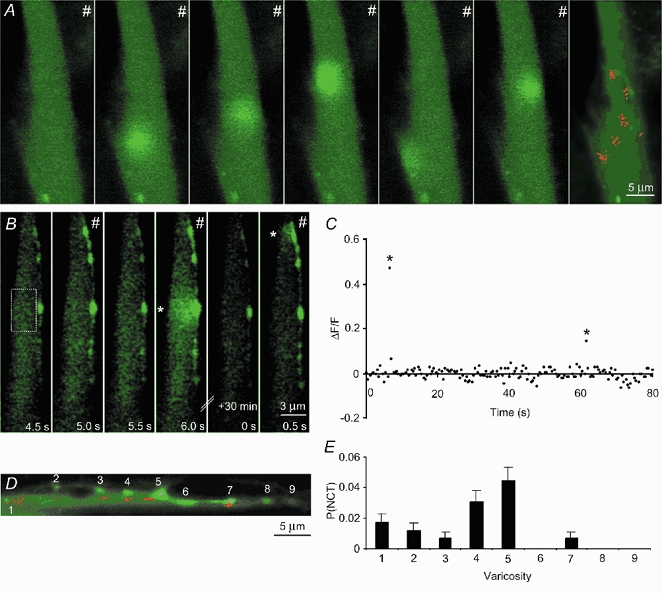
Figure 1
Figure 1. Discrete and intermittent smooth muscle [Ca2+] transients follow nerve stimulation
A, the first six frames show selected images of the same smooth muscle cell taken during 2 Hz stimulation (#). There is no response to most stimuli (frame 1). Other stimuli evoke focal [Ca2+] transients in the smooth muscle cell (frames 2-6). Green represents the fluorescence of the Ca2+ indicator Oregon Green 488 BAPTA-1. The final frame was obtained from a confocal section 3 μm above that of the preceding images, and shows an overlying nerve terminal varicosity (also filled with the indicator). Each red dot denotes the location (centre) of a single smooth muscle [Ca2+] transient occurring at some time during 8 sets of recordings. B, consecutive confocal images of a smooth muscle cell and an adjacent nerve terminal. Field (nerve) stimulation occurred at 1 Hz. Following every stimulus the nerve terminal showed an increase in [Ca2+]. Discrete Ca2+ transients (*) are occasionally detected in the smooth muscle cell. C, the relative change in fluorescence intensity of the Ca2+ indicator in the region marked in B monitored over time. The first significant event in B (frame 4) corresponds to the first significant event in C. D, map of the occurrence of smooth muscle [Ca2+] transients in a different preparation. E, the probability of evoking a focal [Ca2+] transient adjacent to these varicosities, as numbered in D.
Figure 2
Figure 2. Neuroeffector Ca2+ transients reflect intermittent ATP release
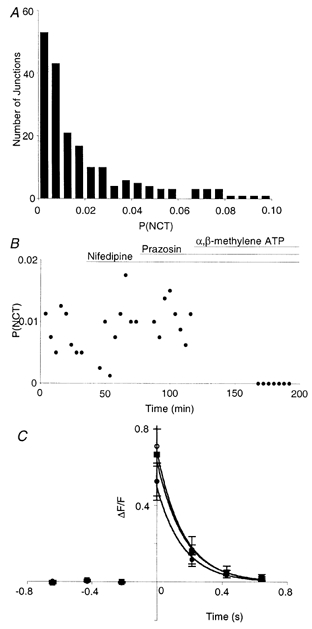
A, NCT probability per junction when stimulated at 1 Hz (np = 13). B, average NCT probability per junction in a single smooth muscle cell as nifedipine (1 μM), then prazosin (100 nm) and finally α,β-methylene ATP (1 μM) were added. Only the latter drug abolished these events, although this took up to 1 h. C, average change in fluorescence signal during NCTs from a single junction (▪; n = 6 NCTs). The time of detection of each NCT was set to 0 s. The temporal resolution of xy-scanning (214 ms) is such that the time of stimulus, the peak of the response, and the time of detection, are synchronous. Nifedipine (○; n = 17) and then prazosin (•; n = 12) had no significant effect on the amplitude.
Figure 3
Figure 3. Line scanning confocal microscopy simultaneously monitors nerve terminal [Ca2+]v and NCTs
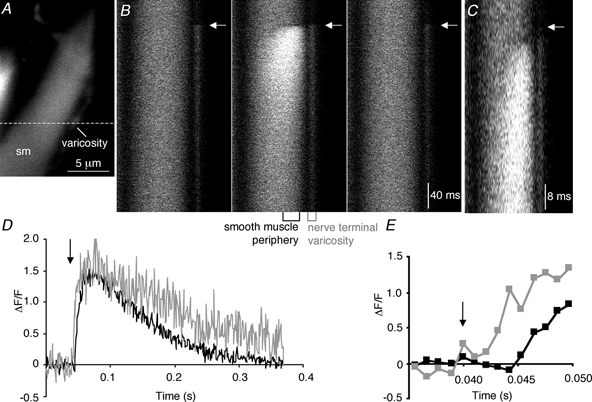
A, xy-scan showing the position (dashed line) of the line scan images through a smooth muscle cell (sm) and an overlying varicosity. B, three consecutive line scan images through the smooth muscle cell and an adjacent nerve terminal varicosity shown in A. The arrow marks the time of the stimulus. The central panel is shown again in C, but with greater temporal resolution around the time of the stimulus. D, quantification of the changes in fluorescence from a region at the right edge of the smooth muscle cell and from the overlying varicosity. E, magnified view, demonstrating that the [Ca2+] in the varicosity rises before that in the smooth muscle cell.
Figure 4
Figure 4. NCTs occur spontaneously at a low frequency
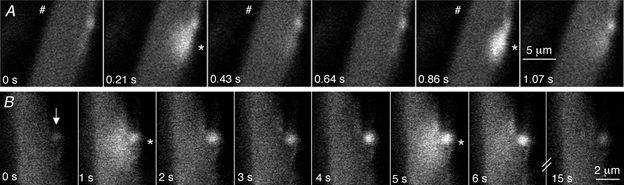
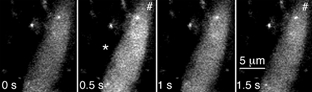
A, spontaneous focal [Ca2+] transients (*) are occasionally recorded (frame 2). These spontaneous focal [Ca2+] transients are similar to evoked NCTs (frame 5), in this case arising adjacent to an indicator-filled varicosity. These images were acquired during a long train of stimuli at high frequency (2.3 Hz), during which the [Ca2+]v accumulated to such an extent that the indicator begins to be saturated and hence the action potential-induced change in [Ca2+]v is not apparent. B, a smooth muscle cell and an adjacent nerve terminal varicosity (arrow) are shown in a series of confocal images. The [Ca2+] in the varicosity rises to a plateau and is associated with spontaneous NCTs at t = 1 and 5 s. Hence spontaneous nerve terminal [Ca2+] transients are sometimes associated with local, spontaneous ATP release.
Figure 5
Figure 5. NCTs from adjacent sites
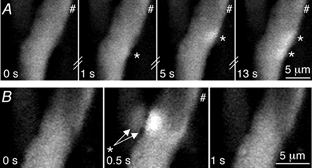
A, selected images of two smooth muscle cells taken during a train of 1 Hz stimuli (#), recorded at a frequency of 2 Hz. NCTs from adjacent regions of the smooth muscle cell (frames 2 and 3) can be resolved, even when they occur synchronously (frame 4). B, the same two adjacent smooth muscle cells in which adjacent regions show simultaneous NCTs (frame 2).
Figure 6
Figure 6. Facilitation and autoinhibition of NCTs
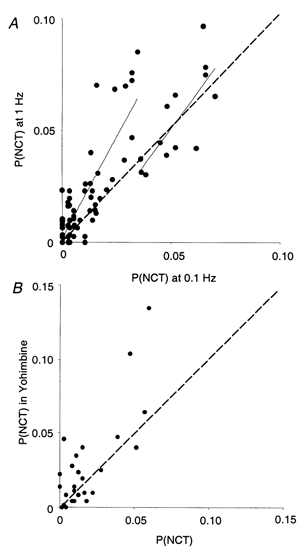
A, NCT probability in response to trains of stimuli at 1 Hz, compared with 0.1 Hz stimulation, in 6 preparations, following more than 200 stimuli with each protocol. Each point represents one neuroeffector junction. The NCT probabilities, when stimulated at 0.1 and 1 Hz, were positively correlated (correlation coefficient 0.84; 95 % confidence interval 0.77 −0.89). Those junctions with a lower initial release probability show more facilitation. The continuous lines are linear curve fits to the data when PNCT < 0.02 at 0.1 Hz, and when PNCT > 0.35 at 0.1 Hz. The dashed line is where the two probabilities are equal. B, in the presence of the α2-antagonist yohimbine (10 μM) during 1 Hz stimulation, however, there is a more uniform elevation in release probability, demonstrating that locally released endogenous NA modulates ATP release from most secretory varicosities. There was a positive correlation between PNCT in the control and in the presence of yohimbine (correlation coefficient 0.87; 95 % confidence interval 0.76-0.93).
Figure 7
Figure 7. Intermittent whole-cell [Ca2+] transients
Whole-cell [Ca2+] increases (*) are intermittently evoked in some smooth muscle cells. These events can be used to detect smooth muscle action potentials.
Figure 8
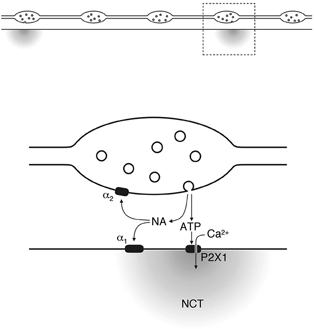
Figure 8. A schematic illustrating the intermittent release of ATP, which generates NCTs
Each nerve terminal action potential invades every varicosity, but a packet of ATP, and presumably NA, is only rarely released. The ATP acts on P2X receptors, triggering the entry of Ca2+. Locally released NA mediates prejunctional autoinhibition.

References

    1. Allcorn RJ, Cunnane TC, Kirkpatrick K. Actions of α,β-methylene ATP and 6-hydroxydopamine on sympathetic neurotransmission in the vas deferens of the guinea-pig, rat and mouse: support for cotransmission. British Journal of Pharmacology. 1986;89:647–659. - PMC - PubMed
    1. Amobi NI, Sugden D, Smith IC. Pharmacomechanical coupling in rat vas deferens: effects of agents that modulate intracellular release of calcium and protein kinase C activation. Life Sciences. 1999;65:145–156. - PubMed
    1. Barden JA, Cottee LJ, Bennett MR. Vesicle-associated proteins and P2X receptor clusters at single sympathetic varicosities in mouse vas deferens. Journal of Neurocytology. 1999;28:469–480. - PubMed
    1. Beattie DT, Cunnane TC, Muir TC. Effects of calcium channel antagonists on action potential conduction and transmitter release in the guinea-pig vas deferens. British Journal of Pharmacology. 1986;89:235–244. - PMC - PubMed
    1. Benham CD, Tsien RW. A novel receptor-operated Ca2+-permeable channel activated by ATP in smooth muscle. Nature. 1987;328:275–278. - PubMed

Publication types

MeSH terms

Substances

LinkOut - more resources