. 2002 Jun;129(2):565-75.
doi: 10.1104/pp.001867.

Regulation of CLV3 expression by two homeobox genes in Arabidopsis

Affiliations

Regulation of CLV3 expression by two homeobox genes in Arabidopsis

Ulrike Brand et al. Plant Physiol. 2002 Jun.

Abstract

The ability of meristems to continuously produce new organs depends on the activity of their stem cell populations, which are located at the meristem tip. In Arabidopsis, the size of the stem cell domain is regulated by two antagonistic activities. The WUS (WUSCHEL) gene, encoding a homeodomain protein, promotes the formation and maintenance of stem cells. These stem cells express CLV3 (CLAVATA3), and signaling of CLV3 through the CLV1/CLV2 receptor complex restricts WUS activity. Homeostasis of the stem cell population may be achieved through feedback regulation, whereby changes in stem cell number result in corresponding changes in CLV3 expression levels, and adjustment of WUS expression via the CLV signal transduction pathway. We have analyzed whether expression of CLV3 is controlled by the activity of WUS or another homeobox gene, STM (SHOOT MERISTEMLESS), which is required for stem cell maintenance. We found that expression of CLV3 depends on WUS function only in the embryonic shoot meristem. At later developmental stages, WUS promotes the level of CLV3 expression, together with STM. Within a meristem, competence to respond to WUS activity by expressing CLV3 is restricted to the meristem apex.


Figures
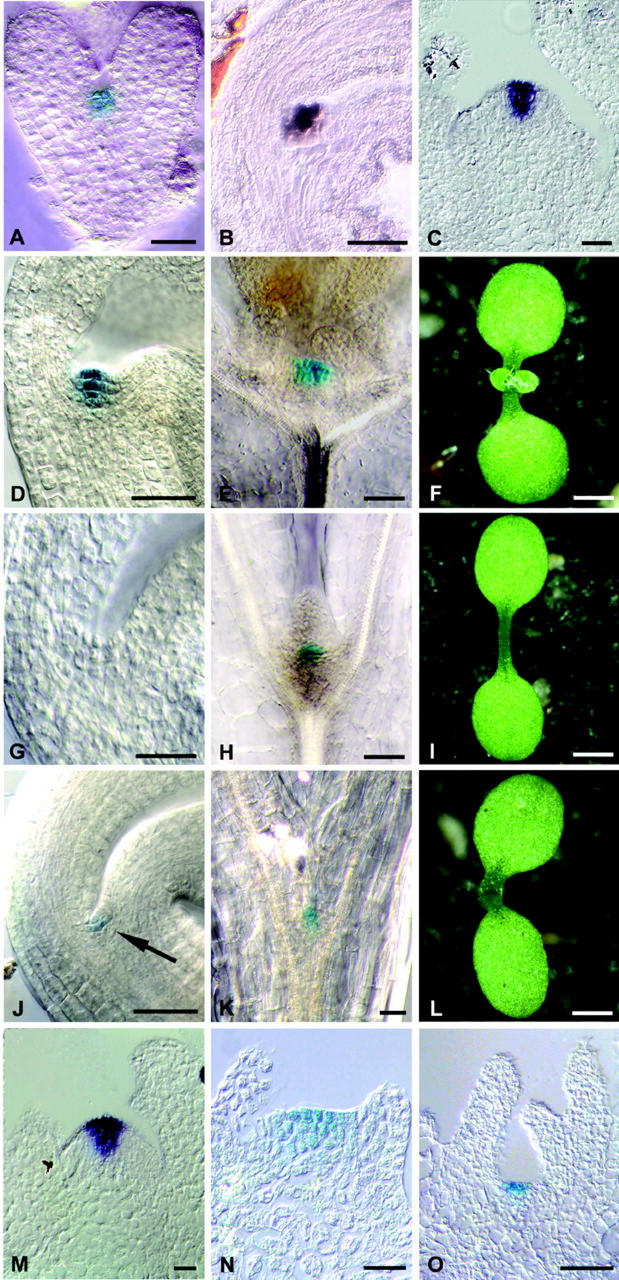
Figure 1
Figure 1
Dependence of CLV3 expression on WUS and STM. A, GUS-stained heart stage CLV3::GUS embryo. B, CLV3 expression in a bent cotyledon stage embryo, detected by in situ hybridization with a CLV3 probe. C, CLV3 expression in a CLV3::GUS inflorescence meristem, detected by in situ hybridization with a GUS probe. D, GUS-stained mature CLV3::GUS embryo; compare with B. E, GUS-stained wild-type seedling 10 d after germination (d.a.g.). F, Wild-type seedling 10 d.a.g. The first leaf pair is visible. G, GUS-stained mature CLV3::GUS/wus-1 embryo. CLV3 expression is not detectable. H, GUS-stained CLV3::GUS/wus-1 seedling 10 d.a.g. I, wus-1 seedling 10 d.a.g. J, GUS-stained mature CLV3::GUS/stm-11 embryo showing CLV3 expression (arrow). K, GUS-stained CLV3::GUS/stm-11 seedling 10 d.a.g. showing CLV3 expression. L, An stm-11 seedling 10 d.a.g. has formed cotyledons, but no SAM is visible. M, Wild-type CLV3::GUS axillary meristem 21 d.a.g. GUS RNA is detected by in situ hybridization. N, GUS-stained CLV3::GUS/wus-1 axillary meristem 21 d.a.g. O, GUS-stained CLV3::GUS/stm-11 axillary meristem 21 d.a.g. Scale bars in F, I, and L = 1 mm; in all other figures, scale bars = 20 μm.
Figure 2
Figure 2
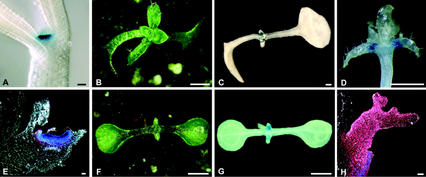
Induction of CLV3 expression by WUS. A, GUS-stained CLV3::GUS/WUS-GR seedling 2 d.a.g., induced with Dex during germination. B, CLV3::GUS/WUS-GR seedling 24 d.a.g., induced with Dex at 4 d.a.g. C, GUS-stained seedling, as in B. D, GUS-stained CLV3::GUS/WUS-GR seedling 28 d.a.g., induced with Dex at 4 d.a.g. The cotyledons have been removed and GUS staining is visible in the leaf axils. E, Longitudinal section through a GUS-stained leaf, as in D; strong GUS expression is found in the apical cell layers of the laterally expanded axillary meristem. F, CLV3::GUS/WUS-GR/STM-GR seedling 24 d.a.g., induced with Dex 4 d.a.g. (compare with B). G, GUS-stained seedling, as in F; GUS expression is found in leaves. H, Section through a GUS-stained primary leaf of G, viewed with dark-field illumination. GUS signal (red) is found in all leaf cells. Scale bars in A, E, and H = 20 μm; in B through D, F, and G, scale bars = 1 mm.
Figure 3
Figure 3
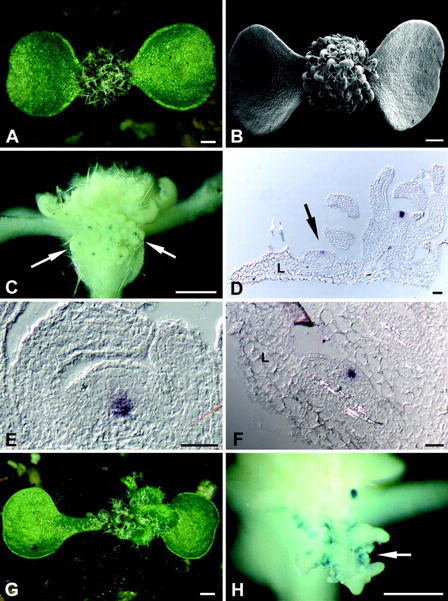
Induction of CLV3 expression by STM. A, STM-GR seedling 24 d.a.g., induced with Dex at 4 d.a.g.; a dense array of leaves with new meristems is formed. B, Scanning electron micrograph of a seedling, as in A. C, GUS-stained CLV3::GUS/STM-GR seedling, as in A; ectopic meristems are initiated on the adaxial leaf surface, GUS signal is found in the center of these meristems (arrow). D, Section through a leaf of a STM-GR seedling, as in A. Expression of CLV3 is detected by RNA in situ hybridization in the central zone of ectopic meristems (arrow). E, Section through the SAM of a STM-GR seedling, as in A. WUS expression, detected by RNA in situ hybridization, is found in the inner regions of the meristem, similar to wild type. F, Section through an axillary meristem of a STM-GR seedling, as in A. The domain of WUS expression resembles the expression in the SAM. E and F, No ectopic expression of WUS is observed. G, CLV3::GUS/STM-GR/wus-1 seedling 24 d.a.g.; Dex induction commenced 7 d.a.g. when the seedlings could be phenotypically identified as wus mutants. H, GUS-stained seedling as in G; GUS signal was detected in ectopic stipules that occasionally formed on the leaf margins (arrow). Note the absence of ectopic meristems. L, Leaf. Scale bars in A through C, G, and H = 500 μm; in D through F, scale bars = 20 μm.
Figure 4
Figure 4
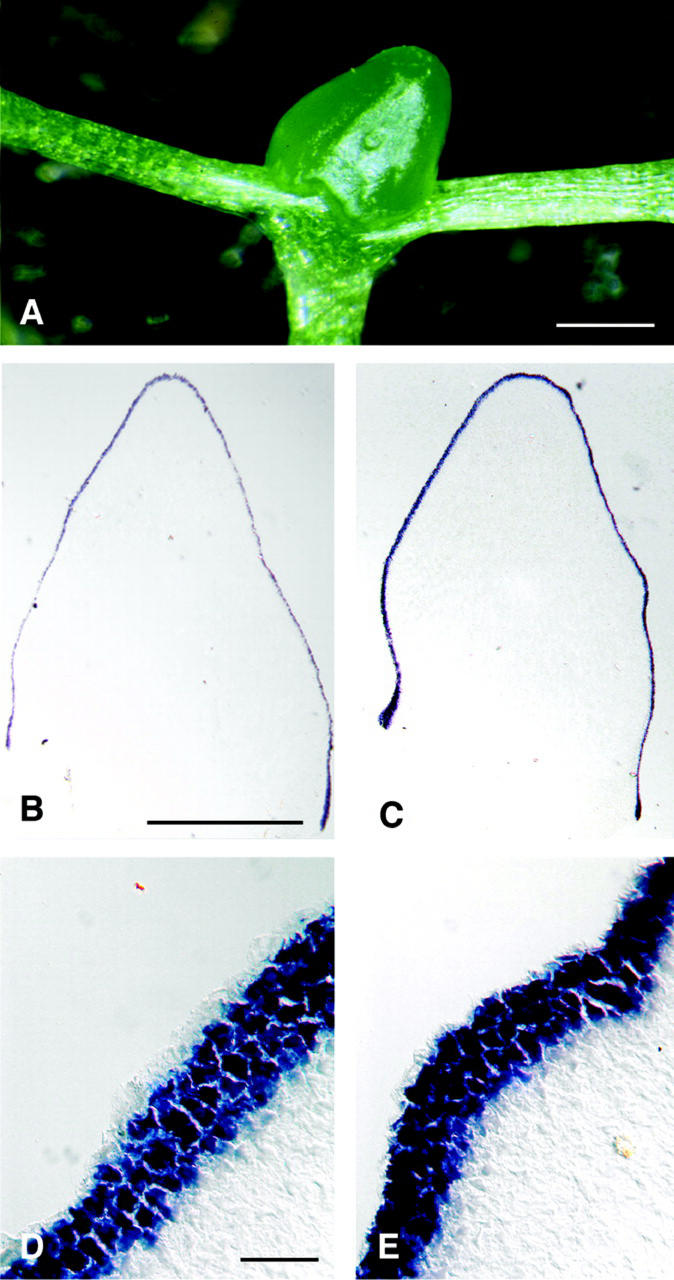
Cell-autonomous induction of CLV3 by WUS in the stem cell domain. A, CLV3::WUS seedling 28 d.a.g.; a large apical dome is formed between the cotyledons, but organs are missing. B, In situ detection of WUS RNA in sections through the apical dome of a CLV3::WUS seedling. WUS RNA is found only in three apical cell layers, but not in the deeper regions of the meristem. D, High magnification view of the outer cell layers in B. C, As in B, but detection of CLV3 RNA. CLV3 and WUS are expressed in the same cells. E, High magnification of C. Scale bars in A and B = 500 μm; scale bars in D = 10 μm.

References

    1. Barton MK, Poethig RS. Formation of the shoot apical meristem in Arabidopsis thaliana: an analysis of development in the wildtype and in the shoot meristemless mutant. Development. 1993;119:823–831.
    1. Brand U, Fletcher JC, Hobe M, Meyerowitz EM, Simon R. Dependence of stem cell fate in Arabidopsis on a feedback loop regulated by CLV3 activity. Science. 2000;289:617–619. - PubMed
    1. Chuck G, Lincoln C, Hake S. KNAT1 induces lobed leaves with ectopic meristems when overexpressed in Arabidopsis. Plant Cell. 1996;8:1277–1289. - PMC - PubMed
    1. Clough SJ, Bent AF. Floral dip: a simplified method for Agrobacterium-mediated transformation of Arabidopsis thaliana. Plant J. 1998;16:735–743. - PubMed
    1. Endrizzi K, Moussian B, Haecker A, Levin JZ, Laux T. The SHOOT MERISTEMLESS gene is required for maintenance of undifferentiated cells in Arabidopsis shoot and floral meristems and acts at a different regulatory level than the meristem genes WUSCHEL and ZWILLE. Plant J. 1996;10:967–979. - PubMed

Publication types

MeSH terms