. 2002 Jun;129(2):625-37.
doi: 10.1104/pp.001842.

Metabolic and environmental regulation of 3-methylcrotonyl-coenzyme A carboxylase expression in Arabidopsis

Affiliations

Metabolic and environmental regulation of 3-methylcrotonyl-coenzyme A carboxylase expression in Arabidopsis

Ping Che et al. Plant Physiol. 2002 Jun.

Abstract

3-Methylcrotonyl-coenzyme A carboxylase (MCCase) is a nuclear-encoded, mitochondrial biotin-containing enzyme composed of two types of subunits: the biotinylated MCC-A subunit (encoded by the gene At1g03090) and the non-biotinylated MCC-B subunit (encoded by the gene At4g34030). The major metabolic role of MCCase is in the mitochondrial catabolism of leucine, and it also might function in the catabolism of isoprenoids and the mevalonate shunt. In the work presented herein, the single-copy gene encoding the Arabidopsis MCC-A subunit was isolated and characterized. It contains 15 exons separated by 14 introns. We examined the expression of the single-copy MCC-A and MCC-B genes in Arabidopsis by monitoring the accumulation of the two protein and mRNA products. In addition, the expression of these two genes was studied in transgenic plants containing the 1.1- and 1.0-kb 5' upstream sequences of the two MCCase subunit genes, respectively, fused to the beta-glucuronidase gene. Light deprivation induces MCCase expression, which is suppressed by exogenous carbohydrates, especially sucrose. Several lines of evidence indicate that the suppressor of MCCase expression is synthesized in illuminated photosynthetic organs, and can be translocated to other organs to regulate MCCase expression. These results are consistent with the hypothesis that the suppressor of MCCase expression is a carbohydrate, perhaps sucrose or a carbohydrate metabolite. We conclude that MCCase expression is primarily controlled at the level of gene transcription and regulated by a complex interplay between environmental and metabolic signals. The observed expression patterns may indicate that one of the physiological roles of MCCase is to maintain the carbon status of the organism, possibly via the catabolism of leucine.


Figures
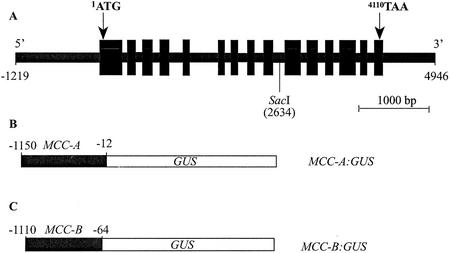
Figure 1
Figure 1
A, Schematic representation of the structure of the MCC-A gene of Arabidopsis. Black boxes represent the 15 exons, and introns are indicated by the solid black lines that join them. Positions of the translation start codon (1ATG) and stop codon (4110TAA) and the unique SacI site are indicated. B, Schematic representation of the MCC-A:GUS transgene, which is composed of the 1.1-kb promoter region (−1,150 to −12) of the MCC-A gene fused to the GUS reporter gene. C, Schematic representation of MCC-B:GUS transgene, which is composed of the 1.0-kb promoter region (−1,110 to −64) of the MCC-B gene fused to the GUS reporter gene.
Figure 2
Figure 2
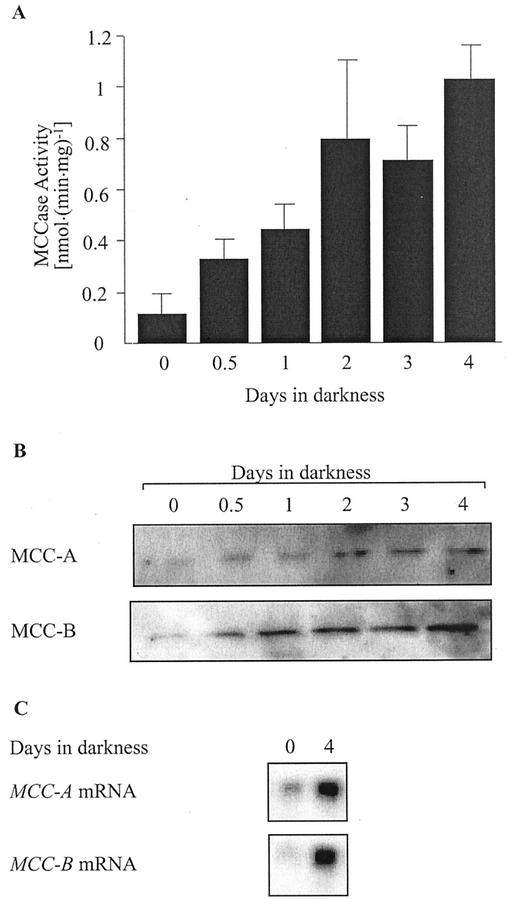
Effect of light deprivation on MCCase expression. A, Changes in MCCase activity in 10-d-old Arabidopsis seedlings, which were initially grown under constant illumination and then transferred to darkness for the indicated time period. The data presented are means ± se from three replicates. B, Western-blot analysis of MCC-A and MCC-B accumulation in Arabidopsis, which were initially grown under constant illumination and then transferred to darkness for the indicated time period. Proteins were extracted from the samples and aliquots containing equal amounts of protein were fractionated by SDS-PAGE, followed by western-blot analysis with antiserum against MCC-A or MCC-B. C, Northern-blot analysis of MCC-A and MCC-B mRNA abundance in 10-d-old Arabidopsis seedlings, which were initially grown under constant illumination and then transferred to darkness for 4 d. Equal amounts of RNA (30 μg) isolated from each sample were fractionated by electrophoresis in a formaldehyde-containing agarose gel. The data presented in B and C were gathered from a single experiment; three replicates of this experiment gave similar results.
Figure 3
Figure 3
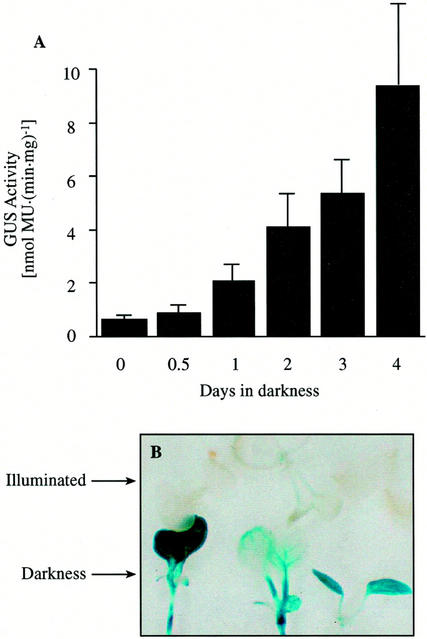
Effect of light deprivation on MCC-A promoter-mediated GUS expression. A, GUS activity in 10-d-old MCC-A:GUS transgenic Arabidopsis seedlings, which were initially grown under constant illumination and then transferred to darkness for the indicated time period. The data are means ± se from three replicates using three independent transgenic lines. B, Histochemical localization of MCC-A:GUS expression in transgenic Arabidopsis plants. GUS activity is indicated by the indigo blue precipitate that accumulates after staining with X-Gluc. Seedlings carrying the MCC-A:GUS transgene were grown in continuous light for 5.5 d; one-half of the seedlings were then moved into darkness. GUS expression was stained 8 d after planting. The upper three seedlings (from three independent transgenic lines) were in continues illumination and the lower three seedlings (from same three independent transgenic lines) were in darkness for the last 60 h before staining.
Figure 4
Figure 4
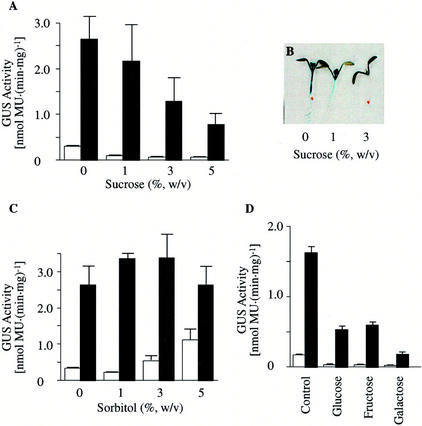
The effect of illumination and carbohydrates on MCC-A promoter-mediated GUS expression. MCC-A:GUS transgenic Arabidopsis seedlings were grown for 8 d on Murashige and Skoog medium containing the indicated concentration of Suc (A), sorbitol (C), and 1.5% (w/v) of the indicated monosaccharides (D). Seedlings were grown either under continuous illumination (□) or transferred to darkness for the last 2 d of growth (■), and GUS activity was determined in protein extracts. The bars represent the mean ± se from three replicates using three independent transgenic lines. B, Histochemical staining of GUS activity in 8-d-old MCC-A:GUS transgenic Arabidopsis plants that were maintained in darkness for the last 2 d of growth. Seedlings were grown in Murashige and Skoog agar medium containing the indicated concentration of Suc.
Figure 5
Figure 5
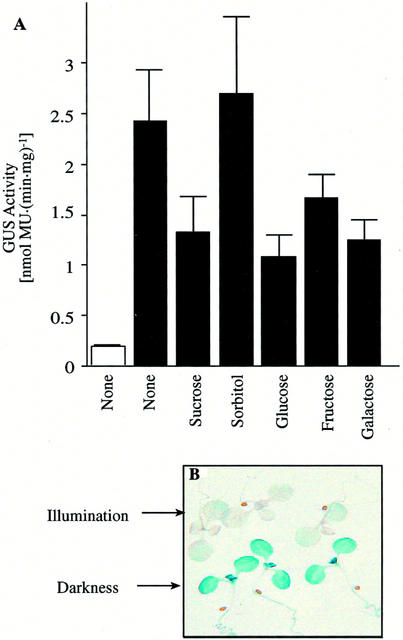
Interaction between illumination and sugars on the regulation of MCC-B promoter-mediated GUS activity. A, MCC-B:GUS transgenic Arabidopsis seedlings were grown for 8 d on Murashige and Skoog medium containing either 3% (w/v) Suc or 1.5% (w/v) of the indicated monosaccharide or sorbitol. Seedlings were grown under continuous illumination (□) or transferred to darkness for the last 2 d of growth (■). GUS activity was determined in protein extracts. The bars represent the mean ± se from three replicates using three independent transgenic lines. B, Histochemical staining of GUS activity in seedlings carrying the MCC-B:GUS transgene. Seedlings were grown in continuous light for 6 d, and then one-half the seedlings were moved into darkness. GUS activity was stained on the 8th d after planting. Upper seedlings (from three independent transgenic lines) were grown under continuous illumination, and the lower seedlings (from same three independent transgenic lines) had been transferred to darkness for the last 2 d of growth.
Figure 6
Figure 6
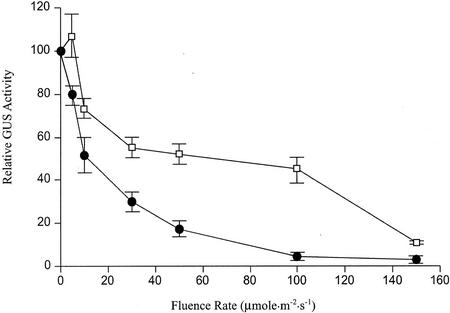
Effect of fluence rate on the transcription of the MCCase subunit genes. MCC-A:GUS (□) and MCC-B:GUS (●) transgenic Arabidopsis seedlings were grown on 1× Murashige and Skoog media under normal illumination levels (150 μmol m−2 s−1) for the first 6 d after planting. Seedlings were then transferred to the indicated light irradiance levels for an additional 2 d of growth. GUS activity was measured in 8-d-old seedlings. GUS activity is expressed as the percentage of that obtained from seedlings grown in darkness. In seedlings transferred to total darkness, MCC-A:GUS and MCC-B:GUS activities were 5.8 ± 0.23 nmol 4-methylumbelliferom (min mg)−1 and 1.83 ± 0.68 nmol 4-methylumbelliferom (min mg)−1, respectively. The data presented here are means ± se from three replicates using three independent transgenic lines.
Figure 7
Figure 7
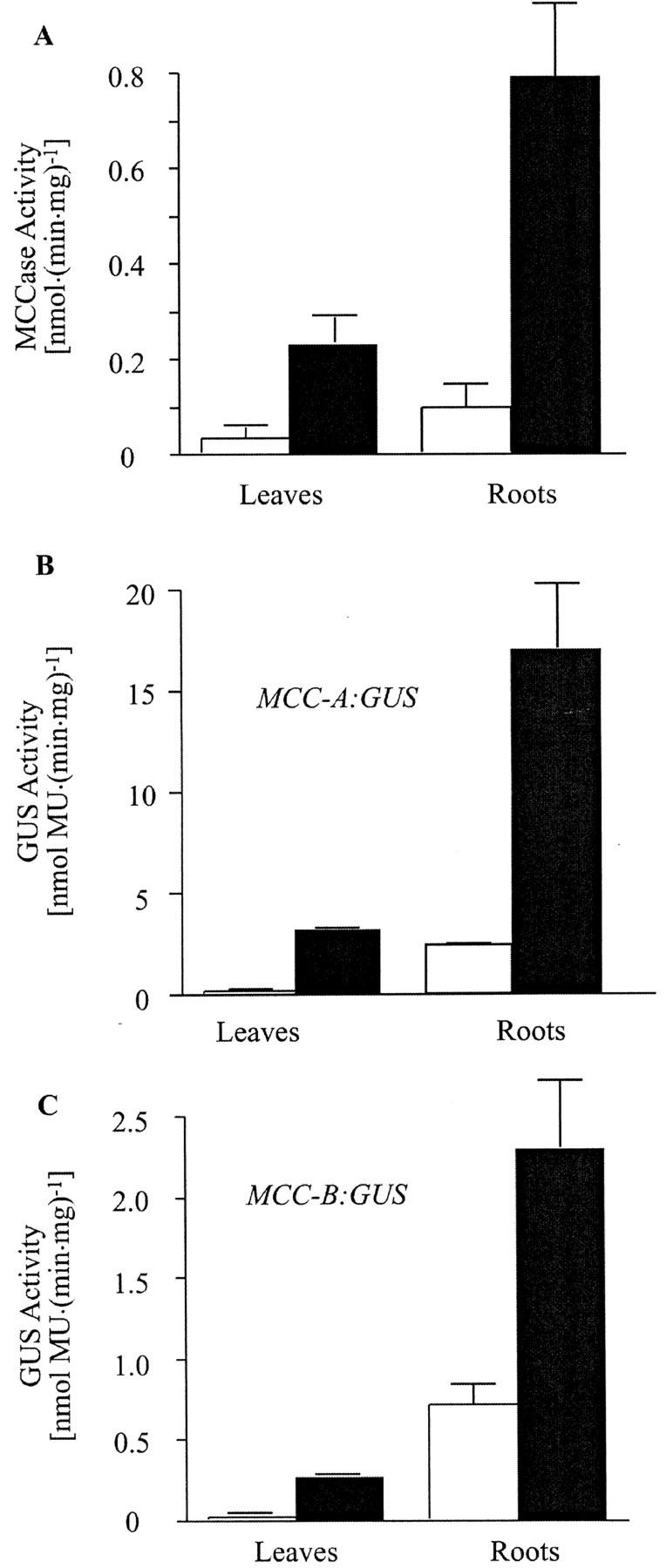
The illumination status of seedlings affects the expression of MCCase in roots and leaves. Arabidopsis seedlings (wild-type [A], MCC-A:GUS [B], or MCC-B:GUS [C] transgenic lines) were grown in soil under constant illumination for 21 d (□) or under constant illumination for 19 d and then transferred to darkness for an additional 2 d of growth (■). MCCase (A) and GUS (B and C) activities were determined in protein extracts prepared from leaves and roots. The data in A are means ± se from three replicates. In B and C, the data are means ± se from three replicates using three independent transgenic lines.
Figure 8
Figure 8
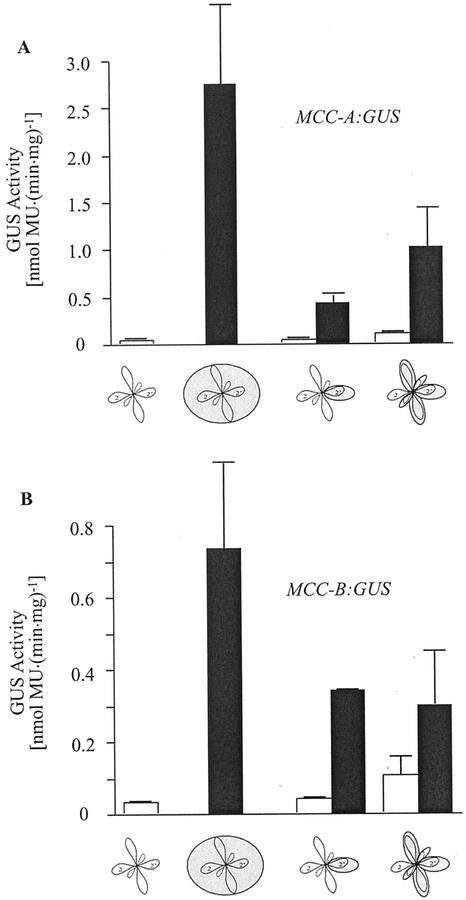
Intraleaf communication of the illumination status of the seedling affects MCCase expression. MCC-A:GUS (A) and MCC-B:GUS (B) transgenic Arabidopsis plants were grown under constant illumination for 19 d. Then, the indicated subset of leaves was shaded by wrapping them in aluminum foil, and seedlings were grown for an additional 2-d period. GUS activity was determined in protein extracts prepared from shaded (formula image) or illuminated (□) second pair of leaves. The data are means ± se from three replicates using three independent transgenic lines.
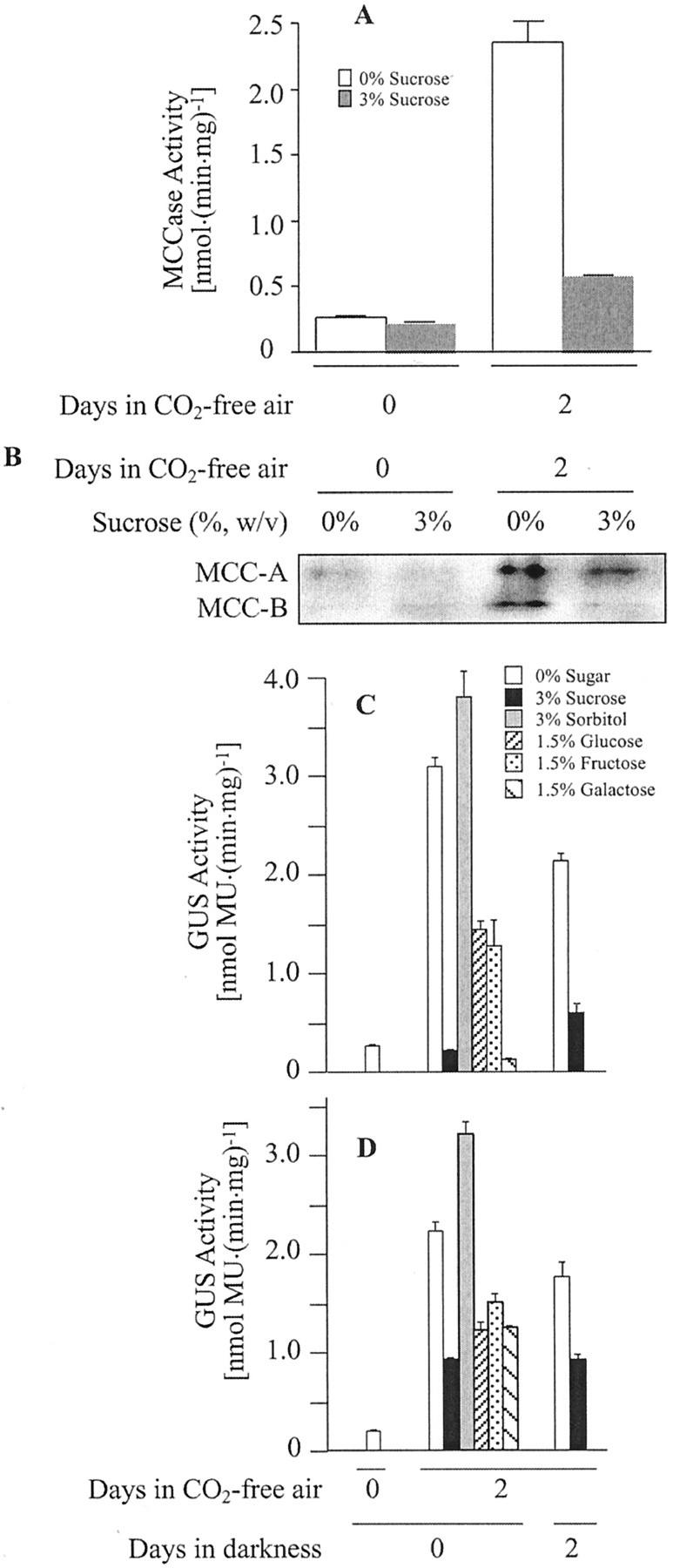
Figure 9
Figure 9
The effect of limiting atmospheric CO2 on MCCase expression. Arabidopsis seedlings (wild-type [A and B], MCC-A:GUS [C], and MCC-B:GUS [D] transgenic lines) were grown on Murashige and Skoog-agar medium supplemented with the indicated carbohydrates (%, w/v). Seedlings were grown in either a normal atmosphere for 8 d under continuous illumination or in a normal atmosphere for the first 6 d of growth followed by 2 d of growth in a CO2-free atmosphere either under continuous illumination or in darkness. MCCase (A) and GUS (C and D) activities were determined in protein extracts prepared from these seedlings. The accumulation of the MCC-A and MCC-B subunits was detected by western analysis of protein extracts (B). The data in A are means ± se from three replicates. The data in B were gathered from a single experiment; three replicates of this experiment gave similar results. The data in C and D are means ± se from three replicates using three independent transgenic lines.
Figure 10
Figure 10
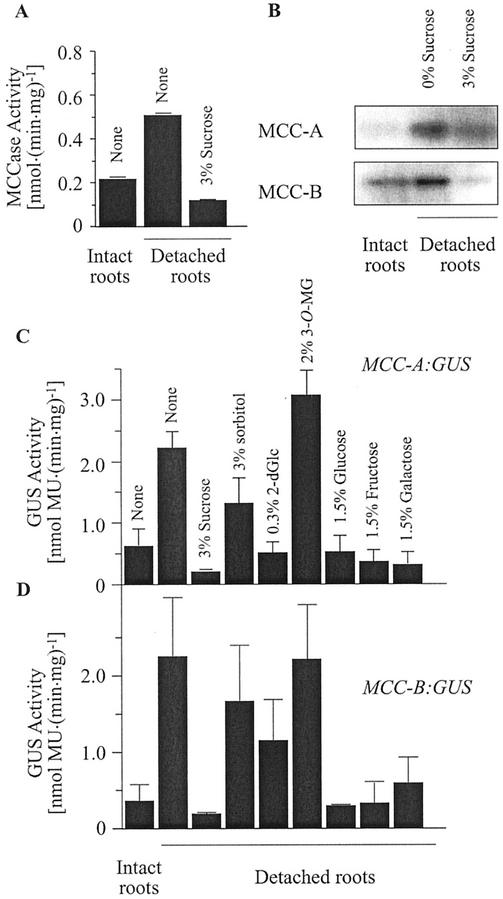
Regulation of MCCase expression in detached roots. Roots were detached from the aerial portions of 14-d-old wild-type (A and B) or MCC-A:GUS (C) and MCC-B:GUS (D) transgenic Arabidopsis seedlings and incubated for 1 d in Murashige and Skoog media containing the indicated sugars (%, w/v). MCCase (A) and GUS (C and D) activities were determined in protein extracts. The accumulation of the MCC-A and MCC-B subunits was determined by western-blot analysis (B). The data in A are means ± se from three replicates. The data in B were gathered from a signal experiment; three replicates of this experiment gave similar results. The data in C and D are means ± se from three replicates using three independent transgenic lines.

References

    1. Alban C, Baldet P, Axiotis S, Douce R. Purification and characterization of 3-methylcrotonyl-CoA carboxylase from higher plant mitochondria. Plant Physiol. 1993;102:957–965. - PMC - PubMed
    1. Anderson MD, Che P, Song J, Nikolau BJ, Wurtele ES. 3-Methylcrotonyl-coenzyme A carboxylase is a component of the mitochondrial leucine catabolic pathway in plant. Plant Physiol. 1998;118:1127–1138. - PMC - PubMed
    1. Aubert S, Alban C, Bligny R, Douce R. Induction of beta-methylcrotonyl-coenzyme A carboxylase in higher plant cells during carbohydrate starvation: evidence for a role of MCCase in leucine catabolism. FEBS Lett. 1996;383:175–180. - PubMed
    1. Bach T. Synthesis and metabolism of mevalonic in plants. Plant Physiol Biochem. 1987;25:163–178.
    1. Bach T. Some new aspects of isoprenoid biosynthesis in plants: a review. Lipid. 1995;30:191–202. - PubMed

Publication types

MeSH terms

LinkOut - more resources