Comparative Study
. 2002 Jun;129(2):838-53.
doi: 10.1104/pp.001362.

Heat stress- and heat shock transcription factor-dependent expression and activity of ascorbate peroxidase in Arabidopsis

Affiliations
Comparative Study

Heat stress- and heat shock transcription factor-dependent expression and activity of ascorbate peroxidase in Arabidopsis

Irina I Panchuk et al. Plant Physiol. 2002 Jun.

Abstract

To find evidence for a connection between heat stress response, oxidative stress, and common stress tolerance, we studied the effects of elevated growth temperatures and heat stress on the activity and expression of ascorbate peroxidase (APX). We compared wild-type Arabidopsis with transgenic plants overexpressing heat shock transcription factor 3 (HSF3), which synthesize heat shock proteins and are improved in basal thermotolerance. Following heat stress, APX activity was positively affected in transgenic plants and correlated with a new thermostable isoform, APX(S). This enzyme was present in addition to thermolabile cytosolic APX1, the prevalent isoform in unstressed cells. In HSF3-transgenic plants, APX(S) activity was detectable at normal temperature and persisted after severe heat stress at 44 degrees C. In nontransgenic plants, APX(S) was undetectable at normal temperature, but could be induced by moderate heat stress. The mRNA expression profiles of known and three new Apx genes were determined using real-time PCR. Apx1 and Apx2 genes encoding cytosolic APX were heat stress and HSF dependently expressed, but only the representations of Apx2 mRNA met the criteria that suggest identity between APX(S) and APX2: not expressed at normal temperature in wild type, strong induction by heat stress, and HSF3-dependent expression in transgenic plants. Our data suggest that Apx2 is a novel heat shock gene and that the enzymatic activity of APX2/APX(S) is required to compensate heat stress-dependent decline of APX1 activity in the cytosol. The functional roles of modulations of APX expression and the interdependence of heat stress and oxidative stress response and signaling mechanisms are discussed.


Figures
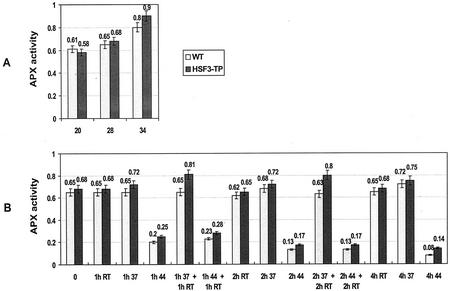
Figure 1
Figure 1
Total soluble APX activities in leaves of WT and HSF3-transgenic plants (HSF3-TP) of Arabidopsis. A, After cultivation at elevated temperatures as indicated. B, After short-term heat treatments at 37°C (37) or 44°C (44) of plants precultivated at 28°C; RT, Incubation at room temperature; 0, control of fresh leaves without treatment. APX activity is expressed as micromoles of AsA oxidized per minute per milligram of protein; bars show means ± sd (n = 4).
Figure 2
Figure 2
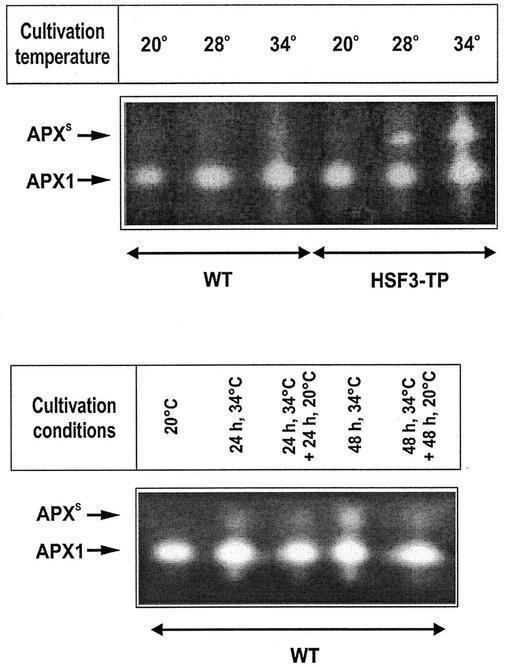
APX isoenzyme activities in WT and HSF3-transgenic plants (HSF3-TP). Total protein extracts of leaves from plants cultivated at different temperatures and times as indicated were subjected to native PAGE followed by activity staining for APX according to Mittler and Zilinskas (1993). APXS, New slow-migrating APX isoform appearing after cultivation at elevated temperatures.
Figure 3
Figure 3
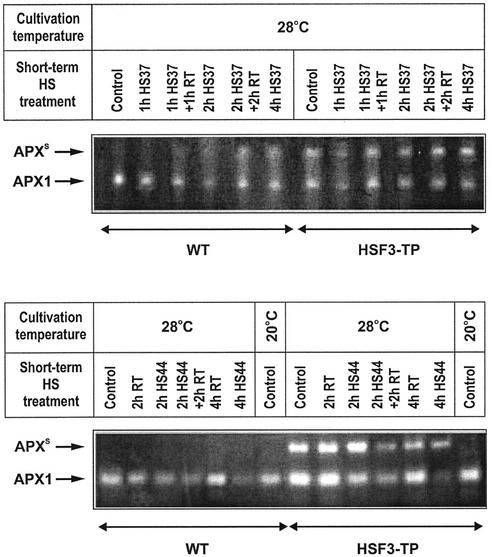
Effects of short-term heat shock (HS) treatments at different temperatures on APX1 and APXS activities in leaves of WT and HSF3-transgenic plants (HSF3-TP). Plant were precultivated at 28°C or 20°C as indicated. Heat stress treatments were at 37°C (HS37) or 44°C (HS44). RT, Incubation at room temperature; Control, fresh leaves without treatments.
Figure 4
Figure 4
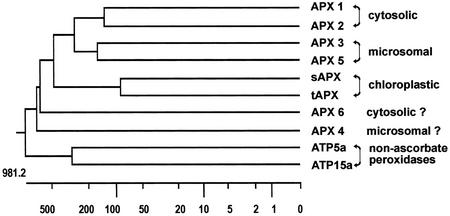
Protein sequences relationships within the APX family of Arabidopsis. Dendrogram was constructed applying J. Hein method with PAM250 residue weight table; presumptive N- and C-terminal signals, specific for proteins with different subcellular localization, were omitted. Protein sequences of non-APXs, ATP5a (X98809) and ATP15a (X99097), were used as outgroups.
Figure 5
Figure 5
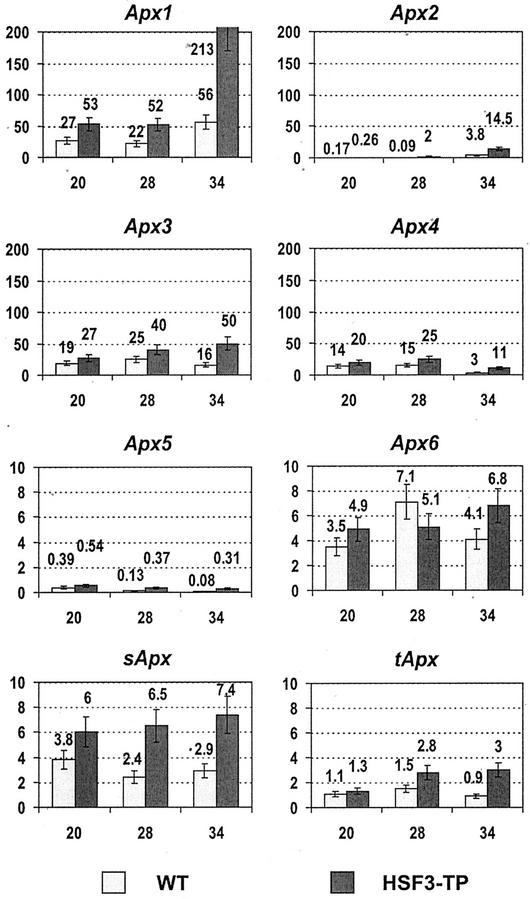
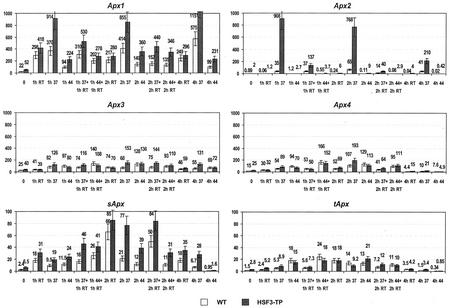
mRNA level for different Apx genes in leaves of WT and HSF3-transgenic plants (HSF3-TP) of Arabidopsis after cultivation at elevated temperatures. Poly(A)+-RNA was isolated from leaves, converted to cDNA, and subjected to real-time PCR. Relative amounts were calculated and normalized with respect to Act2 mRNA (=100%). Bars show means ± sd (n = 4–6). Note: Two different scales are used in graphs.
Figure 6
Figure 6
mRNA level for different Apx genes in leaves of WT and HSF3-transgenic plants (HSF3-TP) of Arabidopsis after short-term heat treatments at 37°C (37) or 44°C (44) of plants precultivated at 28°C. RT, Incubation at room temperature; 0, control of fresh leaves without treatment. Poly(A)+-mRNA was isolated from leaves, converted to cDNA, and subjected to real-time PCR. Relative amounts were calculated and normalized with respect to Act2 mRNA (=100%). Bars show means ± sd (n = 4–6). Note: Two different scales are used in graphs.
Figure 7
Figure 7
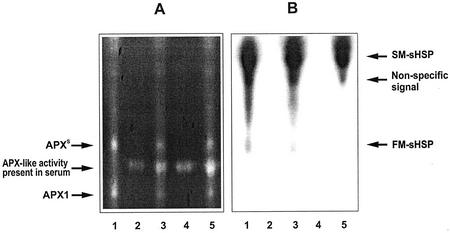
APXS isoenzyme activity in immunodepleted extracts of leaves from HSF3-transgenic plants of Arabidopsis. A, APX gel activity staining; B, western detection of sHSP. Lane 1, Protein extracts (control); lane 2, preimmune serum; lane 3, protein extracts, depleted by preimmune serum; lane 4, anti-sHSP antiserum; lane 5, protein extracts, depleted by anti-sHSP antiserum. SM-sHSP, Slow-migrating sHSP band.
Figure 8
Figure 8
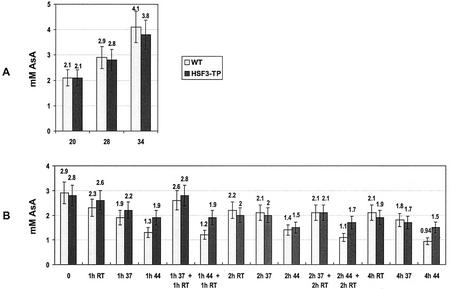
AsA content in leaves of WT and HSF3-transgenic plants (HSF3-TP) of Arabidopsis. A, After cultivation at elevated temperatures; B, after short-term heat treatments at 37°C (37) or 44°C (44) of plants precultivated at 28°C. RT, Incubation at room temperature; 0, control of fresh leaves without treatment. Bars show means ± sd (n = 4).

References

    1. Altschul SF, Madden TL, Schäffer AA, Zhang J, Zhang Z, Miller W, Lipman D. Gapped BLAST and PSI-BLAST: a new generation of protein database search programs. Nucleic Acids Res. 1997;25:3389–3402. - PMC - PubMed
    1. Amako K, Chen G, Asada K. Separate assays for ascorbate peroxidase and guaiacol peroxidase and for the chloroplastic and cytosolic isozymes of ascorbate peroxidase in plants. Plant Cell Physiol. 1994;35:497–504.
    1. An Y-Q, McDowell JM, Huang S, McKinney EC, Chambliss S, Meagher RB. Strong, constitutive expression of the Arabidopsis ACT2/ACT8 actin subclass in vegetative tissues. Plant J. 1996;10:107–121. - PubMed
    1. Banzet N, Richaud C, Deveaux Y, Kazmaier M, Gagnon J, Triantaphlides C. Accumulation of small heat shock proteins, including mitochondrial HSP22, induced by oxidative stress and adaptive response in tomato cells. Plant J. 1998;13:519–527. - PubMed
    1. Barros MD, Czarnecka E, Gurley WB. Mutational analysis of a plant heat shock element. Plant Mol Biol. 1992;19:665–675. - PubMed

Publication types

MeSH terms