Comparative Study
. 2002 Jul;46(7):2095-103.
doi: 10.1128/AAC.46.7.2095-2103.2002.

Comparative intracellular (THP-1 macrophage) and extracellular activities of beta-lactams, azithromycin, gentamicin, and fluoroquinolones against Listeria monocytogenes at clinically relevant concentrations

Affiliations
Comparative Study

Comparative intracellular (THP-1 macrophage) and extracellular activities of beta-lactams, azithromycin, gentamicin, and fluoroquinolones against Listeria monocytogenes at clinically relevant concentrations

Stéphane Carryn et al. Antimicrob Agents Chemother. 2002 Jul.

Abstract

The activities of ampicillin, meropenem, azithromycin, gentamicin, ciprofloxacin, and moxifloxacin against intracellular hemolysin-positive Listeria monocytogenes were measured in human THP-1 macrophages and were compared with the extracellular activities observed in broth. All extracellular concentrations were adjusted to explore ranges that are clinically achievable in human serum upon conventional therapy. In broth, ampicillin, meropenem, and azithromycin were only bacteriostatic, whereas gentamicin, ciprofloxacin, and moxifloxacin were strongly bactericidal in a concentration-dependent manner. In cells, ampicillin, meropenem, azithromycin, and ciprofloxacin were slightly bactericidal (0.3- to 0.8-log CFU reductions), moxifloxacin was strongly bactericidal (2.1-log CFU reduction), and gentamicin was virtually inactive. The difference in the efficacies of moxifloxacin and ciprofloxacin in cells did not result from a difference in levels of accumulation in cells (6.96 +/- 1.05 versus 7.75 +/- 1.03) and was only partially explainable by the difference in the MICs (0.58 +/- 0.04 versus 1.40 +/- 0.17 mg/liter). Further analysis showed that intracellular moxifloxacin expressed only approximately 1/7 of the activity demonstrated against extracellular bacteria and ciprofloxacin expressed only 1/15 of the activity demonstrated against extracellular bacteria. Gentamicin did not increase the intracellular activities of the other antibiotics tested. The data suggest (i) that moxifloxacin could be of potential interest for eradication of the intracellular forms of L. monocytogenes, (ii) that the cellular accumulation of an antibiotic is not the only determinant of its intracellular activity (for fluoroquinolones, it is actually a self-defeating process as far as activity is concerned), and (iii) that pharmacodynamics (activity-to-concentration relationships) need to be considered for the establishment of efficacy against intracellular bacteria, just as they are for the establishment of efficacy against extracellular infections.


Figures
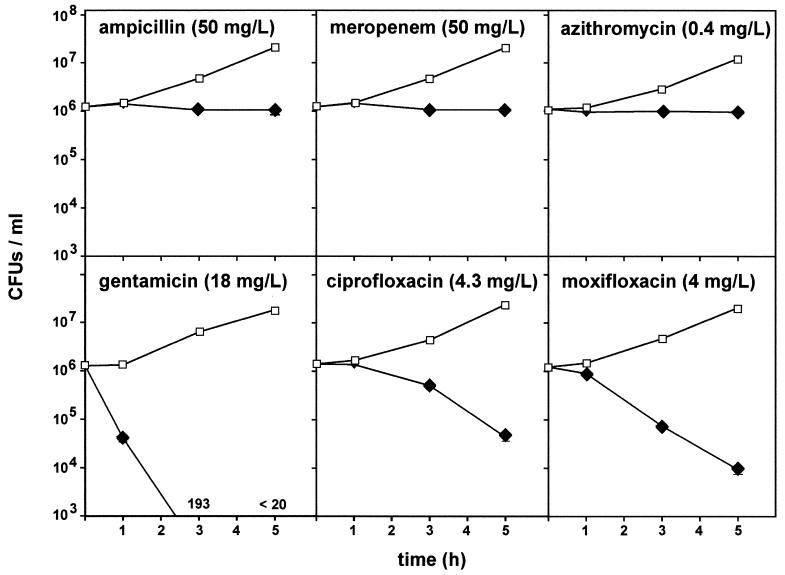
FIG. 1.
FIG. 1.
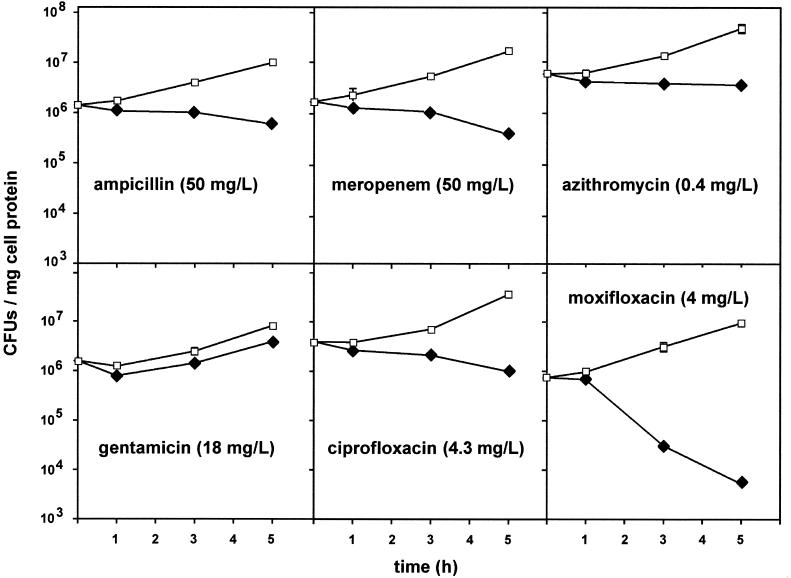
Influences of antibiotics on L. monocytogenes survival (numbers of CFU) in broth upon incubation at a fixed drug concentration for up to 5 h. Closed diamonds, test antibiotics; open squares, controls (to which no antibiotic was added). Values are given as arithmetic means ± standard deviations (n = 3), but most of the corresponding error bars are smaller than the symbols. The values at the bottom of the panel for gentamicin show the number of CFU recorded at the corresponding times.
FIG. 2.
FIG. 2.
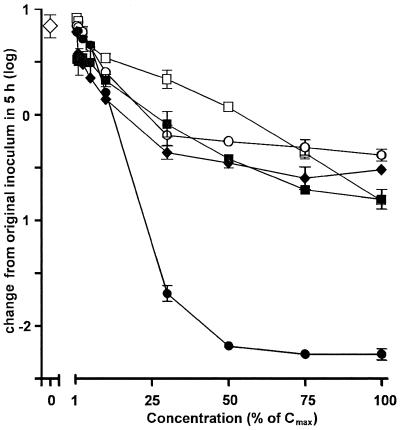
Influences of antibiotics on L. monocytogenes survival (numbers of CFU) in broth upon incubation for a fixed period of 5 h with increasing concentrations of antibiotics (as a percentage of their corresponding Cmaxs [Table 2]). Large open diamond, value observed in controls (no antibiotic was added); closed diamonds, ampicillin (Cmax, 50 mg/liter); closed squares, meropenem (Cmax, 50 mg/liter); open circles, azithromycin (Cmax, 0.4 mg/liter); open squares, ciprofloxacin (Cmax, 4.3 mg/liter); closed circles, moxifloxacin (Cmax, 4 mg/liter). Values are given as arithmetic means ± standard deviations (n = 3), but some of the corresponding error bars are smaller than the symbols.
FIG. 3.
FIG. 3.
Influences of antibiotics on the survival of L. monocytogenes (numbers of CFU) phagocytosed by THP-1 macrophages upon subsequent incubation of cells in the presence of a fixed extracellular drug concentration Closed diamonds, test antibiotics; open squares, controls (to which no antibiotic was added). Values are given as the arithmetic the mean ± standard deviation (n = 3) number of CFU per milligram of protein, but most of the corresponding error bars are smaller than the symbols.
FIG. 4.
FIG. 4.
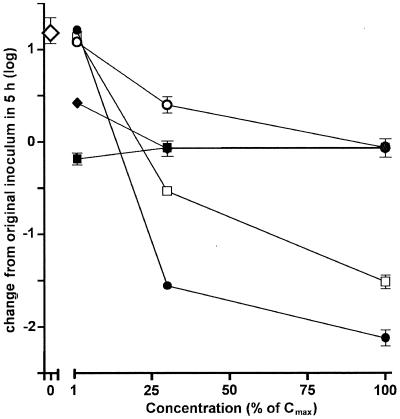
Influences of antibiotics on the survival of L. monocytogenes (numbers of CFU) phagocytosed by THP-1 macrophages upon a subsequent incubation for 5 h at increasing drug Ce (as a percentage of their corresponding Cmax [Table 2]). Large open diamond, value observed in controls (no antibiotic); closed diamonds, ampicillin (Cmax, 50 mg/liter); closed squares, meropenem (Cmax, 50 mg/liter); open circles, azithromycin (Cmax, 0.4 mg/liter); open squares, ciprofloxacin (Cmax, 4.3 mg/liter); closed circles, moxifloxacin (Cmax, 4 mg/liter). Values are given as the arithmetic mean ± standard deviation (n = 3) number of CFU per milligram of protein.
FIG. 5.
FIG. 5.
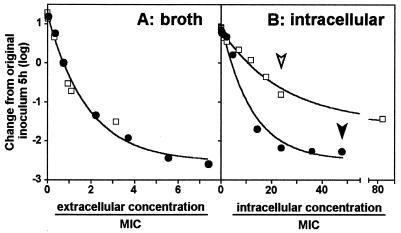
Comparative extracellular (A) and intracellular (B) activities of ciprofloxacin (open squares) and moxifloxacin (closed circles) as a function of the concentration. Experiments were conducted as described in the legends to Fig. 2 and 4, except that a higher concentration of ciprofloxacin was used to achieve a maximal effect against intracellular bacteria. (A) The values on the abscissa indicate the actual drug concentration in broth; (B) the values on the abscissa indicate the calculated Cc (based on the accumulation data shown in Table 3). All values on the abscissas have been normalized with respect to the MIC of the corresponding drug in broth (A) or in the macrophage culture medium (B). Curves were generated by fitting one-phase exponential decay equations to the data (A, R2 = 0.9875; B, R2 = 0.9793 and 0.9858 for ciprofloxacin and moxifloxacin, respectively). The open and closed arrowheads in panel B indicate the Cc/MIC ratio reached at the Cmax of ciprofloxacin and moxifloxacin used in all other experiments, respectively.
FIG. 6.
FIG. 6.
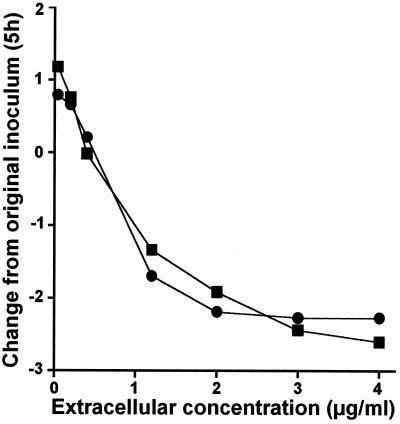
Combined data for moxifloxacin from Fig. 2 and 4. The values on the abscissa indicate the actual drug concentration in broth or the macrophage culture fluid. The values on the ordinate indicate the variations in the numbers of CFU per milliliter of broth (closed squares) or per milligram of cell protein (closed circles) after 5 h of incubation. Statistical analysis (analysis of covariance) shows that there were no significant difference between the two sets of data (P = 0.6457).
FIG. 7.
FIG. 7.
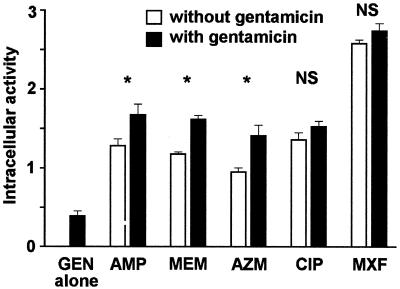
Influence of gentamicin on the activities of antibiotics against intracellular L. monocytogenes. The cells were incubated for 5 h with the Ce of gentamicin and concentrations of the other antibiotics corresponding to their Cmax, as follows: gentamicin (GEN), Cmax = 18 mg/liter; ampicillin (AMP), Cmax = 50 mg/liter); meropenem (MEM), Cmax = 50 mg/liter; azithromycin (AZM), Cmax = 0.4 mg/liter; ciprofloxacin (CIP), Cmax = 4.3 mg/liter; moxifloxacin (MXF), Cmax = 4 mg/liter. Intracellular activity (ordinate) is defined as the difference in the log bacterial counts (numbers of CFU) between cells incubated without antibiotic and (i) cells incubated with gentamicin alone, (ii) cells incubated with each of the other antibiotics alone, or (iii) cells incubated with the combination of gentamicin and the corresponding antibiotic. Each value used for the calculation was the arithmetic mean of three independent determinations. P values between cells exposed to an antibiotic plus gentamicin and cells exposed to an antibiotic alone, as determined by Student's t test, were not significant (NS) or <0.05 or less (asterisks).

References

    1. Aminimanizani, A., P. Beringer, and R. Jelliffe. 2001. Comparative pharmacokinetics and pharmacodynamics of the newer fluoroquinolone antibacterials. Clin. Pharmacokinet. 40:169-187. - PubMed
    1. Bauer, J., H. Hof, T. Nichterlein, and M. Wuenscher. 1993. Comparative activities of macrolide derivatives on murine listeriosis. Zentbl. Bakteriol. Parasitenkd. Infektkrankh. Hyg. Abt. 1 Orig. 278:112-119. - PubMed
    1. Bonventre, P. F., R. Hayes, and J. Imhoff. 1967. Autoradiographic evidence for the impermeability of mouse peritoneal macrophages to tritiated streptomycin. J. Bacteriol. 93:445-450. - PMC - PubMed
    1. Buchmeier, N. A., and R. D. Schreiber. 1985. Requirement of endogenous interferon-gamma production for resolution of Listeria monocytogenes infection. Proc. Natl. Acad. Sci. USA 82:7404-7408. - PMC - PubMed
    1. Buisman, A. M., J. A. Langermans, and R. van Furth. 1998. Effect of granulocyte-macrophage colony-stimulating factor on the number of leucocytes and course of Listeria monocytogenes infection in naive and leucocytopenic mice. Immunology 93:73-79. - PMC - PubMed

Publication types