


doi: 10.1073/pnas.122055299.
Epub 2002 Jun 17.
Liquid-liquid separation in solutions of normal and sickle cell hemoglobin
Affiliations
- PMID: 12070342
- PMCID: PMC124280
- DOI: 10.1073/pnas.122055299
Item in Clipboard
Liquid-liquid separation in solutions of normal and sickle cell hemoglobin
Proc Natl Acad Sci U S A.
.
Abstract
We show that in solutions of human hemoglobin (Hb)--oxy- and deoxy-Hb A or S--of near-physiological pH, ionic strength, and Hb concentration, liquid-liquid phase separation occurs reversibly and reproducibly at temperatures between 35 and 40 degrees C. In solutions of deoxy-HbS, we demonstrate that the dense liquid droplets facilitate the nucleation of HbS polymers, whose formation is the primary pathogenic event for sickle cell anemia. In view of recent results that shifts of the liquid-liquid separation phase boundary can be achieved by nontoxic additives at molar concentrations up to 30 times lower than the protein concentrations, these findings open new avenues for the inhibition of the HbS polymerization.
Figures
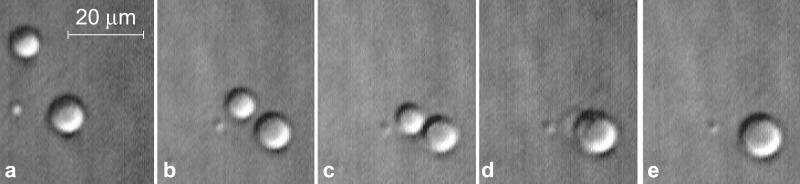
The liquid nature of the second phase in Hb solutions. The sequence shows the coalescence of droplets of the dense liquid of deoxy-HbA suspended in a normal deoxy-HbA solution at 42°C. HbA concentration in starting solution is 30 g/dl. First and last frames are separated by 55 s.
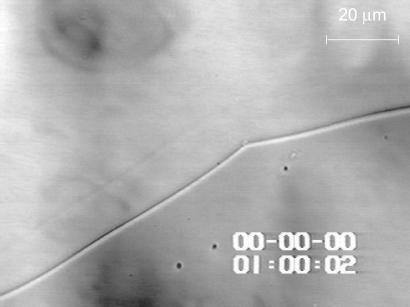
The dense phase consists of deoxy-HbA at a concentration 12 times higher than that of the dilute phase. The two liquid phases occupy well defined areas after equilibrium is reached, allowing spectrophotometric characterization of Hb and determination of the relative concentrations in the two phases. Conditions are identical to those in Fig. 1.
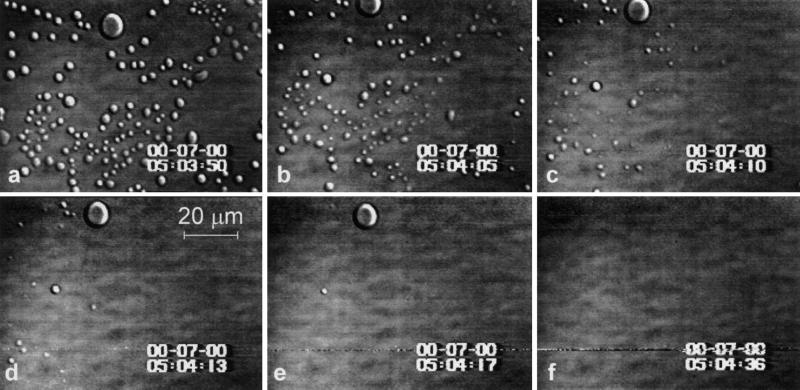
Reversibility of the L–L separation with deoxy-HbA. After temperature is lowered from 42 to 35°C, the dense liquid droplets disappear. The times at which each frame was captured are shown. Solution composition is identical to those in Figs. 1 and 2.
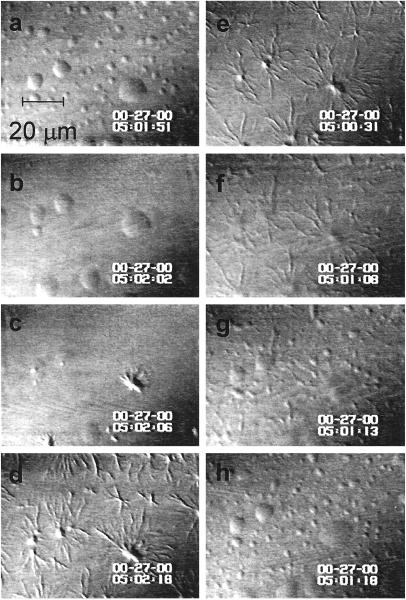
Link between L–L separation and polymer formation in deoxy-HbS solutions. Concentration of HbS is 22 g/dl, with 1% (wt/vol) PEG 8000. (a–d) When temperature is lowered from 42 to 35°C, the smaller of the dense liquid droplets disappear, while the larger ones serve as nucleation centers for HbS spherulites. Spherulites also appear at the locations where smaller droplets have been, apparently because of the undissipated locally higher concentration. (e–h) Upon raising the temperature to 42°C, the spherulites melt into droplets. The whole sequence a–h can be repeated more than 10 times by varying the temperature between these two settings. The reproducibility of the locations of droplets and spherulites emphasizes the link between them.
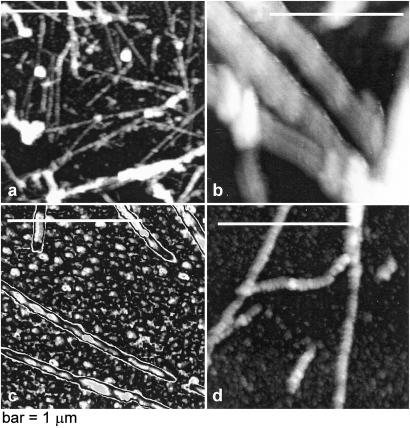
Atomic force microscopy images of the deoxy-HbS polymers formed at 35°C in a 22-g/dl solution of deoxy-HbS. (a) Low-resolution image showing a variety of polymeric structures. (b–d) High resolution images showing thicker fibers consist of thinner polymers of 22 nm diameter (b). (c) The chosen color scheme highlights the pitch of the thin polymer fibers of ∼150 nm. (d) Branched and twisted polymer fibers. Under these conditions, observations of such structures were relatively rare.
References
-
- Steinberg M H, Forget B G, Higgs D R, Nagel R L. Disorders of Hemoglobin: Genetics, Pathology, Clinical Management. Cambridge, U.K.: Cambridge Univ. Press; 2000.
-
- Cole-Strauss A, Yoon K, Xiang Y, Byrne B C, Rice M C, Crynn J, Holloman W K, Kmiec E B. Science. 1996;273:1386–1389. - PubMed
-
- Hahn E V, Gillespie E B. Arch Int Med. 1927;39:233–254.
-
- Sunshine H R, Hofrichter J, Ferrone F A, Eaton W A. J Mol Biol. 1982;158:251–273. - PubMed
-
- Eaton W A, Hofrichter J. In: Advances in Protein Chemistry. Anfinsen C B, Edsal J T, Richards F M, Eisenberg D S, editors. Vol. 40. San Diego: Academic; 1990. pp. 63–279. - PubMed
Publication types
MeSH terms
Substances
Grants and funding
LinkOut - more resources
Full Text Sources
