


Evolutionary genomics of Salmonella: gene acquisitions revealed by microarray analysis
- PMID: 12072558
- PMCID: PMC124405
- DOI: 10.1073/pnas.122153699
Evolutionary genomics of Salmonella: gene acquisitions revealed by microarray analysis
Abstract
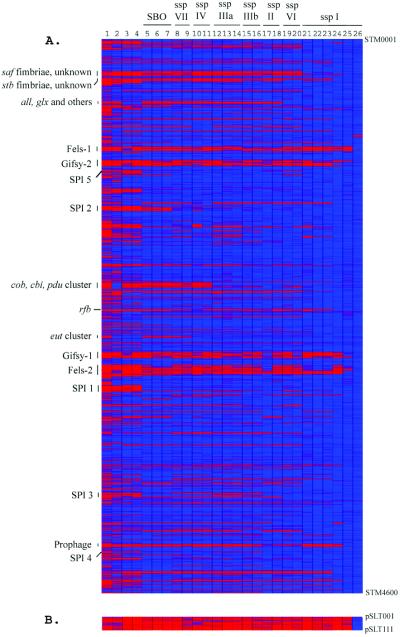
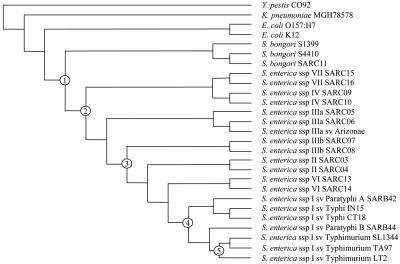
The presence of homologues of Salmonella enterica sv. Typhimurium LT2 genes was assessed in 22 other Salmonella including members of all seven subspecies and Salmonella bongori. Genomes were hybridized to a microarray of over 97% of the 4,596 annotated ORFs in the LT2 genome. A phylogenetic tree based on homologue content, relative to LT2, was largely concordant with previous studies using sequence information from several loci. Based on the topology of this tree, homologues of genes in LT2 acquired by various clades were predicted including 513 homologues acquired by the ancestor of all Salmonella, 111 acquired by S. enterica, 105 by diphasic Salmonella, and 216 by subspecies 1, most of which are of unknown function. Because this subspecies is responsible for almost all Salmonella infections of mammals and birds, these genes will be of particular interest for further mechanistic studies. Overall, a high level of gene gain, loss, or rapid divergence was predicted along all lineages. For example, at least 425 close homologues of LT2 genes may have been laterally transferred into Salmonella and then between Salmonella lineages.
Figures
References
-
- Selander R K, Li J, Nelson K. In: Escherichia coli and Salmonella: Cellular and Molecular Biology. Neidhardt F C, Curtiss R III, Ingraham J L, Lin E C C, Low K B, Magasanik B, Reznikoff W S, Riley M, Schaechter M, Umbarger H E, editors. Washington, DC: Am. Soc. Microbiol.; 1996. pp. 2691–2707.
Publication types
MeSH terms
Grants and funding
LinkOut - more resources
Full Text Sources
Other Literature Sources
