


Transcranial magnetic stimulation for treating depression
- PMID: 12076483
- PMCID: PMC6516872
- DOI: 10.1002/14651858.CD003493
Transcranial magnetic stimulation for treating depression
Abstract
Background: Transcranial magnetic stimulation can either excite or inhibit cortical areas of the brain, depending on whether the speed of the repetitive stimulation is applied at high or low frequencies. It has been used for physiological studies and it has also been proposed as a treatment for depression.
Objectives: To assess the clinical efficacy and safety of transcranial magnetic stimulation for treating depression.
Search strategy: An electronic search was performed including the Cochrane Collaboration Depression, Neurosis and Anxiety Review Group trials register (last searched June, 2001), the Cochrane Controlled Trials Register (Issue 2, 2001), MEDLINE (1966-2001), EMBASE (1974-2001), PsycLIT (1980-2001), and bibliographies from reviewed articles. Unpublished data and grey literature were searched through personal communications with researchers.
Selection criteria: Randomised controlled trials assessing the therapeutic efficacy and safety of transcranial magnetic stimulation for depression.
Data collection and analysis: All reviewers independently extracted the information and verified it by cross-checking. Disagreements were resolved through discussion. Continuous data: When similar studies were grouped, the overall standardised mean difference was calculated under a fixed effect model weighted by the inverse variance method with 95% confidence intervals. (In the presence of statistical heterogeneity, a random effects model was to be used.)
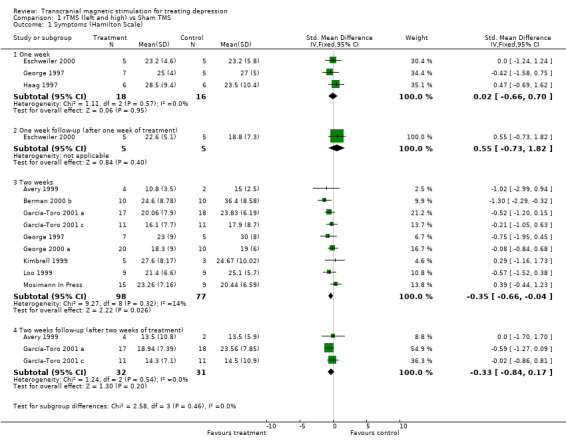
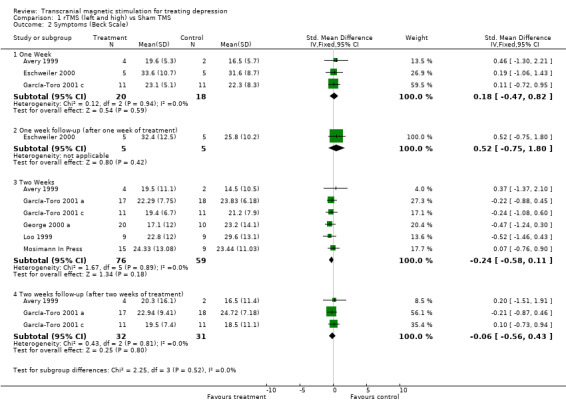
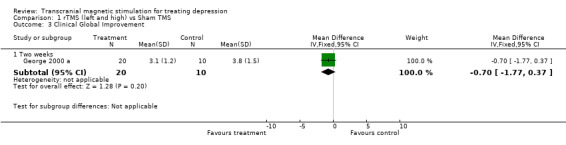
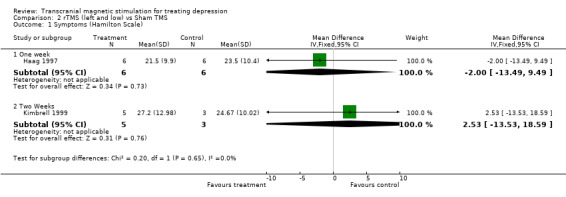
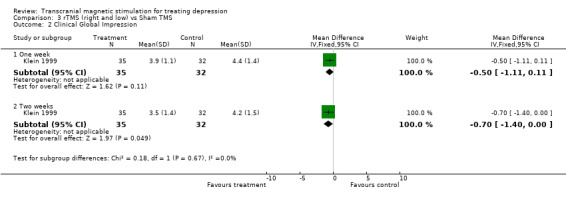
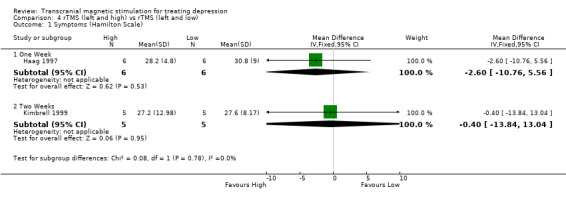
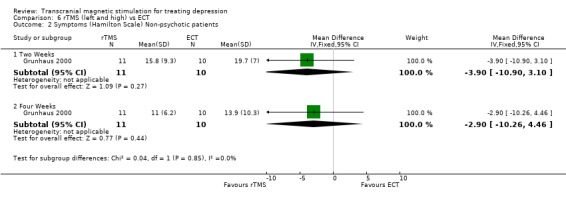
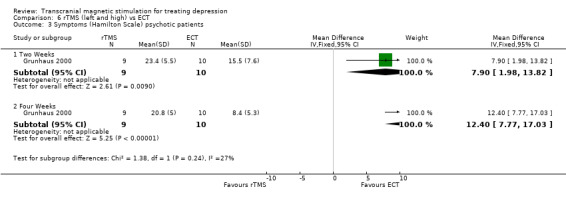
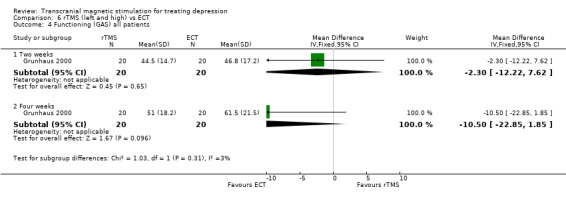
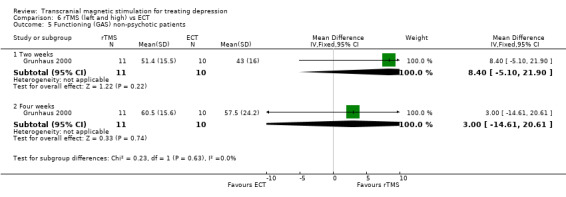
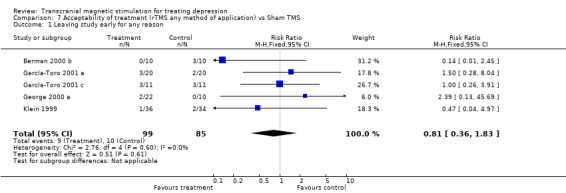
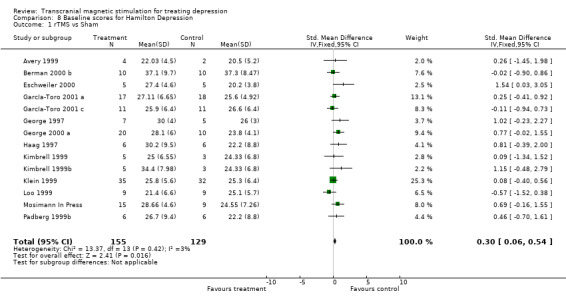
Main results: Sixteen trials were included in the review and fourteen contained data in a suitable form for quantitative analysis. Most comparisons did not show differences between rTMS and other interventions. No difference was seen between rTMS and sham TMS using the Beck Depression Inventory or the Hamilton Depression Rating Scale, except for one time period (after two weeks of treatment) for left dorsolateral prefrontal cortex and high frequency; and also for right dorsolateral prefrontal cortex and low frequency, both in favour of rTMS and both using the Hamilton scale. Comparison of rTMS (left dorsolateral prefrontal cortex and high frequency) with electroconvulsive therapy showed no difference except for psychotic patients after two weeks treatment, using the Hamilton scale, which indicated that electroconvulsive therapy was more effective than rTMS.
Reviewer's conclusions: The information in this review suggests that there is no strong evidence for benefit from using transcranial magnetic stimulation to treat depression, although the small sample sizes do not exclude the possibility of benefit.
Conflict of interest statement
Dr Schlaepfer is involved in one of the two ongoing included studies in the review.
Figures



References
References to studies included in this review
Avery 1999 {published data only}
-
- Avery DH, Claypoole K, Robinson L, Neumaier JF, Dunner DL, Scheele L, et al. Repetitive transcranial magnetic stimulation in the treatment of medication‐resistant depression: preliminary data. Journal of of Nervous & Mental Disease 1999;87(2):114‐7. - PubMed
Berman 2000 b {published and unpublished data}
-
- Berman RM, Narasimhan M, Sanacora G, Miano AP, Hoffman RE, Hu XS, et al. A randomized clinical trial of repetitive transcranial magnetic stimulation in the treatment of major depression. Biological Psychiatry 2000;47(4):332‐7. - PubMed
Conca 1996 {published data only}
-
- Conca A, Koppi S, König P, Swoboda E, Krecke N. Transcranial magnetic stimulation: A novel antidepressive strategy?. Neuropsychobiology 1996;34(4):204‐7. - PubMed
-
- Conca A, Koppi S, Swoboda E, Krecke N, Konig P. Transcranial magnetic stimulation. A new therapeutic approach to the treatment of depressive illness. 8th Congress of the Association of European Psychiatrists, London, UK. 1996.
-
- Koppi S, Conca A, Swoboda E, Krecke N, Koenig P. Transcranial magnetic stimulation‐‐New antidepressive therapy? [Transkranielle magnetstimulation‐‐Eine neue antidepressive therapie?]. Psychiatria Danubina 1997;9(2):83‐8.
Eschweiler 2000 {published data only}
-
- Eschweiler WG, Wegerer C, Schlotter W, Spandl W, Stevens A, Bartels M, et al. Left prefrontal activation predicts therapeutic effects of repetitive transcranial magnetic stimulation (rTMS) in major depression. Psychiatry Research: Neuroimaging Section 2000;99(3):161‐72. - PubMed
García‐Toro 2001 a {published data only}
-
- García‐Toro M, Mayol A, Arnillas H, Capllonch I, Ibarra O, Crespí M, et al. Modest adjuntive benefit with transcranial magnetic stimulation in medication‐resistant depression. Journal of Affective Disorders 2001;64(2‐3):271‐5. - PubMed
García‐Toro 2001 c {unpublished data only}
George 1997 {published data only}
-
- George MS, Wassermann EM, Kimbrell TA, Little JT, Williams WE, Danielson AL, et al. Mood improvement following daily left prefrontal repetitive transcranial magnetic stimulation in patients with depression: a placebo‐controlled crossover trial. American Journal of Psychiatry 1997;154(12):1752‐6. - PubMed
George 2000 a {published data only}
-
- George MS, Nahas Z, Molloy M, Speer AM, Oliver NC, Li XB, et al. A controlled trial of daily left prefrontal cortex TMS for treating depression. Biological Psychiatry 2000;48(10):962‐70. - PubMed
-
- Kozel FA, Nahas Z, deBrux C, Molloy M, Lorberbaum JP, Bohning D, et al. How coil‐cortex distance relates to age, motor threshold, and antidepressant response to repetitive transcranial magnetic stimulation. Journal of Neuropsychiatry & Clinical Neurosciences 2000;12(3):376‐84. - PubMed
-
- Nahas Z, Teneback CC, Kozel A, Speer AM, DeBrux C, Molloy M, et al. Brain effects of TMS delivered over prefrontal cortex in depressed adults: Role of stimulation frequency and coil‐cortex distance. Journal of Neuropsychiatry & Clinical Neurosciences 2001;13(4):459‐70. - PubMed
Grunhaus 2000 {published data only}
-
- Dannon PN, Dolberg OT, Schreiber S, Grunhaus L. Three and six‐month outcome following courses of either ECT or rTMS in a population of severely depressed individuals ‐ Preliminary report. Biological Psychiatry 2002;51(8):687‐90. - PubMed
-
- Grunhaus L, Dannon PN, Schreiber S, Dolberg OH, Amiaz R, Ziv R, et al. repetitive transcranial magnetic stimulation is as effective as electroconvulsive therapy in the treatment of nondelusional major depressive disorder: an open study. Biological Psychiatry 2000;47(4):314‐24. - PubMed
Haag 1997 {published and unpublished data}
-
- Haag C, Padberg F, Thoma H, Zwanzger P, Hampel H, Moller HJ. Rapid transcranial magnetic stimulation (rTMS) in the treatment of major depression: a randomised placebo controlled study. Pharmacopsychiatry 1997;30:173.
-
- Padberg F, Haag C, Zwanzger P, Thoma H, Kathmann N, Stnbner S, et al. Rapid and slow transcranial magnetic stimulation are equally effective in medication‐resistant depression: A placebo‐controlled study. XXIst Collegium Internationale Neuro psychopharmacologicum, Glasgow, Scotland. 12th 16th July. 1998.
-
- Padberg F, Zwanzger P, Keck ME, Toschi N, Mikhaiel P, Thoma H, et al. Repetitive transcranial magnetic stimulation in major depression: Efficacy depends on stimulation intensity. Annual Meeting of the American Psychiatric Association; May 5‐10; New Orleans; LA, USA. 2001.
-
- Padberg F, Zwanzger P, Thoma H, Kathmann N, Haag C, Greenberg B, et al. Repetitive transcranial magnetic stimulation (rTMS) in pharmocotherapy‐refractory major depression: Comparative study of fast, slow and sham rTMS. Psychiatry Research 1999;88(3):163‐71. - PubMed
-
- Zwanzger P, Padberg F, Moller HJ, Hampel H, Mikhaiel P, Thoma H. Transcranial magnetic stimulation in major depression. XI World Congress of Psychiatry , Hamburg, August 6‐11. 1999.
Kimbrell 1999 {published and unpublished data}
-
- Kimbrell TA, Little JT, Dunn RT, Frye MA, Greenberg BD, Wassermann EM, et al. Frequency dependence of antidepressant response to left prefrontal repetitive transcranial magnetic stimulation (rTMS) as a function of baseline cerebral glucose metabolism. Biological Psychiatry 1999;46(12):1603‐13. - PubMed
Kimbrell 1999b {published data only}
-
- Kimbrell TA, Little JT, Dunn RT, Frye MA, Greenberg BD, Wassermann EM, et al. Frequency dependence of antidepressant response to left prefrontal repetitive transcranial magnetic stimulation (rTMS) as a function of baseline cerebral glucose metabolism. Biological Psychiatry 1999;46(12):1603‐13. - PubMed
Klein 1999 {published data only}
-
- Klein E, Kreinin I, Chistyakov A, Koren D, Mecz L, Marmur S, et al. Therapeutic efficacy of right prefrontal slow repetitive transcranial magnetic stimulation in major depression. Archives of General Psychiatry 1999;56(4):315‐20. - PubMed
Kolbinger 1995 {published data only}
-
- Kolbinger HM, Höflich G, Hufnagel H, Möller HJ, Kasper S. Transcranial magnetic stimulation (TMS) in the treatment of major depression ‐ a pilot study. Human Psychopharmacology 1995;10(4):305‐10.
Loo 1999 {published and unpublished data}
-
- Loo C, Mitchell P, Sachdev P, McDarmont B, Parker G, Gandevia S. Double‐blind controlled investigation of transcranial magnetic stimulation for the treatment of resistant major depression. American Journal of Psychiatry 1999;156(6):946‐8. - PubMed
-
- Loo C, Sachdev P, Elsayed H, McDarmont B, Mitchell P, Wilkinson M, et al. Effects of a 2‐ to 4‐week course of repetitive transcranial magnetic stimulation (rtms) on neuropsychologic functioning, electroencephalogram, and auditory threshold in depressed patients. Biological Psychiatry 2001;49(7):615‐23. - PubMed
Mosimann In Press {published data only}
-
- Mosimann UP, Schmitt W, Berkhoff M, Müri RM, Hess CW, Fisch HU, et al. Repetitive transcranial magnetic stimulation as a putative treatment in affective disorders. In press. - PubMed
Padberg 1999b {published data only}
-
- Padberg F, Zwanzger P, Thoma H, Kathmann N, Haag C, Greenberg B, et al. Repetitive transcranial magnetic stimulation (rTMS) in pharmocotherapy‐refractory major depression: Comparative study of fast, slow and sham rTMS. Psychiatry Research 1999;88(3):163‐71. - PubMed
Pridmore 2000 b {published data only}
-
- Pridmore S. Substitution of rapid transcranial magnetic stimulation treatments for electroconvulsive therapy treatments in a course of electroconvulsive therapy. Depression & Anxiety 2000;12(3):118‐23. - PubMed
References to studies excluded from this review
Bohning 1999 {published data only}
-
- Bohning DE, Shastri A, McConnell KA, Nahas Z, Lorberbaum JP, Roberts DR, et al. A combined TMS/fMRI study of intensity‐dependent TMS over motor cortex. Biological Psychiatry 1999;45(4):385‐94. - PubMed
Clark 2000 {published data only}
-
- Clark L, McTavish SF, Harmer CJ, Mills KR, Cowen PJ, Goodwin GM. Repetitive transcranial magnetic stimulation to right prefrontal cortex does not modulate the psychostimulant effects of amphetamine rTMS and amphetamine response. International Journal of Neuropsychopharmacology 2000;3(4):297‐302. - PubMed
Conca 2000 {published data only}
-
- Conca A, Swoboda E, König P, Koppi S, Beraus W, Künz A, et al. Clinical impacts of single transcranial magnetic stimulation (sTMS) as an add‐on therapy in severely depressed patients under SSRI treatment. Human Psychopharmacology 2000;15(6):429‐38. - PubMed
d'Alfonso 2000 {published data only}
-
- d'Alfonso AA, Honk J, Hermans E, Postma A, Haan EF. Laterality effects in selective attention to threat after repetitive transcranial magnetic stimulation at the prefrontal cortex in female subjects. Neuroscience letters 2000;280(3):195‐8. - PubMed
Epstein 1998 {published data only}
-
- Epstein CM, Figiel GS, Mcdonald WM, Amazon‐Leece J, Figiel L. Rapid rate transcranial magnetic stimulation in young and middle‐aged refractory depressed patients. Psychiatric Annals 1998;28(1):36‐9. - PubMed
Feinsod 1998 {published data only}
-
- Feinsod M, Kreinin B, Chistyakov A, Klein E. Preliminary evidence for a beneficial effect of low‐frequency, repetitive transcranial magnetic stimulation in patients with major depression and schizophrenia. Depression & Anxiety 1998;7(2):65‐8. - PubMed
Figiel 1998 {published data only}
-
- Figiel GS, Epstein C, McDonald WM, Amazon‐Leece J, Figiel L, Saldivia A, et al. The use of rapid‐rate transcranial magnetic stimulation (rTMS) in refractory depressd patients. Journal of Neuropsychiatry & Clinical Neurosciences 1998;10(1):20‐5. - PubMed
García 1998 {published data only}
-
- García M, Micó J, Crespí M, Capllong I, Arnillas H. Estimulation magnetica transcraneal repetitiva: una nueva intervención neurobiológica buscando un lugar en psiquiatría. A propósito de cinco casos. Psiquiatria.COM [revista electrónica] 1998;2(2):21 pages.
Geller 1997 {published data only}
-
- Geller V, Grisaru N, Abarbanel JM, Lemberg T, Belmaker RH. Slow magnetic stimulation of prefrontal cortex in depression and schizophrenia. Progress in Neuro‐Psychopharmacology & Biological Psychiatry 1997;21(1):105‐10. - PubMed
George 1995 b {published data only}
-
- George MS, Wassermann EM, Williams WA, Callahan A, Ketter TA, Basser P, et al. Daily repetitive transcranial magnetic stimulation (rTMS) improves mood in depression. Neuroreport 1995;6(14):1853‐56. - PubMed
George 1996 {published data only}
-
- George MS, Wassermann EM, Williams WA, Steppel J, Pascual‐Leone A, Basser P, et al. Changes in mood and hormone levels after rapid‐rate transcranial magnetic stimulation (rTMS) of the prefrontal cortex. Journal of Neuropsychiatry & Clinical Neurosciences 1996;8(2):172‐80. - PubMed
George 1998 {published data only}
-
- George MS, Speer AM, Molloy M, Nahas Z, Teneback CC, Risch SC, et al. Low frequency daily left prefrontal rTMS improves mood in bipolar depression: A placebo‐controlled case report. Human Psychopharmacology 1998;13(4):271‐5.
George 1999 {published data only}
-
- George MS, Nahas Z, Kozel FA, Goldman J, Molloy M, Oliver N. Improvement of depression following transcranial magnetic stimulation. Current Psychiatry Reports 1999;1(2):114‐24. - PubMed
-
- George MS, Lisanby SH, Sackeim HA. Transcranial magnetic stimulation: applications in neuropsychiatry. Archives of General Psychiatry 1999;56(4):300‐11. - PubMed
Grisaru 1998 {published data only}
-
- Grisaru N. TMS in mania: A controlled study. XXIst Collegium Internationale Neuro psychopharmacologicum, Glasgow, Scotland. 12th 16th July. 1998.
-
- Grisaru N, Chudakov B, Yaroslavsky Y, Belmaker RH. Transcranial magnetic stimulation in mania: A controlled study. American Journal of Psychiatry 1998;155(11):1608‐10. - PubMed
Habel 2001 {published data only}
-
- Habel U, Wild B, Topka H, Kircher T, Salloum JB, Schneider F. Transcranial magnetic stimulation: no effect on mood with single pulse during learned helplessness. Progress in Neuro‐Psychopharmacology & Biological Psychiatry 2001;25(3):497‐506. - PubMed
Hansen 2000 {published data only}
-
- Hansen PE. Repetitive magnetic stimulation in the treatment of depression. A review [Repetitiv transkranial magnetisk stimulation. En metode til behandling af depressioner]. Ugeskrift for Laeger 2000;162(16):2310‐3. - PubMed
Höflich 1993 {published data only}
-
- Höflich G, Kasper S, Hufnagel A, Ruhrmann S, Möller HJ. Application of transcranial magnetic stimulation in treatment of drug‐resistant major depression ‐ a report of two cases. Human Psychopharmacology 1993;8(5):361‐5.
Koppi 1997 DELETE {published data only}
-
- Koppi S, Conca A, Swoboda E, Krecké N, König P. Transcranial magnetic stimulation ‐ new antidepressive therapy? [transkranielle magnetstimulation ‐ eine neue antidepressive therapie?]. Psychiatria Danubina 1997;9(2):83‐8.
Kozel 2000 DELETE {published data only}
-
- Kozel FA, Nahas Z, deBrux C, Molloy M, Lorbergaum JP, Bohning D, et al. How coil‐cortex distance relates to age, motor threshold, and antidepressant response to repetitive transcranial magnetic stimulation. Journal of Neuropsychiatry & Clinical Neurosciences 2000;12(3):376‐84. - PubMed
Krystal 2000 {published data only}
-
- Krystal AD, West M, Prado R, Greenside H, Zoldi S, Weiner RD. EEG effects of ECT: implications for rTMS. Depression & Anxiety 2000;12(3):157‐65. - PubMed
Loo 2000 {published data only}
-
- Loo CK, Taylor JL, Gandevia SC, McDarmont BN, Mitchell PB, Sachdev PS. Transcranial magnetic stimulation (TMS) in controlled treatment studies: are some "sham" forms active?. Biological Psychiatry 2000;47(4):325‐31. - PubMed
Loo 2001 DELETE {published data only}
-
- Loo C, Sachdev P, Elsayed H, McDarmont B, Mitchell P, Wilkinson M, et al. Effects of 2‐ to 4‐week course of repetitive transcranial magnetic stimulation (rTMS) on neuropsychologic functioning, electroencephalogram, and auditory threshold in depressed patients. Biological Psychiatry 2001;49(7):615‐23. - PubMed
Markwort 1997 {published data only}
-
- Markwort S, Cordes P, Aldenhoff J. Transcranial magnetic stimulation as a therapeutic alternative to electroconvulsive therapy in therapy‐resistant depressions [Die transkranielle magnet stimulation als behandlungs alternative zur elektrokrampf therapie bei therapieresistenten depressionen]. Fortschritte der Neurologie‐Psychiatrie 1997;65(12):540‐9. - PubMed
McConnell 2001 {published data only}
-
- MCConnell KA, Nahas Z, Shastri A, Lorberbaum JP, Kozel FA, Bohning DE, et al. The transcranial magnetic stimulation motor threshold depends on the distance from coil to underlying cortex: a replication in healthy adults comparing two methods of assessing the distance to cortex. Biological Psychiatry 2001;49(5):454‐9. - PubMed
Menkes 1999 {published data only}
-
- Menkes DL, Bodnar P, Ballesteros RA, Swenson MR. Right frontal lobe slow frequency repetitive transcranial magnetic stimulation (SF r‐TMS) is an effective treatment for depression: a case‐control pilot study of safety and efficacy. Journal of Neurology, Neurosurgery & Psychiatry 1999;67(1):113‐5. - PMC - PubMed
Mosimann 2000 {published data only}
-
- Mosimann UP, Rihs TA, Engeler J, Fisch HU, Schlaepfer TE. Mood effects of repetitive transcranial magnetic stimulation of left prefrontal cortex in healthy volunteers. Psychiatry Research 2000;94(3):251‐6. - PubMed
Nahas 1999 {published data only}
-
- Nahas Z, Bohning DE, Molloy MA, Oustz JA, Risch SC, George MS. Safety and Feasibility of repetitive transcranial magnetic stimulation in the treatment of anxious depression in pregnancy: A case report. Journal of Clinical Psychiatry 1999;60(1):50‐2. - PubMed
Nahas 2000 {published data only}
-
- Nahas Z, DeBrux C, Chandler V, Lorberbaum JP, Speer AM, Molloy MA, et al. Lack of significant changes on magnetic resonance scans before and after 2 weeks of daily left prefrontal repetitive transcranial magnetic stimulation for depression. Journal of ECT 2000;16(4):380‐90. - PubMed
Pascual‐Leone 1996b {published data only}
-
- Pascual‐Leone A, Catalá MD, Pascual‐Leone Pascual A. Lateralized effect of rapid‐rate transcranial magnetic stimulation of the prefrontal cortex on mood. Neurology 1996;46(2):499‐502. - PubMed
Pridmore 1999a {published data only}
-
- Pridmore S. Rapid transcranial magnetic stimulation and normalization of the dexamethasone suppression test. Psychiatry & Clinical Neurosciences 1999;53(1):33‐7. - PubMed
Pridmore 1999b {published data only}
-
- Pridmore S, Rybak M, Turnier‐Shea Y, Reid P, Bruno R, Couper D. A naturalistic study of response in melancholia to transcranial magnetic stimulation (TMS). German Journal of Psychiatry 1999;2(1):13‐21.
Pridmore 1999c {published data only}
-
- Pridmore S, Belmaker R. Transcranial magnetic stimulation in the treatment of psychiatric disorders. Psychiatry & Clinical Neurosciences 1999;53(5):541‐8. - PubMed
Pridmore 2000 a {published data only}
-
- Pridmore S, Bruno R, Turnier‐Shea Y, Reid P, Rybak M. Comparison of unlimited numbers of rapid transcranial magnetic stimulation (rTMS) and ECT treatment sessions in major depressive episode. International Journal of Neuropsychopharmacology 2000;3(4):129‐34. - PubMed
Reid 1999 {published data only}
-
- Reid PD, Pridmore S. Dexamethasone supression test reversal in rapid transcranial magnetic stimulation‐treated depression. Australian and New Zealand Journal of Psychiatry 1999;33(2):274‐7. - PubMed
Schouten 1999 {published data only}
-
- Schouten EA, D'alfonso AA, Nolen WA, Haan EH, Wijkstra J, Kahn RS. Small effect of rapid rate transcranial magnetic stimulation on antidepressant free outpatients with a depressive disorder. A pilot study [Beperkte effectiviteit van transcraniële magnetische stimulatie bij depressie Een oriënterend onderzoek]. Tijdschrift voor Psychiatrie 1999;41(4):233‐7.
Speer 1999 {published data only}
-
- Little JT, Kimbrell TA, Wassermann EM, Grafman J, Figueras S, Dunn RT, et al. Cognitive effects of 1‐ and 20‐ hertz repetitive transcranial magnetic stimulation in depression: Preliminary report. Neuropsychiatry, Neuropsychology, and Behavioral Neurology 2000;13(2):119‐24. - PubMed
-
- Speer AM, Kimbrell TA, Wassemann EM, Willis MW, Post RM. Baseline absolute blood flow measured with oxygen‐15 pet predicts differential antidepressants response to 1hz versus 20 hz rtms. 152nd Annual Meeting of the American Psychiatric Association. Washington DC, USA. 15 20th May. 1999.
-
- Speer AM, Kimbrell TA, Wassermann EM, Repella JD, Willis MW, Herscovitch P, et al. Opposite effects of high and low frequency rTMS on regional brain activity in depressed patients. Biological Psychiatry 2000;48(12):1133‐41. - PubMed
Stikhina 1999 {published data only}
-
- Stikhina NY, Lyskov EB, Lomarev MP, Aleksanyan ZA, Mikhailov VO, Medvedev SV. Transcranial magnetic stimulation in neurotic depression [Transkranial'naia magnitnaia stimuliatsiia pri nevroticheskoi depressii.]. Zhurnal Nevrologii i Psikhiatrii Imeni S.S. Korsakova 1999;99(10):26‐9. - PubMed
Szuba 2000 {published data only}
-
- Szuba MP, O'Reardon JP, Evans DL. Psysiological effects of electroconvulsive therapy and transcranial magnetic stimulation in major depression. Depression & Anxiety 2000;12(3):170‐7. - PubMed
Teneback 1999 {published data only}
-
- Teneback C, Nahas Z, Speer AM, Molloy M, Stallings LE, Spicer KM, et al. Changes in prefrontal cortex and paralimbic activity in depression following two weeks of daily left prefrontal TMS. Journal of Neuropsychiatry and Clinical Neurosciences 1999;11(4):426‐35. - PubMed
Tormos 1999 {published data only}
-
- Tormos JM, Catalá MD, Pascual‐Leone A. Transcranial magnetic stimulation [Estimulación magnética transcraneal]. Revista de Neurologia 1999;29(2):165‐71. - PubMed
Triggs 1999 {published data only}
-
- Triggs WJ, McCoy KJM, Greer R, Rossi F, Bowers D, Kortenkamp S, et al. Effects of left frontal transcranial magnetic stimulation on depressed mood, cognition, and corticomotor threshold. Biological Psychiatry 1999;45(11):1440‐6. - PubMed
Turnier‐Shea 1999 {published data only}
-
- Turnier‐Shea Y, Rybak M, Reid P, Pridmore S. Update on psychotropic medication used concurrently with transcranial magnetic stimulation. German Journal of Psychiatry 1999;2(2):46‐59.
Walter 2001 {published data only}
-
- Walter G, Tormos JM, Israel JA, Pascual‐Leone A. Transcranial magnetic stimulation in young persons: a review of known cases. Journal of Child & Adolescent Psychopharmacology 2001;11(1):69‐75. - PubMed
Zheng 2000 {published data only}
-
- Zheng XM. Regional cerebral blood flow changes in drug‐resistant depressed patients following treatment with transcranial magnetic stimulation: a statistical parametric mapping analysis. Psychiatry Research: Neuroimaging 2000;100(2):75‐80. - PubMed
References to studies awaiting assessment
Pascual‐Leone 1996 {published data only}
-
- Pascual‐Leone A, Rubio B, Pallardo F, Catala MD. Rapid‐rate transcranial magnetic stimulation of left dorsolateral prefrontal cortex in drug‐resistant depression. Lancet 1996;347(9022):233‐7. - PubMed
Speer 2000 {published data only}
-
- Speer AS, Kimbrell TA, Wassermann EM, Repella JD, Willis MW, Herscovitch P, et al. Opposite effects of high and low frequency rTMS on regional brain activity in depressed patients. Biological Psychiatry 2000;48(12):1133‐41. - PubMed
References to ongoing studies
Adsersen‐1 {unpublished data only}
-
- Adsersen. The Avery‐George‐Hotzheimer database of rTMS depression studies. http://www.ists.unibe.ch/ists/TMSAvery.htm. - PubMed
Avery‐1 {unpublished data only}
-
- Avery. The Avery‐George‐Hotzheimer database of rTMS depression studies. http://www.ists.unibe.ch/ists/TMSAvery.htm. - PubMed
D'Alfonso‐1 {unpublished data only}
-
- D'Alfonso. The Avery‐George‐Hotzheimer database of rTMS depression studies. http://www.ists.unibe.ch/ists/TMSAvery.htm. - PubMed
Ebmeier‐1 {unpublished data only}
-
- Ebmeier. The Avery‐George‐Hotzheimer database of rTMS depression studies. http://www.ists.unibe.ch/ists/TMSAvery.htm. - PubMed
Eckert‐1 {unpublished data only}
-
- Eckert. The Avery‐George‐Hotzheimer database of rTMS depression studies. http://www.ists.unibe.ch/ists/TMSAvery.htm. - PubMed
Greenberg‐1 {unpublished data only}
-
- Greenberg. The Avery‐George‐Hotzheimer database of rTMS depression studies. http://www.ists.unibe.ch/ists/TMSAvery.htm. - PubMed
McLoughlin‐1 {unpublished data only}
-
- McLoughlin. The Avery‐George‐Hotzheimer database of rTMS depression studies. http://www.ists.unibe.ch/ists/TMSAvery.htm. - PubMed
Paradiso‐1 {unpublished data only}
-
- Paradiso. The Avery‐George‐Hotzheimer database of rTMS depression studies. http://www.ists.unibe.ch/ists/TMSAvery.htm. - PubMed
Pascual‐Leone‐1 {unpublished data only}
-
- Pascual‐Leone. The Avery‐George‐Hotzheimer database of rTMS depression studies. http://www.ists.unibe.ch/ists/TMSAvery.htm. - PubMed
Pascual‐Leone‐2 {unpublished data only}
-
- Pascual‐Leone. The Avery‐George‐Hotzheimer database of rTMS depression studies. http://www.ists.unibe.ch/ists/TMSAvery.htm. - PubMed
Sackeim‐1 {unpublished data only}
-
- Sackeim. The Avery‐George‐Hotzheimer database of rTMS depression studies. http://www.ists.unibe.ch/ists/TMSAvery.htm. - PubMed
Schaepfer‐1 {unpublished data only}
-
- Schaepfer. The Avery‐George‐Hotzheimer database of rTMS depression studies. http://www.ists.unibe.ch/ists/TMSAvery.htm. - PubMed
Shajahan‐1 {unpublished data only}
-
- Shajahan P. The treatment of partial remission in depression using transcranial magnetic stimulation (TMS): Open pilot trial followed by randomised placebo controlled cross‐over study. National Research Register 2000, issue 3.
Szuba‐1 {unpublished data only}
-
- Szuba. The Avery‐George‐Hotzheimer database of rTMS depression studies. http://www.ists.unibe.ch/ists/TMSAvery.htm. - PubMed
Weber‐1 {unpublished data only}
-
- Weber. The Avery‐George‐Hotzheimer database of rTMS depression studies. http://www.ists.unibe.ch/ists/TMSAvery.htm. - PubMed
Woodruff‐1 {unpublished data only}
-
- Woodruff P. Cost effectiveness of transcranial magnetic stimulation and electro‐convulsive treatment in severe depression (TRANSECT). National Research Register 2000, issue 3.
Additional references
Andrews 1999
APA 1994
-
- American Psychiatric Association. Diagnostic and Statistical Manual of Mental Disorders (dsm‐iv). 4th Edition. Washington, DC: American Psychiatric Association, 1994.
Barker 1985
-
- Barker AT, Jalinous R, Freeston H. Non‐invasive stimulation of the human motor cortex. Lancet. 1985;1:1106‐7. - PubMed
Beck 1961
-
- Beck AT, Ward CH, Mendelson M, Mock J, Erbaugh J. An Inventory for measuring depression. Archives of general psychiatry 1961;4:53‐63. - PubMed
Berger 1999
-
- Berger VW, Exner DV. Detecting selection bias in randomized clinical trials. Controlled Clinical Trials 1999;20:319‐27. - PubMed
Bland 1994
Bonfill 2001
-
- Bonfill X. Ensayos clínicos en intervenciones no farmacológicas. Barcelona: Fundación Dr. Antonio Esteve, 2001.
Casado 1999
-
- Casado A, Prieto L, Alonso J. The size of the effect of the difference between two means: statistically significant or clinically relevant? [El tamaño del efecto de la diferencia entre dos medias: ¿estadísticamente significativo o clínicamente relevante?]. Medicina Clinica 1999;112(15):584‐8. - PubMed
Chalmers 1992
Clarke 2001
-
- Clarke M, Oxman AD. Cochrane Reviewers Handbook. Oxford: Update Software, 2001.
Cohrs 1998
-
- Cohrs S, Tergau F, Riech S, Kastner S, Paulus W, Ziemann U, et al. High‐frequency repetitive transcranial magnetic stimulation delays rapid eye movement sleep. Neuroreport 1998;9(15):3439‐43. - PubMed
Collier 1995
Cracco 1999
-
- Cracco RQ, Cracco JB, Maccabee PJ, Amassian VE. Cerebral function revealed by transcranial magnetic stimulation. Journal of Neuroscience Methods 1999;86(2):209‐19. - PubMed
Davis 1976
-
- Davis CE. The effect of regression to the mean in epidemiologic and clinical studies. American Journal of Epidemiology 1976;104(5):493‐8. - PubMed
Day 2000
Freemantle 2001
Geddes 2001
Grafman 1999
-
- Grafman J, Wassermann E. Transcranial magnetic stimulation can measure and modulate learning and memory. Neuropsychologia 1999;37(2):159‐67. - PubMed
Guallar 1997
-
- Guallar E, Jiménez FJ, García‐Alonso F, Bakke OM. Regression to the median in research and clinical practice [La regresión a la media en la investigación y práctica clínica]. Medicina Clinica 1997;109(1):23‐6. - PubMed
Hallett 2000
-
- Hallett M. Transcranial magnetic stimulation and the human brain. Nature 2000;406(6792):147‐50. - PubMed
Hamilton 1960
Hamilton 1967
-
- Hamilton M. Development of a rating scale for primary depressive illness. British Journal of Social & Clinical Psychology 1967;6(4):278‐96. - PubMed
Hasey 2000
Hotopf 1999
-
- Hotopf M, Churchill R, Lewis G. Pragmatic randomised controlled trials in psychiatry. British Journal of Psychiatry 1999;175:217‐23. - PubMed
Hróbjartsson 2001
-
- Hróbjartsson A, Gotzsche PC. Is the placebo powerless?. New England Journal of Medicine 2001;344(21):1594‐602. - PubMed
Jadad 1998
-
- Jadad AR. Randomised controlled trials. London: BMJ Books, 1998.
Ji 1998
Jones 1996
Juckel 1999
-
- Juckel G, Mendlin A, Jacobs BL. Electrical stimulation of rat medial prefrontal cortex enhances forebrain serotonin output: implications for electroconvulsive therapy and transcranial magnetic stimulation in depression. Neuropsychopharmacology 1999;21(3):391‐8. - PubMed
Kujirai 1993
Laporte 1994
-
- Laporte JR, Figueras A. Placebo effects in psychiatry. Lancet 1994;344(8931):1206‐9. - PubMed
Lisanby 2000
-
- Lisanby SH, Luber B, Perera T, Sackeim HA. Transcranial magnetic stimulation: applications in basic neuroscience and neuropsychopharmacology. International Journal of Neuropsychopharmacology 2000;3:259‐73. - PubMed
Moher 1995
-
- Moher D, Jadad A, Nichol G, Penman M, Tugwell T, Walsh S. Assessing the quality of randomized controlled trials: an annotated bibliography of scales and checklists. Controlled Clinical Trials 1995;16(1):62‐73. - PubMed
Pascual‐Leone 1998
-
- Pascual‐Leone A, Tornos JM, Keenan J, Tarazona F, Canete C, Catala MD. Study and modulation of human cortical excitability with transcranial magnetic stimulation. Journal of Clinical Neurophysiology 1998;95(4):333‐43. - PubMed
Post 1998
-
- Post RM, Denicoff KD, Frye MA, Dunn RT, Leverich GS, Osuch E, et al. A history of the use of anticonvulsants as mood stabilizers in the last two decades of the 20th century. Neuropsychology 1998;38(3):152‐66. - PubMed
Post 1999
-
- Post RM, Kimbrell TA, McCann UD, Dunn RT, Osuch EA, Speer AM, et al. Repetitive transcranial magnetic stimulation as a neuropsychiatric tool: present status and future potential. Journal of ECT 1999;15(1):39‐59. - PubMed
Rosenberg 2000
-
- Rosenberg R. Outcome measures of antidepressive therapy. Acta Psychiatrica Scandinavica, Supplementum 2000;402:41‐4. - PubMed
Ruohonen 2000
-
- Ruohonen J, Ollikainen M, Nikouline V, Virtanen J, Ilmoniemi RJ. Coil desing for real and sham transcranial magnetic stimulation. IEEE Transactions on Biomedical Engineering 2000;47(2):145‐8. - PubMed
Schulz 1995
-
- Schulz KF, Chalmers I, Hayes RJ, Altman DG. Empirical evidence of bias: dimensions of methodological quality associated with estimates of treatment effects in controlled trials. JAMA 1995;273(5):408‐12. - PubMed
Steele 2000
-
- Steele JD, Glabus MF, Shajahan PM, Ebmeier KP. Increased cortical inhibition in depression: a prolonged silent period with transcranial magnetic stimulation (TMS). Psychological Madicine 2000;30(3):565‐70. - PubMed
Streiner 1998
-
- Streiner DL, Joffe R. The adequacy of reporting randomized, controlled trials in the evaluation of antidepressants. Canadian Journal of Psychiatry 1998;43(10):1026‐30. - PubMed
Thomas 1987
Wells 1999
-
- Wells KB. Treatment research at the crossroads: the scientific interface of clinical trials and effectiveness research. American Journal of Psychiatry 1999;156(1):5‐10. - PubMed
WHO 1993
-
- World Health Organisation. The Tenth Revision of the International Classification of Diseases and Related Health Problems (ICD‐10). 10th Edition. Geneva: World Health Organisation, 1993.
Zyss 1999
-
- Zyss T, Mamczarz J, Vetulani J. The influence of rapid‐rate transcranial magnetic stimulation (rTMS) parameters on rTMS effects in Porsolt's forced swimming test. International Journal of Neuropsychopharmacology 1999;2:31‐4. - PubMed
Publication types
MeSH terms
LinkOut - more resources
Full Text Sources
Medical
