Augmentation effect of postprandial hyperinsulinaemia on growth of human hepatocellular carcinoma
- PMID: 12077100
- PMCID: PMC1773270
- DOI: 10.1136/gut.51.1.100
Augmentation effect of postprandial hyperinsulinaemia on growth of human hepatocellular carcinoma
Abstract
Background: Cirrhotic patients with hepatocellular carcinoma (HCC) frequently have impaired glucose metabolism.
Aims: To investigate whether impaired glucose metabolism affects the growth rate of the tumour.
Patients and methods: Tumour doubling time (DT), assessed by ultrasound imaging analysis, was measured in 60 patients with single small HCC (diameter <30 mm). DT was compared with plasma insulin and glucose concentrations following the oral glucose tolerance test (OGTT). The effect of continuous infusion of octreotide (a somatostatin analogue 200 microg/day) for three months on DT in five cases was assessed.
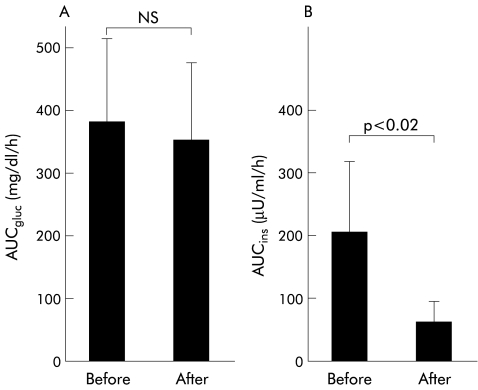
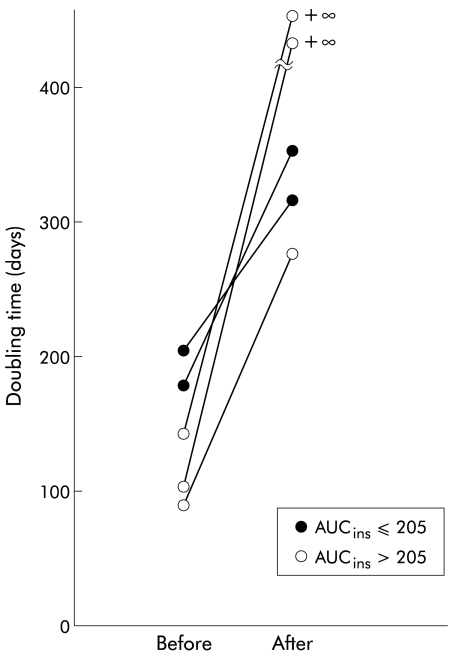
Results: The 60 patients were divided into two groups because the median DT was 140 days: rapid growth group (DT <or=140 days, n=30) and slow growth group (DT >140 days, n=30). Fasting plasma insulin concentration and area under the plasma insulin curve (AUC(ins)) of the OGTT (10.4 (6.2) microU/ml and 262 (152) microU/ml/h, respectively; mean (SD)) in the rapid growth group were significantly higher than those in the slow growth group (7.6 (4.3) and 146 (140), respectively) (p=0.041 and p=0.0006, respectively). In contrast, fasting plasma glucose concentration and area under the plasma glucose curve (AUC(gluc)) in the rapid growth group were significantly lower than those in the slow growth group (p=0.0003 and p=0.0012, respectively). Univariate and multivariate analyses of logistic regression models demonstrated that AUC(ins) was a significant factor contributing to the growth rate of HCC (p=0.001 and p=0.016, respectively). AUC(ins) significantly decreased after octreotide treatment (p<0.02) but AUC(gluc) did not significantly change. DT after treatment increased in three of the five patients and could not be calculated in the remaining two patients because of no change in the diameter of the tumour.
Conclusions: These data suggest that postprandial hyperinsulinaemia is associated with accelerated HCC growth.
Figures
Similar articles
-
Prolonged bleeding time: a new clinical manifestation of hepatocellular carcinoma?J Gastroenterol Hepatol. 1997 Aug;12(8):563-8. doi: 10.1111/j.1440-1746.1997.tb00486.x. J Gastroenterol Hepatol. 1997. PMID: 9304507
-
Insulin resistance in cirrhosis: prolonged reduction of hyperinsulinemia normalizes insulin sensitivity.Hepatology. 1998 Jul;28(1):141-9. doi: 10.1002/hep.510280119. Hepatology. 1998. PMID: 9657106
-
Blood Glucose and Insulin Concentrations after Octreotide Administration in Horses With Insulin Dysregulation.J Vet Intern Med. 2017 Jul;31(4):1188-1192. doi: 10.1111/jvim.14718. Epub 2017 May 15. J Vet Intern Med. 2017. PMID: 28503791 Free PMC article.
-
Plasma proteasome level is a reliable early marker of malignant transformation of liver cirrhosis.Gut. 2009 Jun;58(6):833-8. doi: 10.1136/gut.2008.157016. Epub 2009 Feb 6. Gut. 2009. PMID: 19201777
-
Latent transforming growth factor-beta binding protein-1 in circulating plasma as a novel biomarker for early detection of hepatocellular carcinoma.Int J Clin Exp Pathol. 2015 Dec 1;8(12):16046-54. eCollection 2015. Int J Clin Exp Pathol. 2015. PMID: 26884881 Free PMC article.
Cited by
-
Impact of biomarkers on disease survival and progression in patients treated with octreotide for advanced hepatocellular carcinoma.J Cancer Res Clin Oncol. 2006 Nov;132(11):699-708. doi: 10.1007/s00432-006-0118-4. Epub 2006 Jul 12. J Cancer Res Clin Oncol. 2006. PMID: 16835748 Free PMC article. Clinical Trial.
-
Association of digestive organ disease with metabolic syndrome: role of adipocytokine and its molecular mechanisms.Clin J Gastroenterol. 2008 Apr;1(1):1-6. doi: 10.1007/s12328-008-0001-8. Epub 2008 Mar 20. Clin J Gastroenterol. 2008. PMID: 26193353
-
Liver and diabetes. A vicious circle.Hepatol Res. 2013 Jan;43(1):51-64. doi: 10.1111/j.1872-034X.2012.01031.x. Hepatol Res. 2013. PMID: 23332087 Free PMC article.
-
Prospective evaluation of type 2 diabetes mellitus on the risk of primary liver cancer in Chinese men and women.Ann Oncol. 2013 Jun;24(6):1679-85. doi: 10.1093/annonc/mdt017. Epub 2013 Feb 13. Ann Oncol. 2013. PMID: 23406734 Free PMC article.
-
Nonalcoholic Fatty liver disease, diabetes, obesity, and hepatocellular carcinoma.Clin Liver Dis. 2015 May;19(2):361-79. doi: 10.1016/j.cld.2015.01.012. Epub 2015 Mar 12. Clin Liver Dis. 2015. PMID: 25921668 Free PMC article. Review.
References
-
- Okuda K. Hepatocellular carcinoma: recent progress. Hepatology 1992;15:948–63. - PubMed
-
- Megyesi C, Samols E, Matks V. Glucose tolerance and diabetes in chronic liver disease. Lancet 1967;2:1051–6. - PubMed
-
- Conn HO, Schreiber W, Elkington SG, et al. Cirrhosis and diabetes. Increased incidence of diabetes in patients with Laennec's cirrhosis. I. Am J Dig Dis 1969;14:837–52. - PubMed
-
- Conn HO, Schreiber W, Elkington SG, et al. Cirrhosis and diabetes. Association of impaired glucose tolerance with potal-systemic shunting in Laennec's cirrhosis. Am J Dig Dis 1971;16:227–39. - PubMed
-
- Nolte W, Hartmann H, Ramadori G. Glucose metabolism in liver cirrhosis. Exp Clin Endocrinol 1995;103:63–74. - PubMed
MeSH terms
Substances
LinkOut - more resources
Full Text Sources
Medical