. 2002 Jul;22(14):5047-53.
doi: 10.1128/MCB.22.14.5047-5053.2002.

Yng1p modulates the activity of Sas3p as a component of the yeast NuA3 Hhistone acetyltransferase complex

Affiliations

Yng1p modulates the activity of Sas3p as a component of the yeast NuA3 Hhistone acetyltransferase complex

LeAnn Howe et al. Mol Cell Biol. 2002 Jul.

Abstract

The mammalian ING1 gene encodes a tumor suppressor required for the function of p53. In this study we report a novel function for YNG1, a yeast homolog of ING1. Yng1p is a stable component of the NuA3 histone acetyltransferase complex, which contains Sas3p, the yeast homolog of the mammalian MOZ proto-oncogene product, as its catalytic subunit. Yng1p is required for NuA3 function in vivo but surprisingly is not required for the integrity of the complex. Instead, we find that Yng1p mediates the interaction of Sas3p with nucleosomes and is thus required for the ability of NuA3 to modify histone tails. These data, and the observations that other ING1 homologs are found in additional yeast complexes that posttranslationally modify histones, suggest that members of the ING1 class of proteins may have broad roles in enhancing or modifying the activities of chromatin-modifying complexes, thereby regulating their activities in transcription control.


Figures
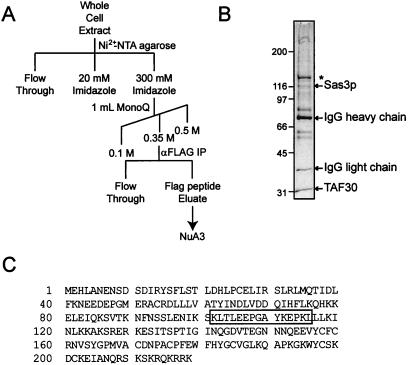
FIG. 1.
FIG. 1.
Yng1p is associated with purified NuA3 HAT complex. (A) Scheme used to generate purified NuA3. (B) Silver stained, SDS-PAGE (4 to 15% gradient) of the purified NuA3 complex. Bands corresponding to the verified subunits, Sas3p and TAF30, are indicated. An asterisk indicates a contaminating band. (C) Complete amino acid sequence for Yng1p. The peptide sequence obtained by mass spectrometry from purified NuA3 is shown boxed. IP, immunoprecipitation.
FIG. 2.
FIG. 2.
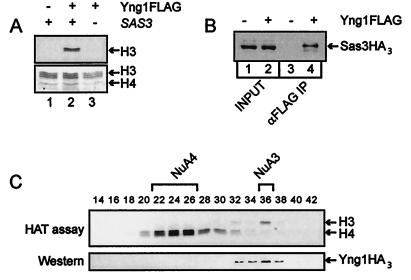
Yng1p is a stable component of the NuA3 HAT complex. (A and B) Whole-cell extracts from the indicated strains were immunoprecipitated (IP) with αFLAG resin and either were assayed for HAT activity on free HeLa histones (panel A; the fluorogram and Coomassie brilliant blue stain of an SDS-PAGE of these histones are shown) or were Western blotted and probed for Sas3HA3 (B). (C) Whole-cell extracts from a strain expressing HA-tagged Yng1p was purified by Ni2+-NTA agarose and MonoQ ion-exchange chromatography. The MonoQ fractions were assayed for HAT activity on free histones by SDS-PAGE and fluorography and for the presence of Yng1HA3 by Western blotting.
FIG. 3.
FIG. 3.
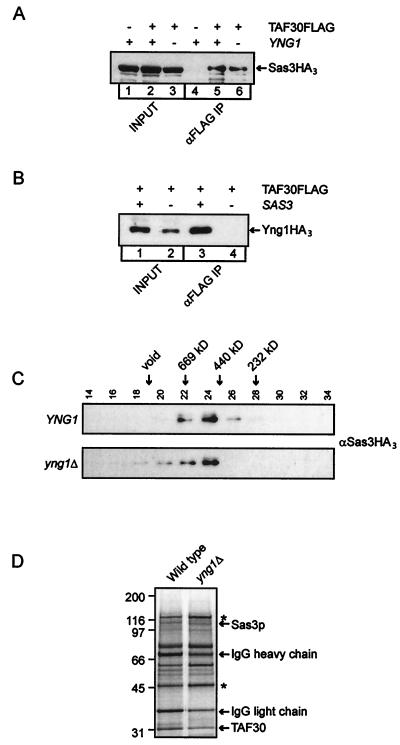
Loss of YNG1 does not disrupt the NuA3 HAT complex. (A and B) Whole-cell extracts from the indicated strains were immunoprecipitated with αFLAG resin. The input whole-cell extracts and immunoprecipitates (IP) were Western blotted and probed for HA. (C) Whole-cell extracts from the indicated strains were resolved on a Superose 6 HR 10/30 column, and the fractions were assayed for the presence of Sas3HA3 by Western blotting. (D) Silver stained, SDS-PAGE (4% to 15% gradient) of NuA3 complexes purified from wild-type (YJW545) and yng1Δ (YJW546) strains. Bands corresponding to the verified subunits Sas3p and TAF30 are indicated. Contaminating bands are indicated by asterisks. IgG, immunoglobulin G.
FIG. 4.
FIG. 4.
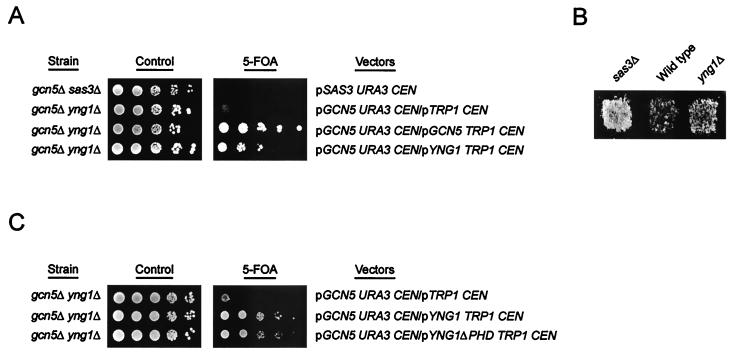
Loss of YNG1 disrupts NuA3 function. (A) gcn5Δ yng1Δ strains are synthetically sick. Yeast strain YJW542 (MATa his3Δ200 leu2Δ1 ura3-52 trp1Δ63 gcn5::HIS3 yng1::HISMX6 pJW218) was transformed with a CEN/ARS TRP1 plasmid alone (pRS314) or with CEN/ARS TRP plasmids encoding Gcn5p or Yng1p (pJW215 and pJW221, respectively), and the resulting transformants were plated on either synthetic complete medium (control) or synthetic complete medium with 5-FOA. Strain YJW134 (MATa his3Δ200 leu2Δ1 ura3-52 trp1Δ63 gcn5::HIS3 sas3::HISMX6 pJW214) was used as a control. (B) Deletion of YNG1 restores silencing to strains with mutations in HMR-E. Wild-type (JRY2069; MATα HMRa-e∗∗ ade2-101 his3 lys2 tyr1 ura3-52) and yng1Δ (YJW548; MATα HMRa-e∗∗ ade2-101 his3 lys2 tyr1 ura3-52 yng1::HISMX6) strains were assayed for mating efficiency, with JRY2726 (MATa his4) as a tester strain. Strain YJW547 (MATα HMRa-e∗∗ ade2-101 his3 lys2 tyr1 ura3-52 sas3::HISMX6) was used as a positive control. (C) Yeast strains YJW542 (MATa his3Δ200 leu2Δ1 ura3-52 trp1Δ63 gcn5::HIS3 yng1::HISMX6 pJW218) was transformed with a CEN/ARS TRP1 plasmid alone (pRS314) or with CEN/ARS TRP1 plasmids encoding Yng1p or Yng1ΔPHD (pJW221 and pJW222, respectively), and the resulting transformants were plated on either synthetic complete medium (control) or synthetic complete medium with 5-FOA.
FIG. 5.
FIG. 5.
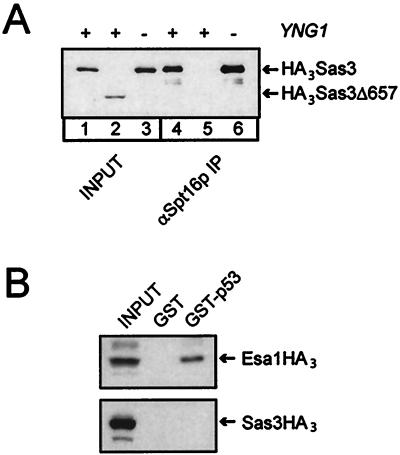
Yng1p does not mediate interactions of Spt16p or p53 with NuA3. (A) Spt16p was immunoprecipitated (IP) from yeast whole-cell extracts from YNG1 (YJW549) and yng1Δ (YJW550) strains expressing an amino-terminal-tagged Sas3p. A YNG1 strain expressing a carboxyl-terminal-truncated version of HA3Sas3p (YJW120) was used as a negative control. The input whole-cell extracts and the bead fractions were assayed for the presence of HA3Sas3p by Western blotting. (B) Yeast whole-cells extracts from strains expressing HA-tagged Sas3p (YJW537) or Esa1p (YJW207) were incubated with either GST or GST-p53 fusion proteins bound to glutathione Sepharose beads. The input whole-cell extracts and the bead fractions were assayed for the presence of Esa1HA3 and Sas3HA3 by Western blotting.
FIG. 6.
FIG. 6.
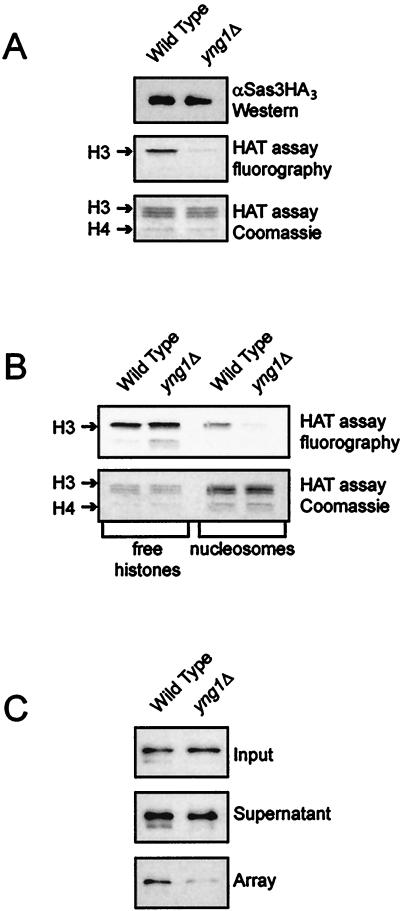
Yng1p is required for NuA3 HAT activity. (A) Wild-type (YJW540) and yng1Δ (YJW541) TAF30 affinity-purified NuA3, normalized for levels of Sas3HA3 by Western blotting, were assayed for HAT activity on free HeLa histones. The fluorogram and Coomassie brilliant blue stain of an SDS-PAGE of these histones are shown. (B) NuA3 purified from strains YJW540 and YJW541, normalized for levels of HAT activity on free histones, was assayed for HAT activity on HeLa nucleosomes. (C) Yng1p mediates interaction of NuA3 with nucleosomal arrays. Biotinylated G5E4-5S nucleosome arrays were bound to paramagnetic beads (Dynabeads) coupled to streptavidin. NuA3 purified from either wild-type or yng1Δ strains was added to the array template where indicated. The template beads were concentrated with a magnet, and the presence of Sas3p in the input, supernatants, and beads was analyzed by Western blotting.

References

    1. Aasland, R., T. J. Gibson, and A. F. Stewart. 1995. The PHD finger: implications for chromatin-mediated transcriptional regulation. Trends Biochem. Sci. 20:56-59. - PubMed
    1. Allard, S., R. T. Utley, J. Savard, A. Clarke, P. Grant, C. J. Brandl, L. Pillus, J. L. Workman, and J. Cote. 1999. NuA4, an essential transcription adaptor/histone H4 acetyltransferase complex containing Esa1p and the ATM-related cofactor Tra1p. EMBO J. 18:5108-5119. - PMC - PubMed
    1. Ausubel, F. M. 1987. Current protocols in molecular biology. J. Wiley, New York, N.Y.
    1. Balasubramanian, R., M. G. Pray-Grant, W. Selleck, P. A. Grant, and S. Tan. 2002. Role of the Ada2 and Ada3 transcriptional coactivators in histone acetylation. J. Biol. Chem. 277:7989-7995. - PubMed
    1. Brown, C. E., L. Howe, K. Sousa, S. C. Alley, M. J. Carrozza, S. Tan, and J. L. Workman. 2001. Recruitment of HAT complexes by direct activator interactions with the ATM-related Tra1 subunit. Science 292:2333-2337. - PubMed

Publication types

MeSH terms