


Proximal location of mouse prostate epithelial stem cells: a model of prostatic homeostasis
- PMID: 12082083
- PMCID: PMC2173539
- DOI: 10.1083/jcb.200202067
Proximal location of mouse prostate epithelial stem cells: a model of prostatic homeostasis
Abstract
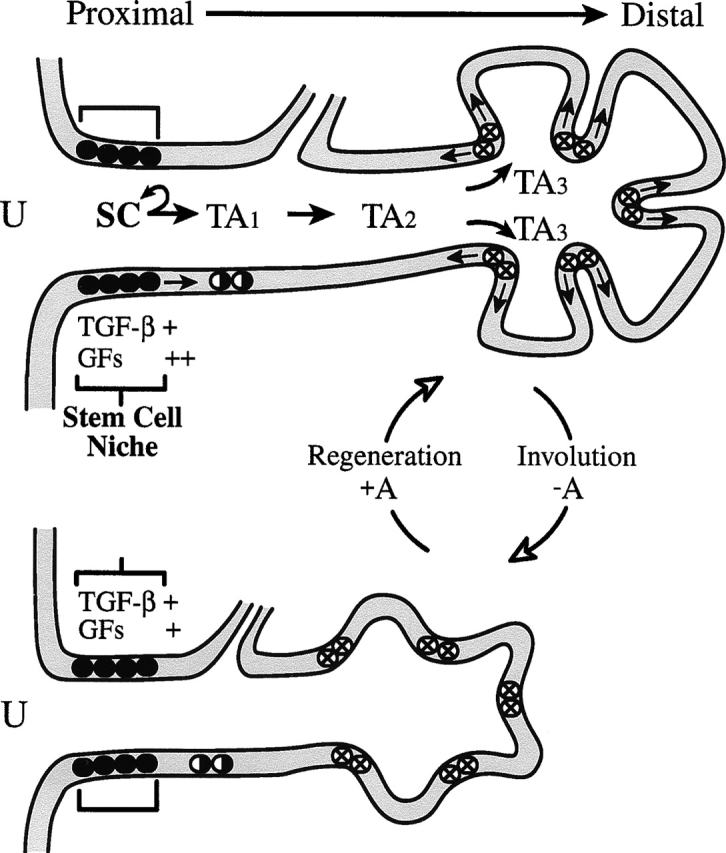
Stem cells are believed to regulate normal prostatic homeostasis and to play a role in the etiology of prostate cancer and benign prostatic hyperplasia. We show here that the proximal region of mouse prostatic ducts is enriched in a subpopulation of epithelial cells that exhibit three important attributes of epithelial stem cells: they are slow cycling, possess a high in vitro proliferative potential, and can reconstitute highly branched glandular ductal structures in collagen gels. We propose a model of prostatic homeostasis in which mouse prostatic epithelial stem cells are concentrated in the proximal region of prostatic ducts while the transit-amplifying cells occupy the distal region of the ducts. This model can account for many biological differences between cells of the proximal and distal regions, and has implications for prostatic disease formation.
Figures


References
-
- Baldwin, B.H., B.C. Tennant, T.J. Reimers, R.G. Cowan, and P.W. Concannon. 1985. Circannual changes in serum testosterone concentrations of adult and yearling woodchucks (Marmota monax). Biol. Reprod. 32:804–812. - PubMed
-
- Banerjee, P.P., S. Banerjee, B.R. Zirkin, and T.R. Brown. 1998. Telomerase activity in normal adult Brown Norway rat seminal vesicle: regional distribution and age-dependent changes. Endocrinology. 139:1075–1081. - PubMed
-
- Berardi, A.C., A. Wang, J.D. Levine, P. Lopez, and D.T. Scadden. 1995. Functional isolation and characterization of human hematopoietic stem cells. Science. 267:104–108. - PubMed
Publication types
MeSH terms
Substances
Grants and funding
LinkOut - more resources
Full Text Sources
Other Literature Sources
Medical
