. 2002 Aug 6;99(16):10528-32.
doi: 10.1073/pnas.102303999. Epub 2002 Jun 24.

Waddington's canalization revisited: developmental stability and evolution

Affiliations

Waddington's canalization revisited: developmental stability and evolution

Mark L Siegal et al. Proc Natl Acad Sci U S A. .

Abstract

Most species maintain abundant genetic variation and experience a range of environmental conditions, yet phenotypic variation is low. That is, development is robust to changes in genotype and environment. It has been claimed that this robustness, termed canalization, evolves because of long-term natural selection for optimal phenotypes. We show that the developmental process, here modeled as a network of interacting transcriptional regulators, constrains the genetic system to produce canalization, even without selection toward an optimum. The extent of canalization, measured as the insensitivity to mutation of a network's equilibrium state, depends on the complexity of the network, such that more highly connected networks evolve to be more canalized. We argue that canalization may be an inevitable consequence of complex developmental-genetic processes and thus requires no explanation in terms of evolution to suppress phenotypic variation.


Figures
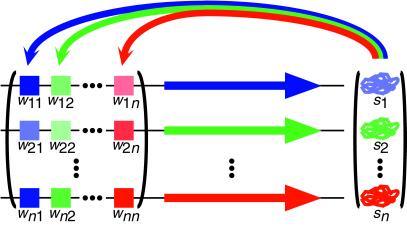
Fig 1.
Fig 1.
Representation of a gene regulation network. Each gene (horizontal arrow) is regulated by the products of the other genes, via upstream enhancer elements (boxes). Strength and direction of regulation (depicted as different color saturation levels) are a function of both the regulatory element and the abundance of its corresponding gene product. Genotype is represented as the matrix, W, of regulatory interactions, and phenotype is the vector, Ŝ, of gene-product levels at equilibrium (see Methods).
Fig 2.
Fig 2.
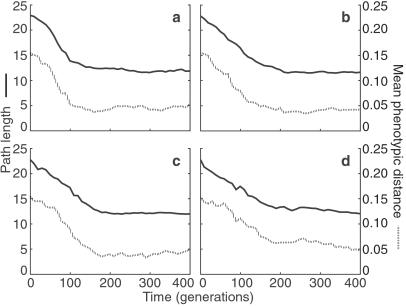
Typical time course of path length to developmental equilibrium (solid line) and of sensitivity to mutation (mean phenotypic distance of each individual in the population to phenotypes produced by single mutations of its genotype, broken line). The same founder individual evolves under strong stabilizing selection, σ = 0.1 (a), intermediate stabilizing selection, σ = 1 (b), and no stabilizing selection, σ ≈ ∞ (c and d). Populations are either random mating (a–c) or random mating without fertility selection (d) (see text).
Fig 3.
Fig 3.
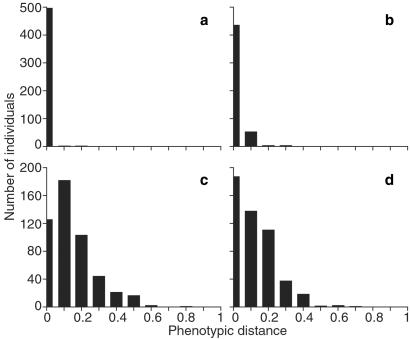
Effect of stabilizing selection on phenotypic variation. (a–d) Histograms of the phenotypic distances between the population's founding individual and each of the 500 members of the final population. Data are from the respective simulations in Fig. 2.
Fig 4.
Fig 4.
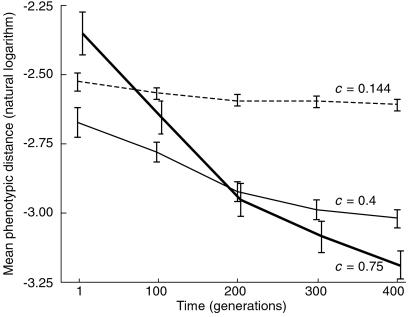
Effect of network complexity on sensitivity to mutation. Three sets of 100 simulations were performed, with different average proportions of nonzero regulatory interactions: c = 0.75 (thick solid line), 0.4 (thin solid line), and 0.144 (broken line). Sensitivity to mutation was determined every 100 generations. Log-transformed values were analyzed, as untransformed data departed significantly from normality, whereas transformed data did not (Lilliefors tests). Plotted are mean sensitivities, expressed as mean phenotypic distances on perturbation; error bars are ±1 SEM. Two-way ANOVA on the transformed data yields p ≈ 0 for each main effect (c and time) as well as their interaction. Nonparametric Kruskal–Wallis tests on untransformed data confirm these strong effects.

Comment in

  • Progress on canalization.
    Stearns SC. Stearns SC. Proc Natl Acad Sci U S A. 2002 Aug 6;99(16):10229-30. doi: 10.1073/pnas.172388999. Epub 2002 Jul 30. Proc Natl Acad Sci U S A. 2002. PMID: 12149521 Free PMC article. Review. No abstract available.

References

    1. Waddington C. H. (1942) Nature (London) 150, 563-565.
    1. Scharloo W. (1991) Annu. Rev. Ecol. Syst. 22, 65-93.
    1. Polaczyk P. J., Gasperini, R. & Gibson, G. (1998) Dev. Genes Evol. 207, 462-470. - PubMed
    1. Moreno G. (1994) Annu. Rev. Ecol. Syst. 25, 31-44.
    1. Gibson G. & Hogness, D. S. (1996) Science 271, 200-203. - PubMed

Publication types