


The genetic properties of the primary endosymbionts of mealybugs differ from those of other endosymbionts of plant sap-sucking insects
- PMID: 12088995
- PMCID: PMC126778
- DOI: 10.1128/AEM.68.7.3198-3205.2002
The genetic properties of the primary endosymbionts of mealybugs differ from those of other endosymbionts of plant sap-sucking insects
Abstract
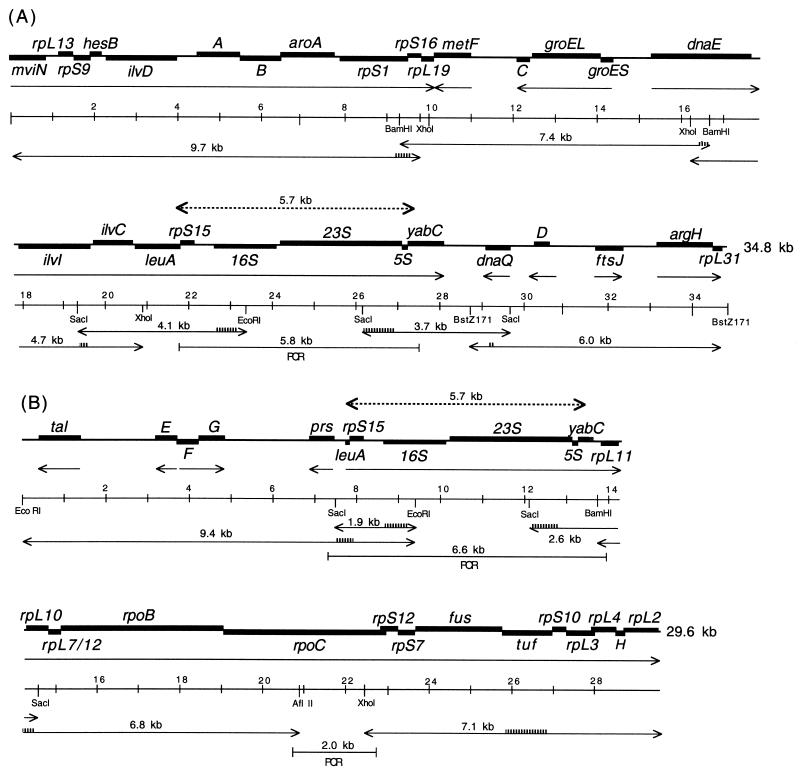
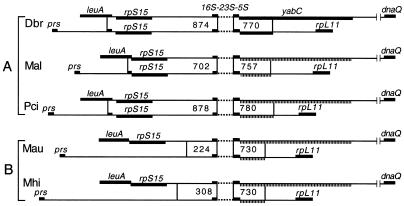
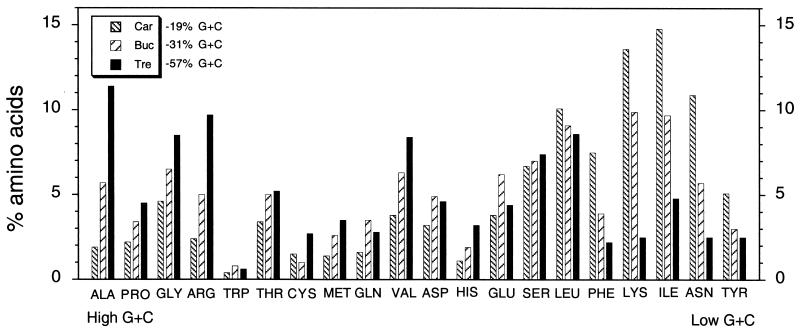
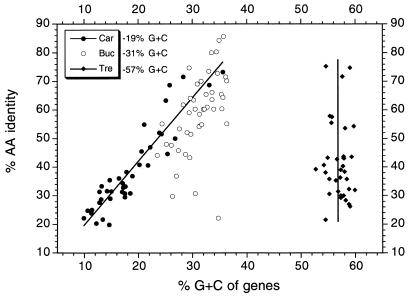
Mealybugs (Hemiptera, Coccoidea, Pseudococcidae), like aphids and psyllids, are plant sap-sucking insects that have an obligate association with prokaryotic endosymbionts that are acquired through vertical, maternal transmission. We sequenced two fragments of the genome of Tremblaya princeps, the endosymbiont of mealybugs, which is a member of the beta subdivision of the Proteobacteria. Each of the fragments (35 and 30 kb) contains a copy of 16S-23S-5S rRNA genes. A total of 37 open reading frames were detected, which corresponded to putative rRNA proteins, chaperones, and enzymes of branched-chain amino acid biosynthesis, DNA replication, protein translation, and RNA synthesis. The genome of T. princeps has a number of properties that distinguish it from the genomes of Buchnera aphidicola and Carsonella ruddii, the endosymbionts of aphids and psyllids, respectively. Among these properties are a high G+C content (57.1 mol%), the same G+C content in intergenic spaces and structural genes, and similar G+C contents of the genes encoding highly and poorly conserved proteins. The high G+C content has a substantial effect on protein composition; about one-third of the residues consist of four amino acids with high-G+C-content codons. Sequence analysis of DNA fragments containing the rRNA operon and adjacent regions from endosymbionts of several mealybug species suggested that there was a single duplication of the rRNA operon and the adjacent genes in an ancestor of the present T. princeps. Subsequently, in one mealybug lineage rpS15, one of the duplicated genes, was retained, while in another lineage it decayed. These results extend the diversity of the types of endosymbiotic associations found in plant sap-sucking insects.
Figures
References
-
- Andersson, S. G. E., and C. G. Kurland. 1998. Reductive evolution of resident genomes. Trends Microbiol. 6:263-268. - PubMed
-
- Ausubel, F. M., R. Brent, R. E. Kingston, D. D. Moore, J. G. Seidman, J. A. Smith, and K. Struhl (ed.). 2001. Current protocols in molecular biology. Wiley, New York, N.Y.
-
- Bandi, C., G. Damiani, L. Magrassi, A. Grigolo, R. Fani, and L. Sacchi. 1994. Flavobacteria as intracellular symbionts of cockroaches. Proc. R. Soc. Lond. B Biol. Sci. 257:43-48. - PubMed
Publication types
MeSH terms
Substances
Associated data
- Actions
- Actions
- Actions
- Actions
- Actions
- Actions
- Actions
- Actions
- Actions
- Actions
- Actions
- Actions
- Actions
- Actions
- Actions
- Actions
- Actions
LinkOut - more resources
Full Text Sources
Molecular Biology Databases
Miscellaneous
