. 2002 Jul;68(7):3408-15.
doi: 10.1128/AEM.68.7.3408-3415.2002.

Improving the pathogenicity of a nematode-trapping fungus by genetic engineering of a subtilisin with nematotoxic activity

Affiliations

Improving the pathogenicity of a nematode-trapping fungus by genetic engineering of a subtilisin with nematotoxic activity

Johan Ahman et al. Appl Environ Microbiol. 2002 Jul.

Abstract

Nematophagous fungi are soil-living fungi that are used as biological control agents of plant and animal parasitic nematodes. Their potential could be improved by genetic engineering, but the lack of information about the molecular background of the infection has precluded this development. In this paper we report that a subtilisin-like extracellular serine protease designated PII is an important pathogenicity factor in the common nematode-trapping fungus Arthrobotrys oligospora. The transcript of PII was not detected during the early stages of infection (adhesion and penetration), but high levels were expressed concurrent with the killing and colonization of the nematode. Disruption of the PII gene by homologous recombination had a limited effect on the pathogenicity of the fungus. However, mutants containing additional copies of the PII gene developed a higher number of infection structures and had an increased speed of capturing and killing nematodes compared to the wild type. The paralyzing activity of PII was verified by demonstrating that a heterologous-produced PII (in Aspergillus niger) had a nematotoxic activity when added to free-living nematodes. The toxic activity of PII was significantly higher than that of other commercially available serine proteases. This is the first report showing that genetic engineering can be used to improve the pathogenicity of a nematode-trapping fungus. In the future it should be possible to express recombinant subtilisins with nematicidal activity in other organisms that are present in the habitat of parasitic nematodes (e.g., host plant).


Figures
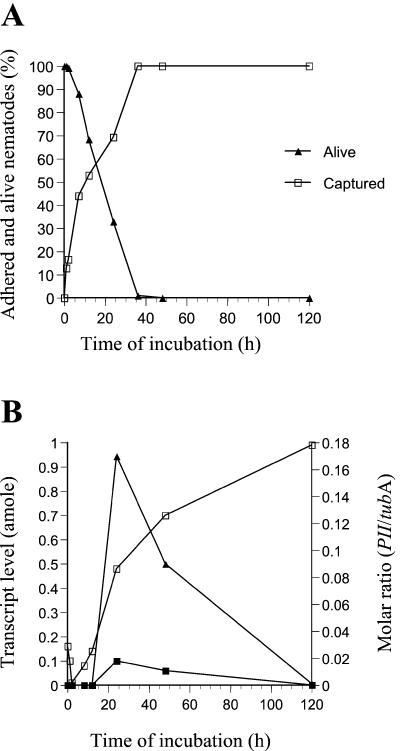
FIG. 1.
FIG. 1.
Expression of the subtilisin PII during the infection of nematodes. (A) Adhesion and killing of the nematode P. redivivus during infection by the fungus A. oligospora. The numbers of adhered (captured) and killed (captured and not moving) nematodes were counted using a microscope. (B) Results of analysis of transcript levels of PII and tubA, using competitive reverse transcription-PCR. Tubulin was used as a positive control gene fragment and for normalizing the data. ▪, PII transcript level; □, tubA transcript level; ▴, PII-tubA molar ratio.
FIG. 2.
FIG. 2.
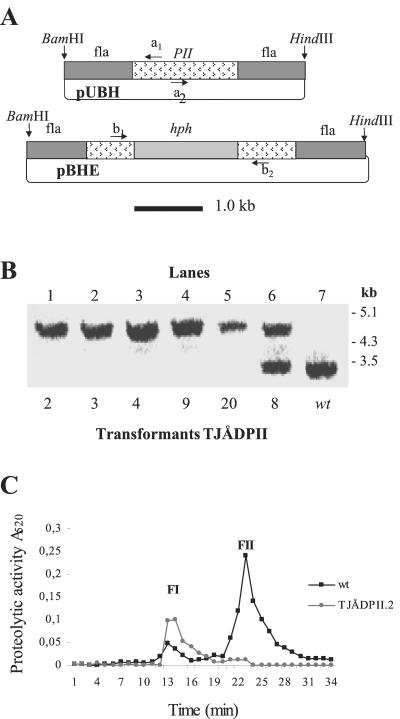
Construction of ΔPII mutants. (A) Gene disruption vector pBHE constructed by inserting the hph gene (Escherichia coli hygromycin B resistance gene, under the control of the trpC promoter from A. nidulans) in the open reading frame of PII present in the vector pUBH. fla, flanking region. Arrows indicate PCR primers used for cloning (a1 and a2) and for screening (b1 and b2). (B) Southern analysis of gene disruption mutants obtained using the vector pBHE. Genomic DNA was digested with BamHI/HindIII and probed with a 32P-labeled fragment of the PII gene (BamHI/HindIII fragment excised from pUBH) (30). Lanes 1 to 5 are mutants (designated TJÅDPII.2, -3, -4, -9, and -20) for which the mutated PII gene has been homologously integrated into the genome. Lane 6 shows a mutant (TJÅDPII.8) containing nonhomologous integration of the mutated PII gene. Lane 7 is the wild type. (C) Partial purification of the extracellular serine proteases produced by the wild type and the deletion mutant TJÅDPII.2 of A. oligospora when grown in liquid medium that stimulated the formation of infection structures (traps). The extracts were applied on a Mono Q column equilibrated with a Tris-HCl buffer (pH 7.5) and eluted with a gradient of NaCl using a flow of 1 ml/min (27). One-milliliter fractions were collected and assayed for protease activity by using the chromogenic substrate Azocoll.
FIG. 3.
FIG. 3.
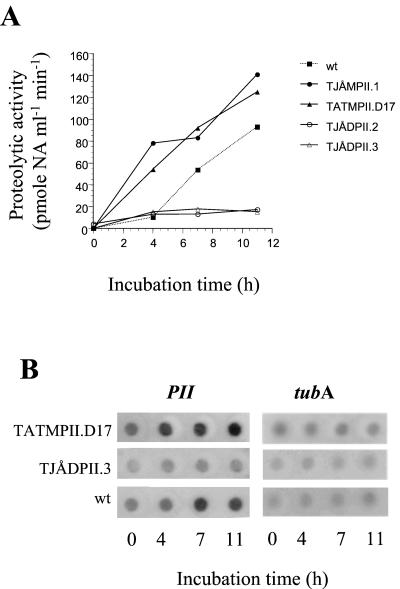
Proteolytic activity and expression of mRNA in PII mutants of A. oligospora. Mycelia were grown for 2 days in a nitrogen-limited medium before being transferred to a medium containing albumin as nitrogen and carbon source. (A) Proteolytic activity (in the culture filtrates) as estimated by measuring hydrolysis of the peptide substrate Bz-Phe-Val-Arg-NA. (B) Dot blot of total RNA hybridized with a 32P-labeled fragment of the PII gene (BamHI/HindIII fragment excised from pUBH) (1) and tubA (EcoRI fragment excised from pAotubF2) (cf. Table 1).
FIG. 4.
FIG. 4.
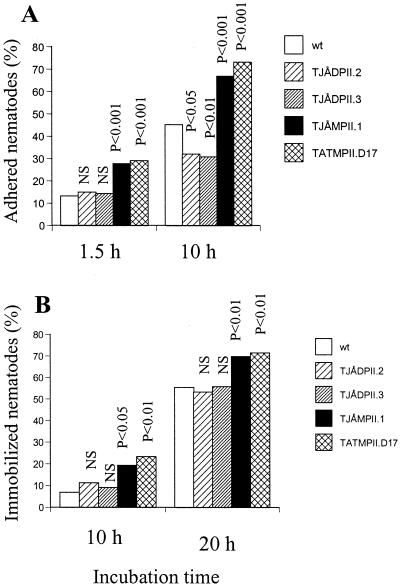
Infection of nematodes by various mutants of A. oligospora. (A) Adhesion of nematodes; (B) immobilization of captured nematodes. Indicated significance levels are from χ2 tests (df = 1) comparing the frequencies of captured and free nematodes (A) or mobile and immobile nematodes (B) in the mutant strains versus the wild type. NS, not significant.
FIG. 5.
FIG. 5.
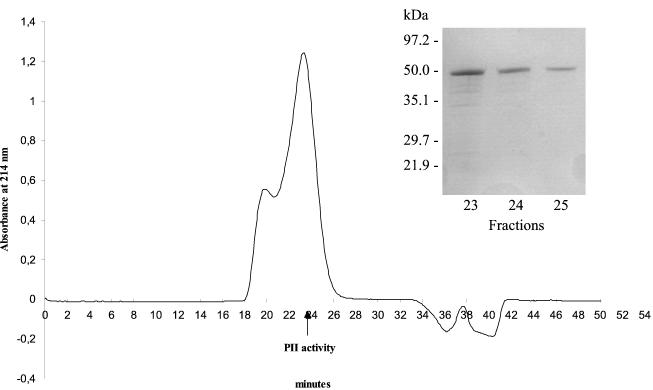
Heterologous expression of PII and purification of heterologous PII from A. niger strain AB1.13pclA:3. Extracellular proteases were purified by anion-exchange, hydrophobic-interaction, and size-exclusion chromatography (shown). Protease activities in the different fractions (every minute) were analyzed using the peptide substrate Bz-Phe-Val-Arg-NA. The arrow indicates major PII activity. Inserted is an SDS-PAGE of fraction 23-25.
FIG. 6.
FIG. 6.
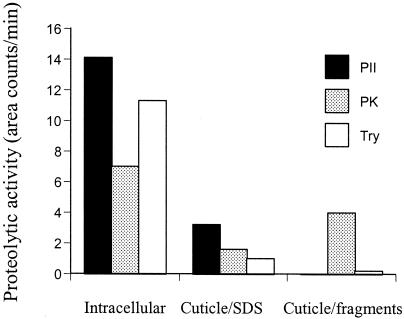
Hydrolysis of nematode cuticle and tissues by various serine proteases. The nematode P. redivivus was sonicated and separated into three fractions. Heterologous-produced PII, proteinase K (PK), or trypsin (Try) were added to the fractions and incubated at 37°C for 2 h. The amount of released peptides was assayed by using HPLC.
FIG. 7.
FIG. 7.
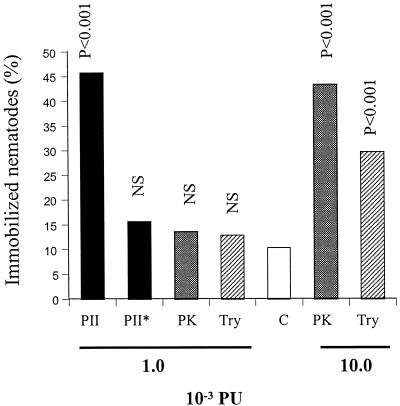
Nematotoxic activity of heterologous PII. The proteases were incubated with the nematode P. redivivus in microtiter wells. After 20 to 22 h the number of mobile and immobile (i.e., with arrested movements) nematodes were counted in a light microscope. Indicated significance levels are from χ2 tests (df = 1) comparing the frequencies of mobilized and immobilized nematodes in treated versus control samples (without enzymes). NS, not significant. PII, PII produced in A. niger; PII∗, boiled PII (10 min); PK, proteinase K; Try, trypsin; C, control (buffer). The proteolytic activities of the added enzymes, as measured by using the substrate Azocoll, are indicated.

References

    1. Åhman, J., B. Ek, L. Rask, and A. Tunlid. 1996. Sequence analysis and regulation of a gene encoding a cuticle-degrading serine protease from the nematophagous fungus Arthrobotrys oligospora. Microbiology 142:1605-1616. - PubMed
    1. Bennet, J. W., and L. L. Lasure. 1991. Growth media, p. 444-445. In J. W. Bennet and L. L. Lasure (ed.), More gene manipulations in fungi. Academic Press, San Diego, Calif.
    1. Bonants, P. J. M., P. F. L. Fitters, H. Thijs, E. Den-Belder, C. Waalwijk, and J. W. D. M. Henfling. 1995. A basic serine protease from Paecilomyces lilacinus with biological activity against Meloidogyne hapla eggs. Microbiology 141:775-784. - PubMed
    1. Campbell, W. C. 1982. Progress and prospects in the chemotherapy of nematode infections of man and other animals. J. Nematol. 15:608-615. - PMC - PubMed
    1. Carrol, A. M., J. A. Sweigard, and B. Valent. 1995. Improved vectors for selecting resistance to hygromycin. Fungal Gen. News 41:22.

Publication types

LinkOut - more resources