Comparative Study
. 2002 Jul 1;21(13):3327-36.
doi: 10.1093/emboj/cdf354.

GH3, a novel proapoptotic domain in Drosophila Grim, promotes a mitochondrial death pathway

Affiliations
Comparative Study

GH3, a novel proapoptotic domain in Drosophila Grim, promotes a mitochondrial death pathway

Cristina Clavería et al. EMBO J. .

Abstract

Grim encodes a protein required for programmed cell death in Drosophila. The Grim N-terminus induces apoptosis by disrupting IAP blockage of caspases; however, N-terminally-deleted Grim retains pro apoptotic activity. We describe GH3, a 15 amino acid internal Grim domain absolutely required for its proapoptotic activity and sufficient to induce cell death when fused to heterologous carrier proteins. A GH3 homology region is present in the Drosophila proapoptotic proteins Reaper and Sickle. The GH3 domain and the homologous regions in Reaper and Sickle are predicted to be structured as amphipathic alpha-helixes. During apoptosis induction, Grim colocalizes with mitochondria and cytochrome c in a GH3-dependent but N-terminal- and caspase activity-independent manner. When Grim is overexpressed in vivo, both the N-terminal and the GH3 domains are equally necessary, and cooperate for apoptosis induction. The N-terminal and GH3 Grim domains thus activate independent apoptotic pathways that synergize to induce programmed cell death efficiently.


Figures
None
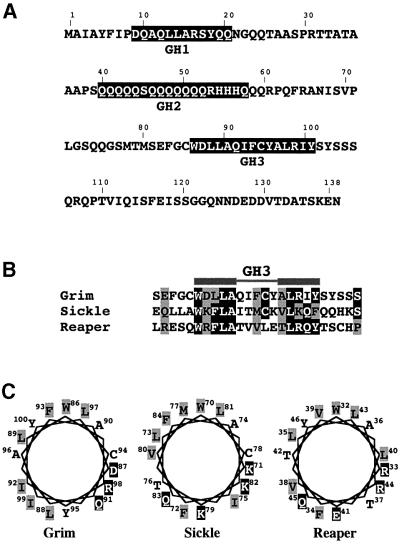
Fig. 1. Sequence and structural similarity between Grim GH3 domain, Reaper and Sickle. (A) Grim protein sequence showing the three predicted α-helices GH1–GH3 (black boxes). (B) Sequence alignment of the Grim GH3 domain with Sickle and Reaper. Black boxes identify highly similar residues and grey boxes show those with lesser similarity. (C) Helical wheel projection diagram of the Grim GH3 domain (left) and corresponding Sickle and Reaper homology regions, in which hydrophobic residues are shown in black over grey and hydrophilic residues in white over black.
None
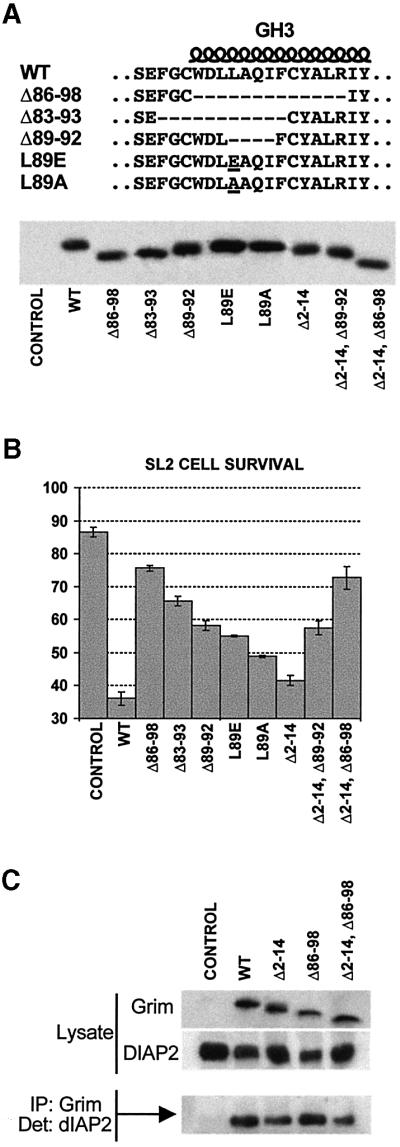
Fig. 2. Requirement of Grim N-terminal and GH3 domains for apoptosis induction and IAP binding. (A) Top, amino acid sequences of WT Grim GH3 and neighbouring residues, and of the mutant proteins synthesized. Bottom, western blot showing the stability of the various GH3 mutants and their combinations with the N-terminal deletion. (B) Bar diagram showing survival ratios of SL2 cells transfected with Grim and the various mutant forms. Survival ratios were calculated by comparing the ratio of LacZ-positive cells with and without copper induction; the result was expressed as a percentage. (C) Immuno precipitation showing the relevance of N-terminal and GH3 Grim domains for its association with DIAP2.
None
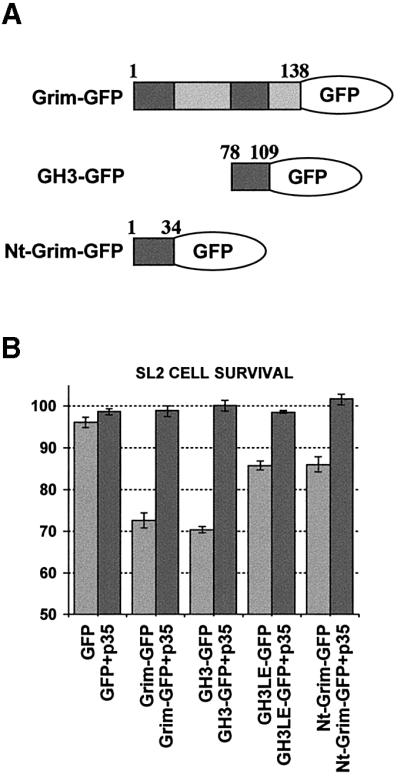
Fig. 3. The GH3 domain is sufficient to induce apoptosis in Drosophila SL2 cells. (A) Scheme shows the different GFP fusion proteins used, indicating the Grim amino acids included. (B) Bar diagram showing survival ratios of SL2 cells transfected with the different GFP fusion proteins with or without p35 coexpression. Survival ratios were calculated by comparing the ratio of LacZ-positive cells with and without copper induction; the result was expressed as a percentage.
None
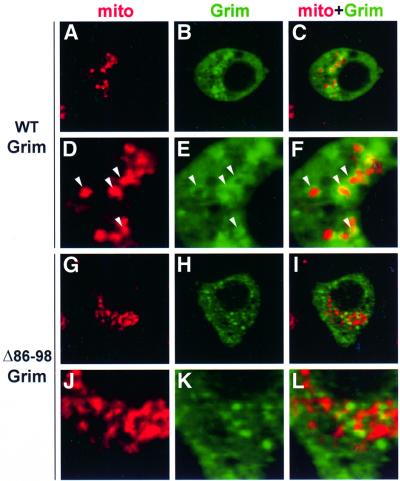
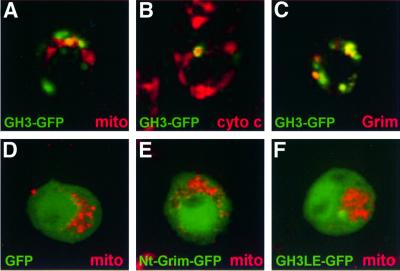
Fig. 4. Grim subcellular distribution associates with mitochondria in a GH3-dependent manner. Immunodetection of WT Grim or Δ86–98Grim (green), a mitochondrial marker (red), and their colocalization are shown as indicated. White arrowheads in (DF) indicate regions of Grim–mitochondrial staining association.
None
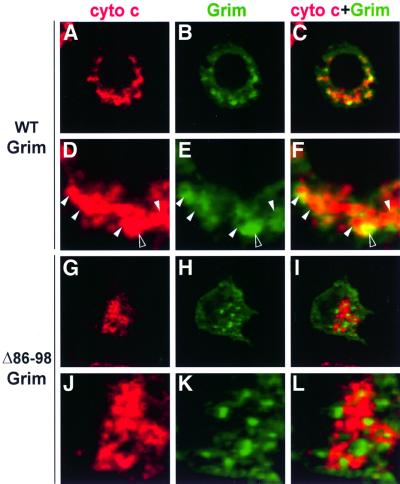
Fig. 5. Grim subcellular distribution associates with cytochrome c in a GH3-dependent manner. Immunodetection of WT Grim or Δ86–98Grim (green), cytochrome c (red), and their colocalization are shown as indicated. White arrowheads in (DF) indicate regions of Grim–cytochrome c staining association and/or colocalization; open arrowhead shows a region of strong Grim–cytochrome c staining and colocalization.
None
Fig. 6. Subcellular distribution of GFP fused to different Grim domains. GFP alone (D) or fused to Grim regions containing GH3 (AC), N-terminal (E) and GH3-L89E (F) domains are shown in green. Colocalization with mitochondria (red) is shown in (A), (D), (E) and (F), with cytochrome c (red) in (B), and with WT Grim (red) in (C).
None
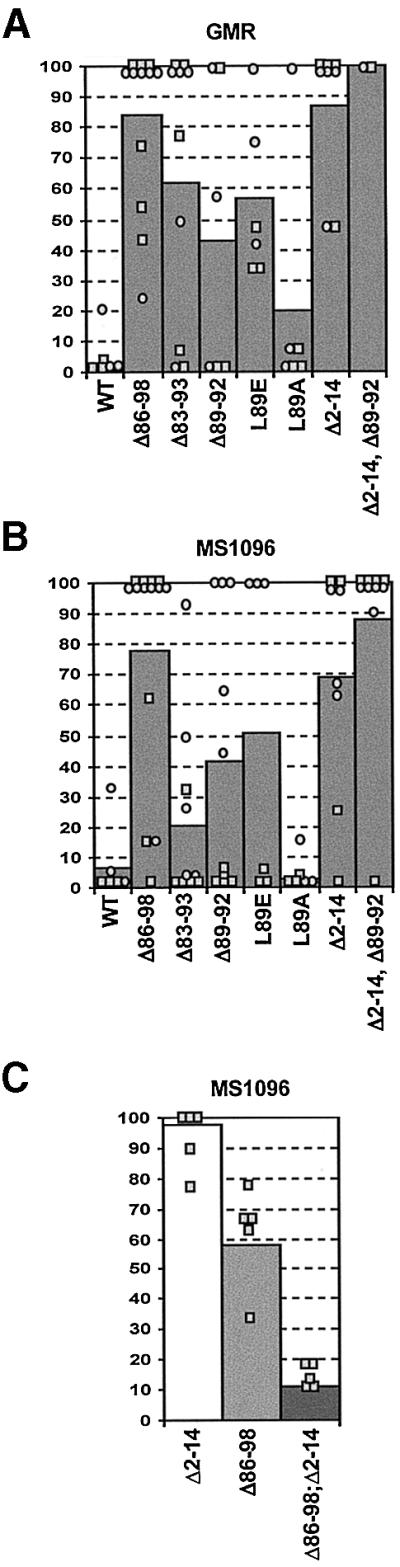
Fig. 7. Relevance of N-terminal and GH3 Grim domains during apoptosis induction in vivo. GMR-Gal4 (A) or MS1096-Gal4 (B) driver lines were crossed with several independent lines bearing UAS-Grim transgenes coding for the WT protein or the different mutant forms. Graphs show the viability of the independent transgenic lines analysed for each mutant. The GMR and MS1096 driver lines are located in the X chromosome. Due to hypertranscription of the male X chromosome, male viability was always lower than that of females; thus, male (squares) and female (circles) viability is shown independently. Bars represent the overall viability of each mutant, calculated by averaging results obtained with each independent line (males and females). Results were obtained from crosses at 18°C for GMR and 25°C for MS1096 lines. (C) Viability of transgenic male flies expressing Δ2–14 Grim or Δ86–98 Grim mutant proteins driven by MS1096-Gal4, alone or simultaneously, as indicated.
None
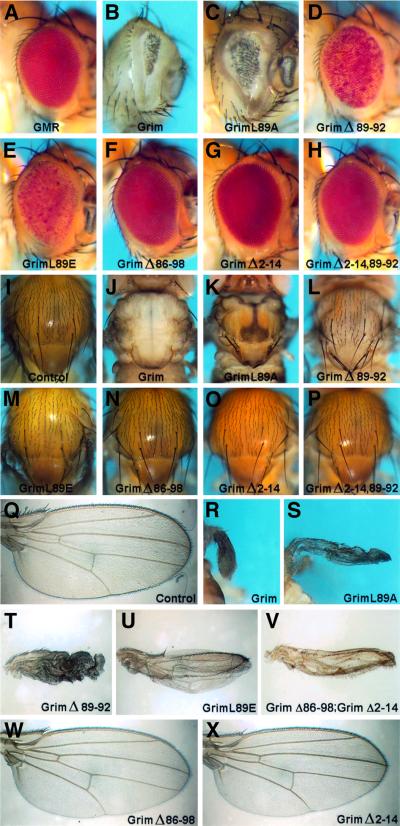
Fig. 8. Mutations in the GH3 and N-terminal domains rescue targeted tissue deletion by Grim in transgenic flies. Images show representative phenotypes induced in the eyes of GMR-Gal4;UAS-Grim (BH), and the notum (JP) and wings (RU, W and X) of MS1096-Gal4;UAS-Grim female adult flies. Results correspond to overexpression of WT Grim and the distinct Grim mutants, as indicated. (V) Wing of an MS1096-Gal4;UAS-GrimΔ86–98;UAS-GrimΔ2–14 male adult fly. (A) GMR-Gal4 fly, (I and Q) WT notum and wing.

References

    1. Abrams J.M. (1999) An emerging blueprint for apoptosis in Drosophila. Trends Cell Biol., 9, 435–440. - PubMed
    1. Aravind L., Dixit,V.M. and Koonin,E.V. (1999) The domains of death: evolution of the apoptosis machinery. Trends Biochem. Sci., 24, 47–53. - PubMed
    1. Ashburner M. (1989) Drosophila: A Laboratory Handbook. Cold Spring Harbor Laboratory Press, Cold Spring Harbor, NY, pp. 1017–1063.
    1. Bergmann A., Agapite,J., McCall,K. and Steller,H. (1998) The Drosophila gene hid is a direct molecular target of Ras-dependent survival signaling. Cell, 95, 331–341. - PubMed
    1. Brachmann C.B., Jassim,O.W., Wachsmuth,B.D. and Cagan,R.L. (2000) The Drosophila bcl-2 family member dBorg-1 functions in the apoptotic response to UV-irradiation. Curr. Biol., 10, 547–550. - PubMed

Publication types

MeSH terms