. 2002 Jul 1;21(13):3377-89.
doi: 10.1093/emboj/cdf334.

Drosophila cyclin E interacts with components of the Brahma complex

Affiliations

Drosophila cyclin E interacts with components of the Brahma complex

Anthony M Brumby et al. EMBO J. .

Abstract

Cyclin E-Cdk2 is essential for S phase entry. To identify genes interacting with cyclin E, we carried out a genetic screen using a hypomorphic mutation of Drosophila cyclin E (DmcycE(JP)), which gives rise to adults with a rough eye phenotype. Amongst the dominant suppressors of DmcycE(JP), we identified brahma (brm) and moira (mor), which encode conserved core components of the Drosophila Brm complex that is highly related to the SWI-SNF ATP-dependent chromatin remodeling complex. Mutations in genes encoding other Brm complex components, including snr1 (BAP45), osa and deficiencies that remove BAP60 and BAP111 can also suppress the DmcycE(JP) eye phenotype. We show that Brm complex mutants suppress the DmcycE(JP) phenotype by increasing S phases without affecting DmcycE protein levels and that DmcycE physically interacts with Brm and Snr1 in vivo. These data suggest that the Brm complex inhibits S phase entry by acting downstream of DmcycE protein accumulation. The Brm complex also physically interacts weakly with Drosophila retinoblastoma (Rbf1), but no genetic interactions were detected, suggesting that the Brm complex and Rbf1 act largely independently to mediate G(1) arrest.


Figures
None
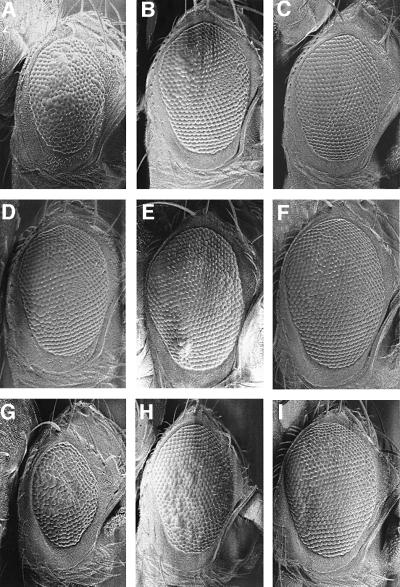
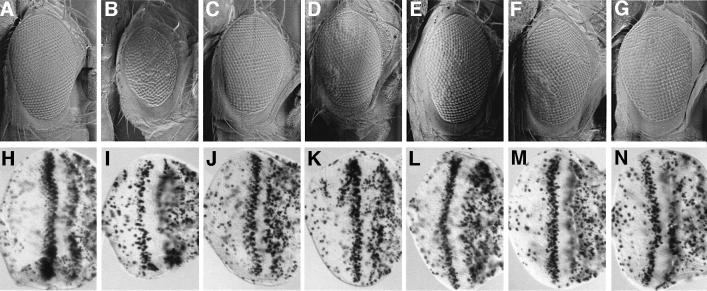
Fig. 1. brm and mor dominantly suppress the DmcycEJP rough eye phenotype by increasing S phases. (A–G) Scanning electron micrographs of adult eyes. (A) Wild-type (w1118); (BDmcycEJP; (CDmcycEJP; brm25S14/+; (DDmcycEJP; brm2/+; (EDmcycEJP; mor35S1/+; (FDmcycEJP; mor1/+; and (GbrmK804R; DmcycEJP. (H–N) Third instar larval eye imaginal discs labelled with BrdU. (H) Wild-type (w1118); (IDmcycEJP; (J) DmcycEJP; brm25S14/+; (KDmcycEJP; brm2/+; (LDmcycEJP; mor35S1/+; (MDmcycEJP; mor1/+; and (NbrmK804R; DmcycEJP. Adult eyes and larval imaginal discs are orientated anterior to the right in this and all subsequent figures.
None
Fig. 2. Dominant suppression of DmcycEJP rough eye phenotype by SWI–SNF genes. Scanning electron micrographs of DmcycEJP adult eyes. (A–F) In the background of w/+; b DmcycEJP bw/DmcycEJP. (A) +; (B) snr101319/+; (Csnr1R3/+; (Dosa00090/+; (EosaS3263b/+; (FDf(BAP111)/+. (G–I) In the background of w; DmcycEJP, which is slightly more extreme than w/+; b DmcycEJP bw/DmcycEJP. (G) +; (HP[w+; UASGALhsp70-snr1-cdel.3] snr1R3/P[w+; 69B-GAL4]. (IP[w+; UASGALhsp70-snr1-cdel.3] snr1R3/P[w+; Act5C-GAL4].
None
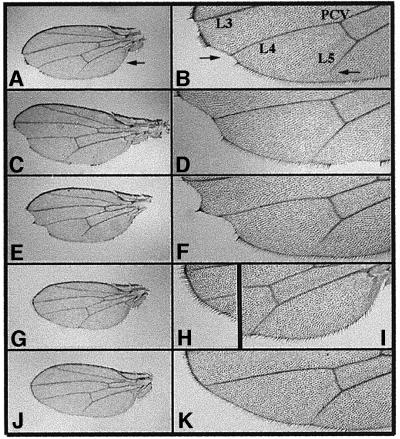
Fig. 3. Suppression of DmcycEJP wing phenotypes by mutations in brm and by ectopic expression of a snr1 deletion transgene. Wings were dissected from flies homozygous for the DmcycEJP mutation on the second chromosome and either wild-type or heterozygous for various mutations and/or transgenes carried on the third chromosome. Wings shown in (A), (C), (E), (G) and (J) are at the same magnification, as are the magnified views of the same wings shown in (B), (D), (F), (H), (I) and (K). (A and B) Flies homozygous for DmcycEJP alone shown as a whole wing view (A) or at increased magnification (B). Note the notching at the posterior/distal wing margin, the missing hairs along the posterior/proximal wing blade and shortening of the fifth longitudinal vein (L5), indicated by arrows in (A) and (B). Also indicated are the positions of the L3 and L4 longitudinal veins and the posterior cross-vein (PCV). (C–K) DmcycEJP containing heterozygous mutations and/or transgenes on the third chromosome. (C and Dw; DmcycEJP; P[w+; Act5C-GAL4]/TM3. Note the phenotypes similar to those observed in (A) and (B). (E and Fw; DmcycEJP, P[w+; UASGALhsp70-snr1-cdel.3], snr1R3/TM3. (GIw; DmcycEJP, P[w+; UASGALhsp70-snr1-cdel.3], snr1R3/P[w+; Act5C-GAL4]. Note the suppression of both the wing margin and L5 defects in flies that ubiquitously overexpress the snr1-cdel.3 truncated transgene with a heterozygous snr1R3 mutation. Shown in (H) and (I) are magnified views of the wing margin (shown in G) between the L3 and L4 veins. (J and Kw; DmcycEJP; brm2/TM3. Note the suppression of the wing defects similar to those observed with overexpression of the snr1-cdel.3 truncation transgene shown above.
None
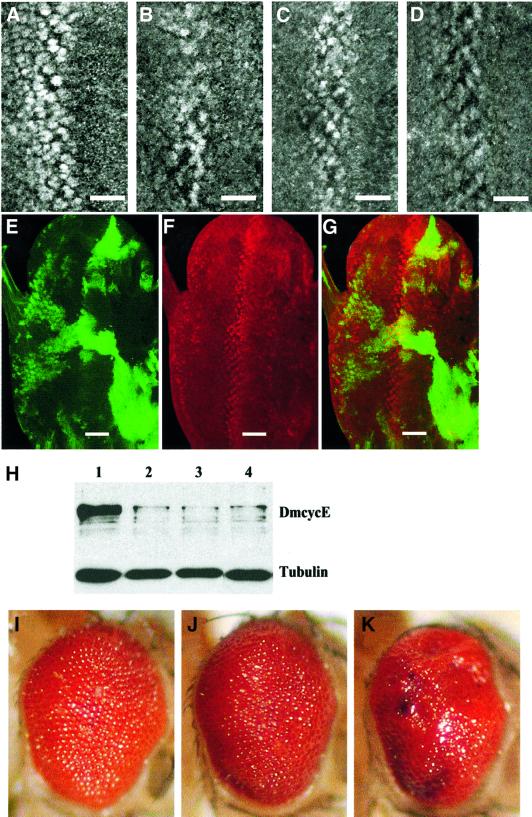
Fig. 4. The Brm complex does not affect DmcycE protein levels and functions genetically downstream of DmcycE transcription. DmcycE antibody staining of larval eye imaginal discs from (A) wild-type; (BDmcycEJP; (CDmcycEJP; brm25S14/+; and (DDmcycEJP; mor1/+. (E–G) DmcycE antibody staining and GFP fluorescence from an ey-FLP, UAS-GFP; Tb-GAL4 FRT(82B) GAL80/FRT(82B) UAS-brmK804R eye disc. (E) GFP (green) marks the clones expressing UAS-brmK804R. (F) DmcycE antibody staining. (G) Merge. Note that in clones expressing UAS-brmK804R distant from the normal band of cyclin E staining, cyclin E is not expressed ectopically. The bar indicates the position of the morphogenetic furrow. (H) Western analysis of DmcycE protein (upper panel) or tubulin (lower panel) in eye imaginal discs from wild-type (lane 1); DmcycEJP (lane 2); DmcycEJP; brm25S14/+ (lane 3); and DmcycEJP; mor1/+ (lane 4). Since DmcycEJP affects the eye imaginal disc but not the antennal disc, the antennal disc was removed from the eye disc before protein was prepared. Quantitation of band intensities from the DmcycE immunoblot normalized to tubulin showed that the level of DmcycE in DmcycEJP eye discs was not increased by halving the dosage of brm or mor. (I–K) Adult eyes from (IGMR-GAL4, UAS-DmcycE/+; GMR-p35/+; (JGMR-GAL4, UAS-DmcycE/+; GMR-p35/brm25S14; and (KGMR-GAL4, UAS-DmcycE/+; GMR-p35/mor35S1.
None
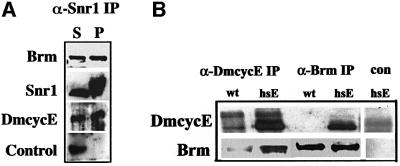
Fig. 5. Brm and Snr1 form a complex with cyclin E. (A) Snr1 and Brm form a complex with DmcycE in embryos. Native wild-type embryo extracts (500 µg) were incubated with affinity-purified Snr1 rabbit antibodies and precipitated with protein G–Sepharose beads. The presence of Brm, Snr1, DmcycE and a control nuclear protein was examined in the supernatant (S) and in the pelleted material eluted from the Sepharose beads (P) by immunoblotting. The supernatant tracks represent one-tenth of the immunoprecipitated tracks. (B) Brm forms a complex with DmcycE in larval brains/discs. Larval extracts were prepared from w1118 or a line transgenic for hsp70-DmcycE and incubated with an anti-DmcycE (8B10) or anti-Brm antibodies and precipitated with protein A–Sepharose beads. Pelleted proteins were examined for the presence of Brm (lower panel) and DmcycE (upper panel) by immunoblotting. The control immunoprecipitation was carried out using DmcycE pre-immune serum.
None
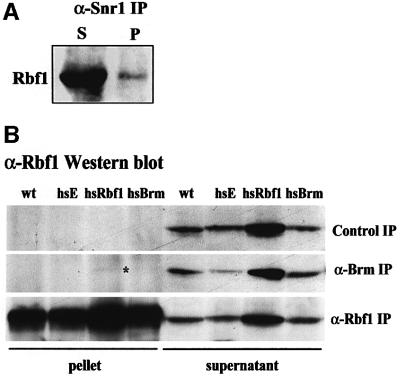
Fig. 6. Brm and Snr1 physically interact weakly with Rbf1. (A) Snr1 and Rbf1 physically interact weakly in embryos. Embryo extracts were incubated with affinity-purified anti-Snr1 antibodies and precipitated with protein G–Sepharose beads. The presence or Rbf1 was examined in the supernatant (S) and in the pelleted material eluted from the beads (P) by immunoblotting. (B) Rbf1 and Brm weakly physically interact in larval brains/discs. Extracts prepared from w1118 or heat-shocked hsp70-DmcycE (hsE), hsp70-rbf1 (hsRbf1) or hsp70-GAL4, UAS-brmK804R (hsBrm) larvae were immunoprecipitated with anti-Rbf1 or anti-Brm antibodies. Pelleted proteins and the supernatants were examined for the presence of Rbf1 by immunoblotting. Rbf1 was detected weakly in Brm immunoprecipitates in the hsRbf1 track (*). The control immunoprecipitation was carried out using protein A–Sepharose beads alone. (A and B) The supernatant tracks represent one-tenth of the immunoprecipitated tracks. Quantitation of band intensities showed that only a small fraction of total Rbf1 is co-immunoprecipitated with Snr1 or with Brm.
None
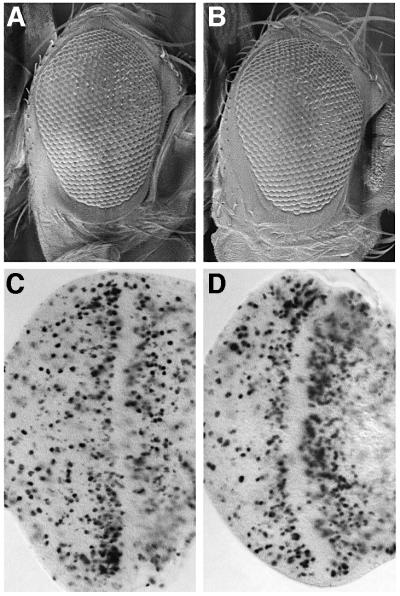
Fig. 7. brm or mor do not interact genetically with rbf1. Scanning electron micrographs of adult eyes from (Arbf1120a/rbf111 and (Brbf1120a/rbf111; brm25S14, +/+, mor35S1. (C and D) BrdU labeling of eye imaginal discs from (Crbf1120a/rbf111 and (Drbf1120a/rbf111; brm25S14, +/+, mor35S1.

References

    1. Austin R., Orr-Weaver,T.L. and Bell,S.P. (1999) Drosophila Orc specifically binds to Ace3, an origin of DNA replication control element. Genes Dev., 13, 2639–2649. - PMC - PubMed
    1. Brand A.H. and Perrimon,N. (1993) Targeted gene expression as a means of altering cell fates and generating dominant phenotypes. Development, 118, 401–415. - PubMed
    1. Bosco G., Du,W. and Orr-Weaver,T.L. (2001) DNA replication control through interaction of E2F-RB and the origin recognition complex. Nature Cell Biol., 3, 289–295. - PubMed
    1. Collins R.T. and Treisman,J.E. (2000) Osa-containing Brahma chromatin remodeling complexes are required for the repression of wingless target genes. Genes Dev., 14, 3140–3152. - PMC - PubMed
    1. Collins R.T., Furukawa,T., Tanese,N. and Treisman,J.E. (1999) Osa associates with the Brahma chromatin remodeling complex and promotes the activation of some target genes. EMBO J., 18, 7029–7040. - PMC - PubMed

Publication types

MeSH terms