Comparative Study
. 2002 Jul 1;21(13):3476-85.
doi: 10.1093/emboj/cdf352.

Molecular basis of sequence-specific single-stranded DNA recognition by KH domains: solution structure of a complex between hnRNP K KH3 and single-stranded DNA

Affiliations
Comparative Study

Molecular basis of sequence-specific single-stranded DNA recognition by KH domains: solution structure of a complex between hnRNP K KH3 and single-stranded DNA

Demetrios T Braddock et al. EMBO J. .

Abstract

To elucidate the basis of sequence-specific single-stranded (ss) DNA recognition by K homology (KH) domains, we have solved the solution structure of a complex between the KH3 domain of the transcriptional regulator heterogeneous nuclear ribonucleoprotein K (hnRNP K) and a 10mer ssDNA. We show that hnRNP K KH3 specifically recognizes a tetrad of sequence 5'd-TCCC. The complex is stabilized by a dense network of methyl-oxygen hydrogen bonds involving the methyl groups of three isoleucine residues and the O2 and N3 atoms of the two central cytosine bases. Comparison with the recently solved structure of a specific protein-ssDNA complex involving the KH3 and KH4 domains of the far upstream element (FUSE) binding protein FBP suggests that the amino acid located five residues N-terminal of the invariant GXXG motif, which is characteristic of all KH domains, plays a crucial role in discrimination of the first two bases of the tetrad.


Figures
None
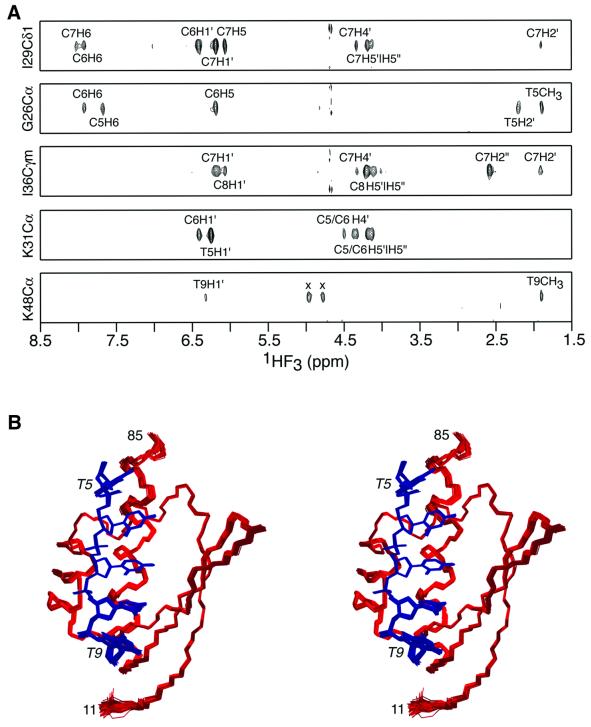
Fig. 1. Solution structure of the hnRNP K KH3–ssDNA complex. (A) Strips from a 3D 13C-separated/12C-filtered NOE experiment illustrating intermolecular NOEs between protein protons attached to 13C and DNA protons attached to 12C (along the F3 axis). (The two peaks in the lower panel marked by an x are residual diagonal peaks.) (B) Stereoview showing a superposition of the final 125 simulated annealing structures. The protein backbone (residues 11–85) is shown in red, and the DNA (nucleotides 5–9) in blue. Residues 1–10 and 86–90 of the protein are disordered in solution. Only the nucleotides that interact with the protein are shown. Although the whole ssDNA 10mer displays NOEs characteristic of right-handed DNA, the orientation of the nucleotides that do not contact the protein relative to the core complex (residues 11–85 and nucleotides 5–9) is poorly determined by the experimental data.
None
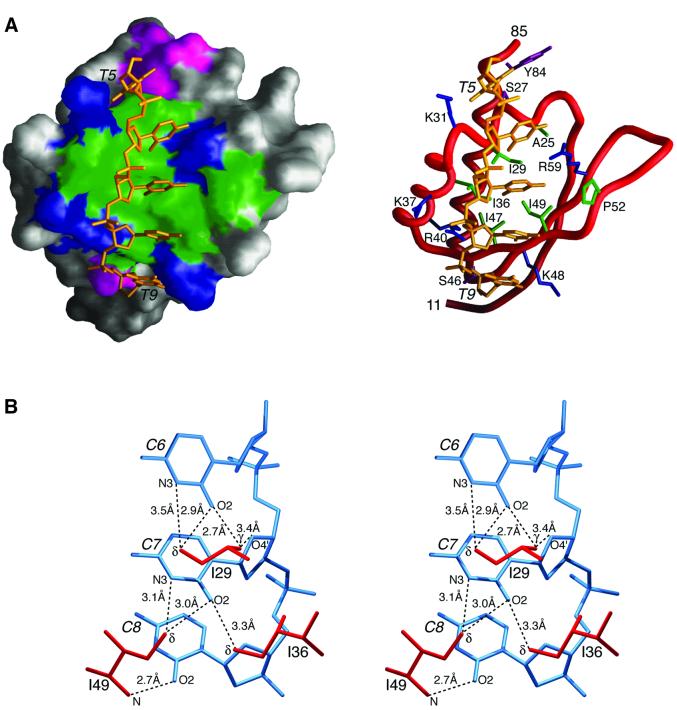
Fig. 2. ssDNA binding by hnRNP K KH3. (A) Overall complex. The protein is displayed as a molecular surface (left) and as a backbone tube (right); hydrophobic, uncharged hydrophilic, positively charged and negatively charged residues located in the ssDNA binding site are depicted in green, magenta, blue and red, respectively; the ssDNA heavy atoms are in gold. (B) Detailed stereoview showing the hydrogen-bonding interactions of the methyl groups of Ile29, Ile36 and Ile49 with the O2 and N3 atoms of the cytosine bases. Nucleotide numbering is in italics.
None
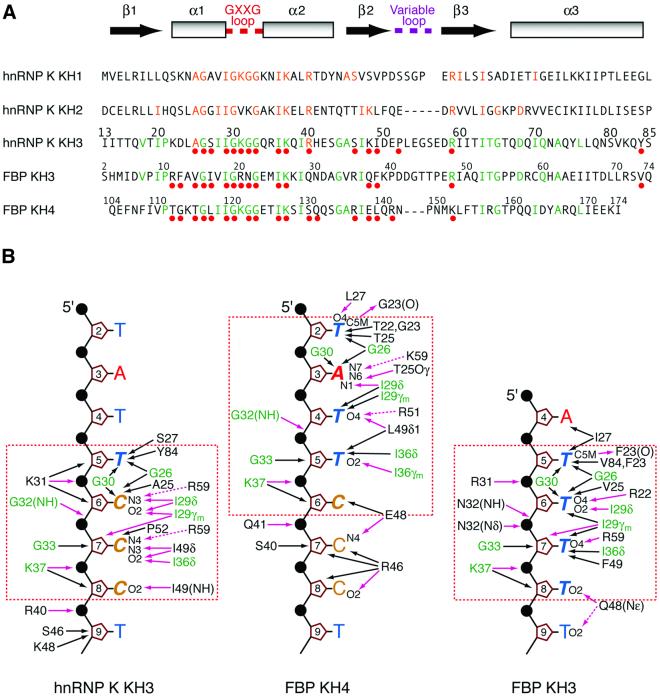
Fig. 3. Comparison of the interaction of hnRNP K KH3, FBP KH3 and FBP KH4 with ssDNA. (A) Structure-based sequence alignment of the KH domains of hnRNP K and the KH3 and KH4 domains of FBP. The location of the secondary structure elements is shown at the top of the figure. The loop connecting strands β2 and β3 is variable in length (five residues in hnRNP K KH1, six residues in hnRNP K KH3 and FBP KH3, seven residues in hnRNP K KH2, and nine residues in FBP KH4). Residues that contact the DNA in the complexes of hnRNP K KH3, FBP KH3 and FBP KH4 with ssDNA are indicated by the solid red circles. Residues in the KH3 and KH4 domains of FBP that are identical in the KH domain of hnRNP K KH3 are colored green; residues in the KH1 and KH2 domains of hnRNP that are identical in the KH3 domain of hnRNP K are colored orange. The numbering scheme for hnRNP K KH3 is shown above the hnRNP K KH3 sequence; the numbering of FBP KH3 and KH4 used by Braddock et al. (2002) is indicated in smaller numerals above their respective sequences. For the structurally aligned sequences shown in the figure, the overall percentage sequence identities of hnRNP K KH1, hnRNP K KH2, FBP KH3 and FBP KH4 to hnRNP K KH3 are 23, 24, 26 and 32%, respectively. (B) Summary of interactions between hnRNP K KH3, FBP KH4 and FBP KH3 and ssDNA. The protein residue and ssDNA nucleotide numbering employed is that of the hnRNP K KH3–ssDNA complex. Residues at the protein–ssDNA interface that are common to all three complexes are shown in green. Hydrogen bonds and salt bridges are represented by purple arrows; the dashed arrows indicate potential electrostatic interactions, either direct or water mediated. The core recognition sequences are enclosed by the dashed orange box. The ssDNA 10mers used for the complexes with hnRNP K KH3 and FBP KH4 are identical. The core recognition elements for hnRNP K KH3 and FBP KH3 are the tetrads 5′d-TCCC and 5′d-TTTT, respectively; the core recognition element for FBP KH4 is a pentad of sequence 5′d-TATTC. The first two nucleotides of each recognition sequence form a vice that grips helix 1 in all three complexes, and the nature of the amino acid at positions 25 (numbering scheme of hnRNP K KH3) is critical for determining the register of ssDNA binding: Ala for the KH domains of hnRNPK, Thr for FBP KH4 and Val for FBP KH3. The intermolecular contacts observed in the FBP KH3 and KH4 complexes were analyzed from the coordinates of Braddock et al. (2002) (accession code 1J4W).
None
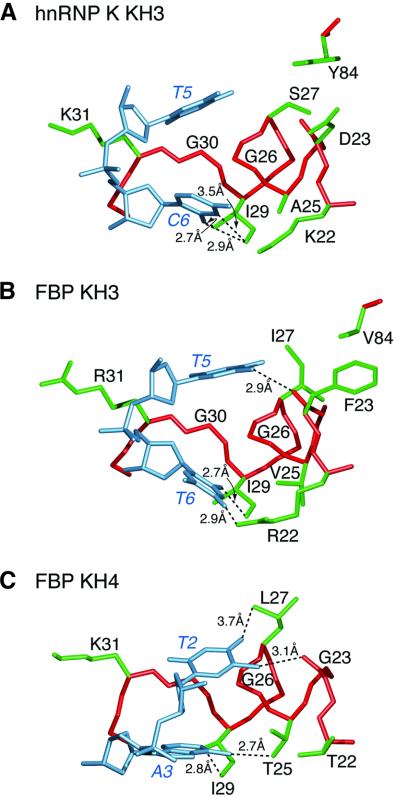
Fig. 4. Discrimination of the first two first bases of the ssDNA recognition site by KH domains of hnRNP K and FBP. (A) hnRNP K KH3 recognizes TC, (B) FBP KH3 recognizes TT and (C) FBP KH4 recognizes TA. The protein backbone and side chains are shown in red and green, respectively, and the DNA in light blue. The numbering scheme employed is that of the hnRNP K KH3–ssDNA complex. Dashed lines indicate intermolecular hydrogen bonds. The residue at position 25 plays a key role in selection of the first two bases of the site. The coordinates of the FBP KH3/KH4 complex (accession code 1J4W) are taken from Braddock et al. (2002).
None

References

    1. Baber J.L., Libutti,D., Levens,D. and Tjandra,N. (1999) High-precision solution structure of the C-terminal KH domain of heterogeneous nuclear ribonucleoprotein J, a c-myc transcription factor. J. Mol. Biol., 289, 949–962. - PubMed
    1. Baber J.L., Levens,D., Libutti,D. and Tjandra,N. (2000) Chemical shift mapped DNA-binding sites and the 15N relaxation analysis of the C-terminal KH domain of heterogeneous nuclear ribonucleoprotein K. Biochemistry, 39, 6022–6032. - PubMed
    1. Bax A., Vuister,G.W., Grzesiek,S., Delaglio,F., Wang,A.C., Tschudin,R. and Zhu,G. (1994) Measurement of homo- and heteronuclear J-couplings from quantitative J correlation spectroscopy. Methods Enzymol., 239, 79–106. - PubMed
    1. Bomsztyk K., van Seuningen,I., Suzuki,H., Denisenko,O. and Ostrowski,J. (1997) Diverse molecular interactions of the hnRNP K protein. FEBS Lett., 403, 113–115. - PubMed
    1. Braddock D.T., Louis,J.M., Baber,J.L., Levens,D. and Clore,G.M. (2002) Structure and dynamics of KH domains from FBP bound to ss DNA. Nature, 415, 1051–1056. - PubMed

Publication types

MeSH terms

Associated data