. 2002 Jul 1;196(1):129-34.
doi: 10.1084/jem.20020063.

Suppression of lymphoma and epithelial malignancies effected by interferon gamma

Affiliations

Suppression of lymphoma and epithelial malignancies effected by interferon gamma

Shayna E A Street et al. J Exp Med. .

Abstract

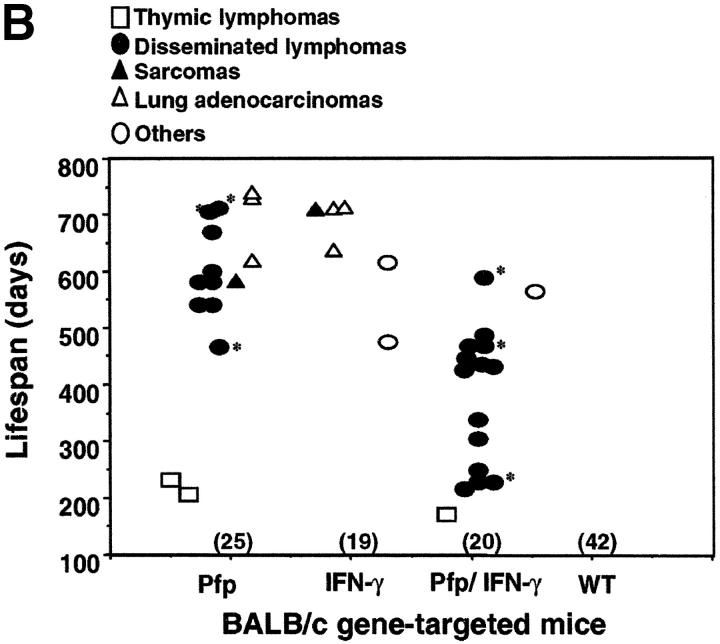
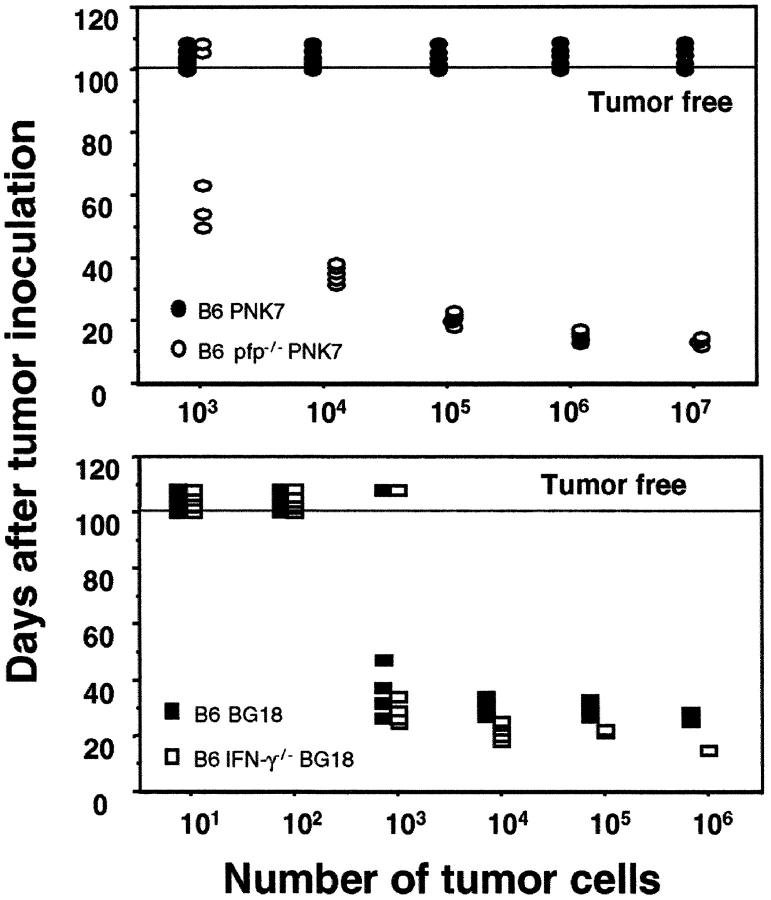
The immunosurveillance of transformed cells by the immune system remains one of the most controversial and poorly understood areas of immunity. Gene-targeted mice have greatly aided our understanding of the key effector molecules in tumor immunity. Herein, we describe spontaneous tumor development in gene-targeted mice lacking interferon (IFN)-gamma and/or perforin (pfp), or the immunoregulatory cytokines, interleukin (IL)-12, IL-18, and tumor necrosis factor (TNF). Both IFN-gamma and pfp were critical for suppression of lymphomagenesis, however the level of protection afforded by IFN-gamma was strain specific. Lymphomas arising in IFN-gamma-deficient mice were very nonimmunogenic compared with those derived from pfp-deficient mice, suggesting a comparatively weaker immunoselection pressure by IFN-gamma. Single loss of IL-12, IL-18, or TNF was not sufficient for spontaneous tumor development. A significant incidence of late onset adenocarcinoma observed in both IFN-gamma- and pfp-deficient mice indicated that some epithelial tissues were also subject to immunosurveillance.


Figures
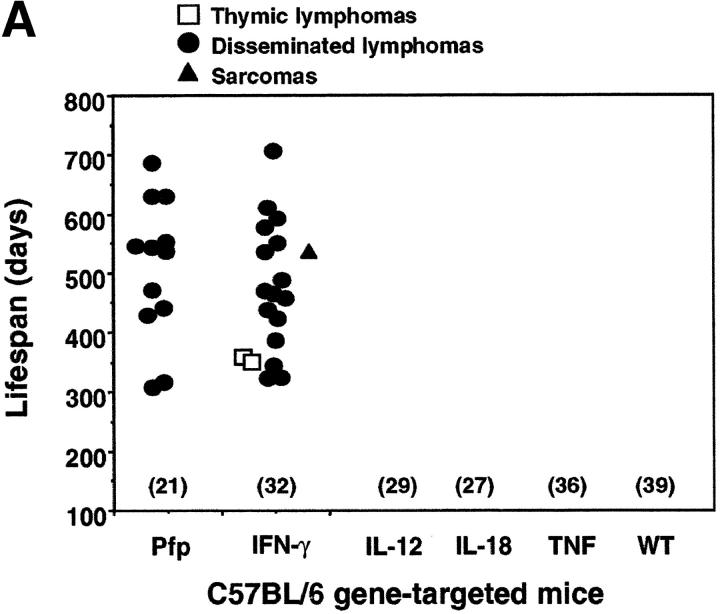
Figure 1.
Figure 1.
Pfp and IFN-γ protect mice from spontaneous lymphoma. The appearance of tumors was recorded in mice of (A) C57BL/6 and (B) BALB/c backgrounds as indicated. Groups of mice (number in parentheses) were evaluated on a weekly basis and, when moribund, tumor type (white squares, thymic lymphoma; black squares, disseminated lymphoma; black triangles, sarcoma; white triangles, lung adenocarcinoma; and white circles, other tumors) recorded against the age at the time of death/autopsy (in days). *, disseminated lymphomas of histiocyte morphology. No tumors were observed in heterozygote control groups of (B6 × B6 IFN-γ−/−)F1(n = 17), (BALB/c × BALB/c IFN-γ−/−)F1 (n = 12), and (BALB/c × BALB/c pfp−/−)F1 (n = 18) mice over a 750-d period. A small number of the oldest surviving BALB/c IFN-γ−/− mice (700–750 d) also developed nonmalignant mucosal hamartomas in the stomach.
Figure 1.
Figure 1.
Pfp and IFN-γ protect mice from spontaneous lymphoma. The appearance of tumors was recorded in mice of (A) C57BL/6 and (B) BALB/c backgrounds as indicated. Groups of mice (number in parentheses) were evaluated on a weekly basis and, when moribund, tumor type (white squares, thymic lymphoma; black squares, disseminated lymphoma; black triangles, sarcoma; white triangles, lung adenocarcinoma; and white circles, other tumors) recorded against the age at the time of death/autopsy (in days). *, disseminated lymphomas of histiocyte morphology. No tumors were observed in heterozygote control groups of (B6 × B6 IFN-γ−/−)F1(n = 17), (BALB/c × BALB/c IFN-γ−/−)F1 (n = 12), and (BALB/c × BALB/c pfp−/−)F1 (n = 18) mice over a 750-d period. A small number of the oldest surviving BALB/c IFN-γ−/− mice (700–750 d) also developed nonmalignant mucosal hamartomas in the stomach.
Figure 2.
Figure 2.
Distinct behavior of lymphomas arising in B6 pfp−/− mice and B6 IFN-γ2/− mice. Primary lymphomas arising in B6 pfp−/− (top) and B6.IFN-γ2/− (bottom) were secondarily transplanted intraperitoneally (101–107 cells in 0.2 ml PBS, as indicated) into groups of five untreated B6 WT (black circles or squares), B6 pfp−/− (white circles) or B6 IFN-γ−/− (white squares) mice. Mice were monitored for 100 d and each symbol depicts an individual mouse. Tumor-free mice are indicated above the horizontal line. The results are representative of seven primary lymphomas and three primary lymphomas transplanted from B6 pfp−/− and B6 IFN-γ−/− mice, respectively. Top, PNK-7 (B cell lymphoma from B6 pfp−/− mouse); bottom, BG18 (T cell lymphoma from B6 IFN-γ−/− mouse).

References

    1. Gresser, I., F. Belardelli, C. Maury, M.T. Maunoury, and M.G. Tovey. 1983. Injection of mice with antibody to interferon enhances the growth of transplantable murine tumors. J. Exp. Med. 158:2095–2107. - PMC - PubMed
    1. Tuttle, T.M., C.W. McCrady, T.H. Inge, M. Salour, and H.D. Bear. 1993. γ-interferon plays a key role in T-cell-induced tumor regression. Cancer Res. 53:833–839. - PubMed
    1. Takeda, K., Y. Hayakawa, M.J. Smyth, N. Kayagaki, N. Yamaguchi, S. Kakuta, Y. Iwakura, H. Yagita, and K. Okumura. 2001. Involvement of tumor necrosis factor-related apoptosis-inducing ligand in surveillance of tumor metastasis by liver natural killer cells. Nat. Med. 7:94–100. - PubMed
    1. van den Broek, M.F., D. Kagi, R.M. Zinkernagel, and H. Hengartner. 1995. Perforin dependence of natural killer cell-mediated tumor control in vivo. Eur. J. Immunol. 25:3514–3516. - PubMed
    1. van den Broek, M.E., D. Kagi, F. Ossendorp, R. Toes, S. Vamvakas, W.K. Lutz, C.J. Melief, R.M. Zinkernagel, and H. Hengartner. 1996. Decreased tumor surveillance in perforin-deficient mice. J. Exp. Med. 184:1781–1790. - PMC - PubMed

Publication types

MeSH terms