Comparative Study
. 2002 Jul 9;99(14):9509-14.
doi: 10.1073/pnas.132181499. Epub 2002 Jul 1.

The complete genome sequence of Chlorobium tepidum TLS, a photosynthetic, anaerobic, green-sulfur bacterium

Affiliations
Comparative Study

The complete genome sequence of Chlorobium tepidum TLS, a photosynthetic, anaerobic, green-sulfur bacterium

Jonathan A Eisen et al. Proc Natl Acad Sci U S A. .

Abstract

The complete genome of the green-sulfur eubacterium Chlorobium tepidum TLS was determined to be a single circular chromosome of 2,154,946 bp. This represents the first genome sequence from the phylum Chlorobia, whose members perform anoxygenic photosynthesis by the reductive tricarboxylic acid cycle. Genome comparisons have identified genes in C. tepidum that are highly conserved among photosynthetic species. Many of these have no assigned function and may play novel roles in photosynthesis or photobiology. Phylogenomic analysis reveals likely duplications of genes involved in biosynthetic pathways for photosynthesis and the metabolism of sulfur and nitrogen as well as strong similarities between metabolic processes in C. tepidum and many Archaeal species.


Figures
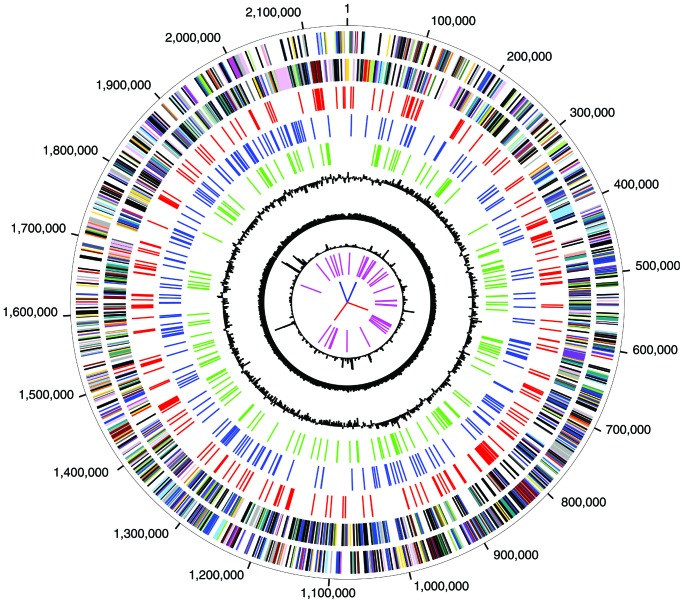
Figure 1
Figure 1
Circular representation of the C. tepidum genome. Circles 1 and 2: predicted protein-coding regions on the plus and minus strand, color-coded by putative role categories as in ref. . Circles 3, (red), 4 (blue), and 5 (green): proteins with top matches to proteins from Archaea, photosynthetic species, and C. tepidum, respectively. Other circles: 6, GC skew; 7, percent G+C; 8, χ2 value for trinucleotide composition in a 2,000-bp window; 9, tRNA genes; and 10, rRNA genes (blue) and sRNA genes (red).
Figure 2
Figure 2
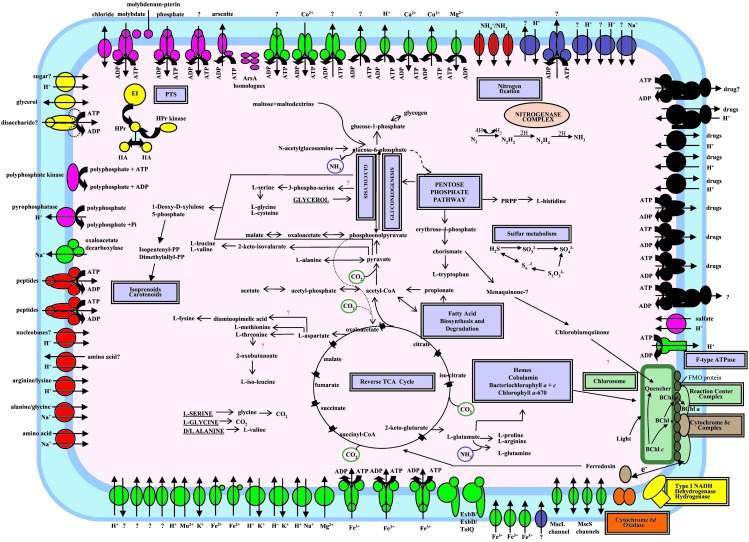
Overview of known and predicted metabolism (energy production and organic compounds) and transport in C. tepidum. Transporters are grouped by substrate specificity: inorganic cations (green), inorganic anions (pink), carbohydrates (yellow), amino acids/peptides/amines/purines and pyrimidines (red), drugs (black), other (blue), and uncertain specificity (??). Arrows indicate direction of transport. Energy coupling mechanisms are also shown: solutes transported by channel proteins (double-headed arrow); secondary transporters (two-arrowed lines indicating both the solute and the coupling ion); ATP-driven transporters (ATP hydrolysis reaction); and unknown energy coupling mechanism (single arrow).
Figure 3
Figure 3
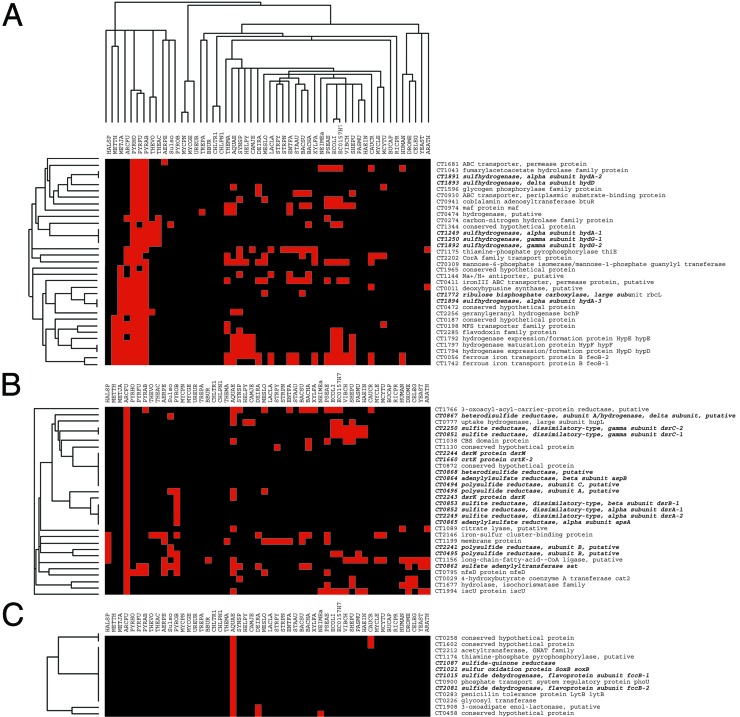
Phylogenetic (PG) profile analysis of C. tepidum. C. tepidum proteins were clustered according to their distribution patterns across species for which complete genomes are available, using the single-linkage clustering algorithm with column weighting of CLUSTER (http://rana.lbl.gov). A protein was considered present (and is shown in red) if there is a match with an E-value ≤ 10−15. Clusters were viewed with TREEVIEW (http://rana.lbl.gov). (A) PG profile of C. tepidum's large subunit RubisCO homolog showing its grouping with some genes involved in S metabolism. (B and C) PG profile of many of C. tepidum's other S metabolism genes.

References

    1. Wahlund T M, Woese C R, Castenholz R W, Madigan M T. Arch Microbiol. 1991;156:81–90.
    1. Golbeck J H. Proc Natl Acad Sci USA. 1993;90:1642–1646. - PMC - PubMed
    1. Evans M C, Buchanan B B, Arnon D I. Proc Natl Acad Sci USA. 1966;55:928–934. - PMC - PubMed
    1. Cavalier-Smith T. J Mol Evol. 2001;53:555–595. - PubMed
    1. Gruber T M, Bryant D A. Arch Microbiol. 1998;170:285–296. - PubMed

Publication types

MeSH terms

Associated data