


A genetic locus for adolescent idiopathic scoliosis linked to chromosome 19p13.3
- PMID: 12094330
- PMCID: PMC379172
- DOI: 10.1086/341607
A genetic locus for adolescent idiopathic scoliosis linked to chromosome 19p13.3
Abstract
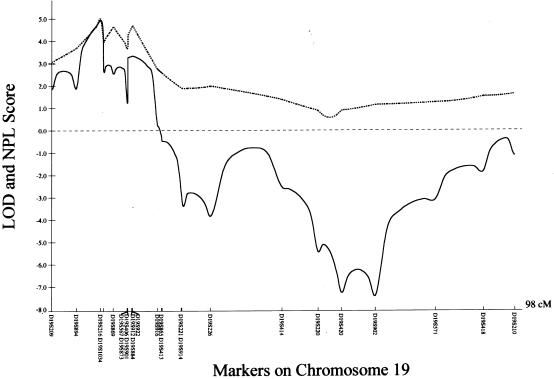
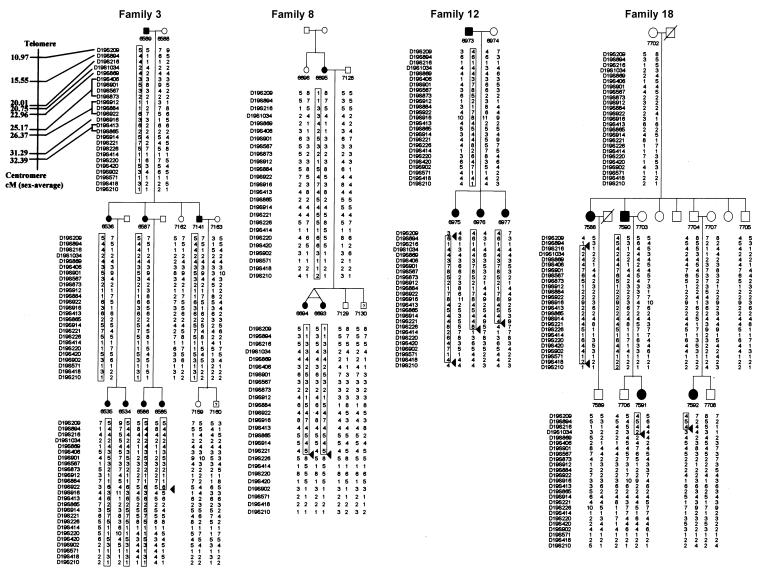
Adolescent idiopathic scoliosis (AIS) is one of the most common orthopedic disorders, affecting up to 4% of schoolchildren worldwide. We studied seven unrelated multiplex families of southern Chinese descent with AIS, consisting of 25 affected members. A genomewide scan with >400 fluorescent microsatellite markers was performed. Multipoint linkage analysis by GENEHUNTER revealed significant linkage of the abnormal phenotype to the distal short arm of chromosome 19, with both a maximum multipoint LOD score and a nonparametric LOD score of 4.93. Two-point linkage analysis by MLINK gave a LOD score of 3.63 (recombination fraction theta[m=f]=0.00) at D19S216. Further high-density mapping and informative recombinations defined the AIS critical region in the vicinity of D19S216, flanked by D19S894 and D19S1034, spanning 5.2 cM on the sex-averaged genetic map on chromosome 19p13.3.
Figures
References
Electronic-Database Information
-
- Center for Medical Genetics, http://research.marshfieldclinic.org/genetics/ (for the Marshfield comprehensive human linkage map)
-
- Genome Database, The, http://www.gdb.org/
-
- National Center for Biotechnology Information, http://www.ncbi.nlm.nih.gov/
-
- Online Mendelian Inheritance in Man (OMIM), http://www.ncbi.nlm.nih.gov/Omim/ (for IS [MIM 181800]) - PubMed
-
- Stanford Human Genome Center, http://shgc-www.stanford.edu/
References
-
- Adams W (1865) Lectures on pathology and treatment of lateral and other forms of curvature of the spine. Churchill Livingstone, London - PubMed
-
- Bell M, Teebi AS (1995) Autosomal dominant idiopathic scoliosis. Am J Med Genet 55:112 - PubMed
-
- Cobb JR (1948) Outline for the study of scoliosis. American Academy of Orthopaedic Surgeons Instructional Course Lectures 5:261–265
-
- Cowell HR, Hall JN, MacEwen GD (1972) Genetic aspects of idiopathic scoliosis: a Nicholas Andry Award Essay, 1970. Clin Orthop 86:121–131 - PubMed
-
- Fisher RL, De George FV (1967) Idiopathic scoliosis: an investigation of genetic and environmental factors. J Bone Joint Surg 49:1005
Publication types
MeSH terms
Associated data
- Actions
LinkOut - more resources
Full Text Sources
Other Literature Sources
Medical
