


Bear Canyon virus: an arenavirus naturally associated with the California mouse (Peromyscus californicus)
- PMID: 12095441
- PMCID: PMC2730321
- DOI: 10.3201/eid0807.010281
Bear Canyon virus: an arenavirus naturally associated with the California mouse (Peromyscus californicus)
Abstract
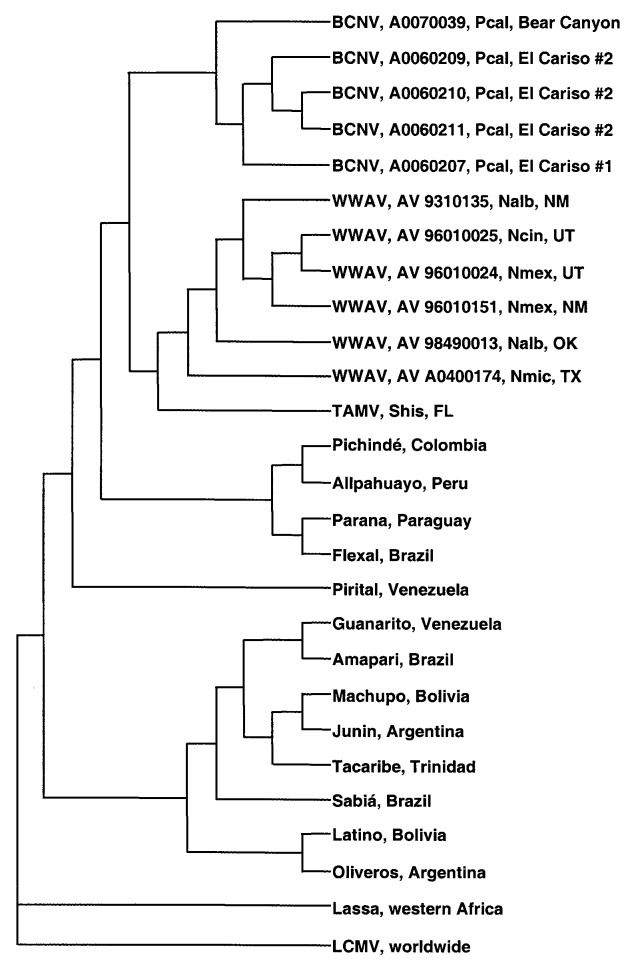
Thirty-four rodents captured in southern California were studied to increase our knowledge of the arenaviruses indigenous to the western United States. An infectious arenavirus was isolated from 5 of 27 California mice but none of the 7 other rodents. Analyses of viral nucleocapsid protein gene sequence data indicated that the isolates from the California mice are strains of a novel Tacaribe serocomplex virus (proposed name "Bear Canyon") that is phylogenetically most closely related to Whitewater Arroyo and Tamiami viruses, the only other Tacaribe serocomplex viruses known to occur in North America. The discovery of Bear Canyon virus is the first unequivocal evidence that the virus family Arenaviridae is naturally associated with the rodent genus Peromyscus and that a Tacaribe serocomplex virus occurs in California.
Figures
References
-
- Buchmeier MJ, Bowen MD, Peters CJ. Arenaviridae: The viruses and their replication. In: Knipe DM, Howley PM, Griffin DE, Lamb RA, Martin MA, Roizman B, et al., editors. Fields virology. 4th ed. Philadelphia: Lippincott, Williams, and Wilkins; 2001, p. 1635–68.
-
- Childs JE, Peters CJ. Ecology and epidemiology of arenaviruses and their hosts. In: Salvato MS, editor. The Arenaviridae. New York: Plenum Press; 1993, p. 331–84.
-
- Kosoy MY, Elliot LH, Ksiazek TG, Fulhorst CF, Rollin PE, Childs JE, et al. Prevalence of antibodies to arenaviruses in rodents from the southern and western United States: evidence for an arenavirus associated with the genus Neotoma. Am J Trop Med Hyg. 1996;54:570–5. - PubMed
Publication types
MeSH terms
Substances
Grants and funding
LinkOut - more resources
Full Text Sources
Molecular Biology Databases