


doi: 10.1128/jvi.76.15.7855-7859.2002.
Handedness of the herpes simplex virus capsid and procapsid
Affiliations
- PMID: 12097597
- PMCID: PMC136369
- DOI: 10.1128/jvi.76.15.7855-7859.2002
Item in Clipboard
Handedness of the herpes simplex virus capsid and procapsid
J Virol.
2002 Aug.
Abstract
The capsid of herpes simplex virus has an icosahedral surface lattice with a nonskew triangulation number, T=16. Nevertheless, the proteins arrayed on this lattice necessarily have an intrinsic handedness. We have determined the handedness of both the herpes simplex virus type 1 capsid and its precursor procapsid by a cryoelectron microscopic tilting method.
Figures
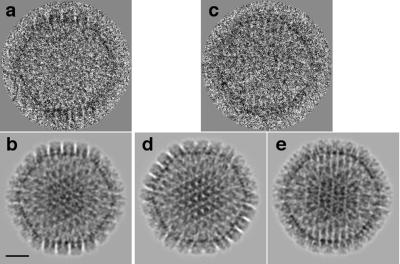
Example of matching of the correct enantiomeric model of HSV-1 capsid to a tilted cryo-EM image. (a) Micrograph of the untilted particle; (b) reprojection of the model(s) (enantiomers [A and B] give identical projections); (c) second exposure of the same particle tilted through 10o; (d) reprojection of model A, similarly rotated, giving a poor match with panel c; (e) reprojection of model B, similarly rotated, matching well with panel c. Bar = 250 Å.
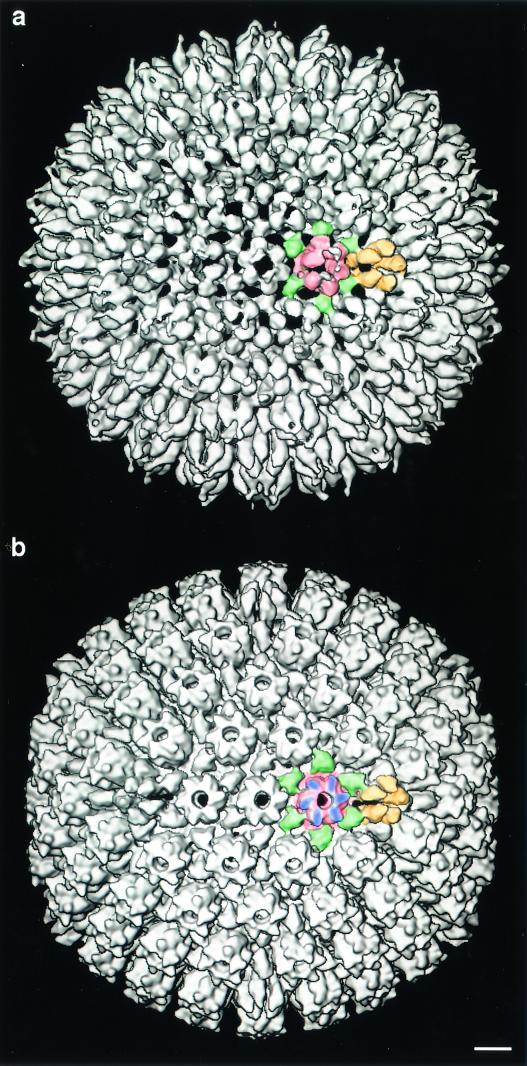
Outer surfaces of the HSV-1 procapsid (a) and mature capsid (b) with the correct handedness. The particles are viewed down an icosahedral twofold axis. A few examples of the molecules that make up the surface lattice (reviewed in reference 20) are color coded: six copies of major capsid protein VP5 (150 kDa) make up each hexon (red), and five copies of VP5 make up each penton (yellow). Each triplex (green) is a heterotrimer of VP19c (50 kDa; one copy) and VP23 (35 kDa; two copies). In the mature capsid (b), six copies of VP26 (12 kDa; blue) bind around the outer rim of each hexon but not to pentons. VP26 is not present on the procapsid (a). Handedness manifests itself in features such as the connections of the triplex proteins to the hexon and penton protrusions, the vorticity of the hexon caps (six copies of 12-kDa VP26) on the mature capsid, and the twist of the outward-protruding portions of the pentons and hexons. The images shown here and in Fig. 3 were recalculated from previously published data (17). Bar =100 Å.
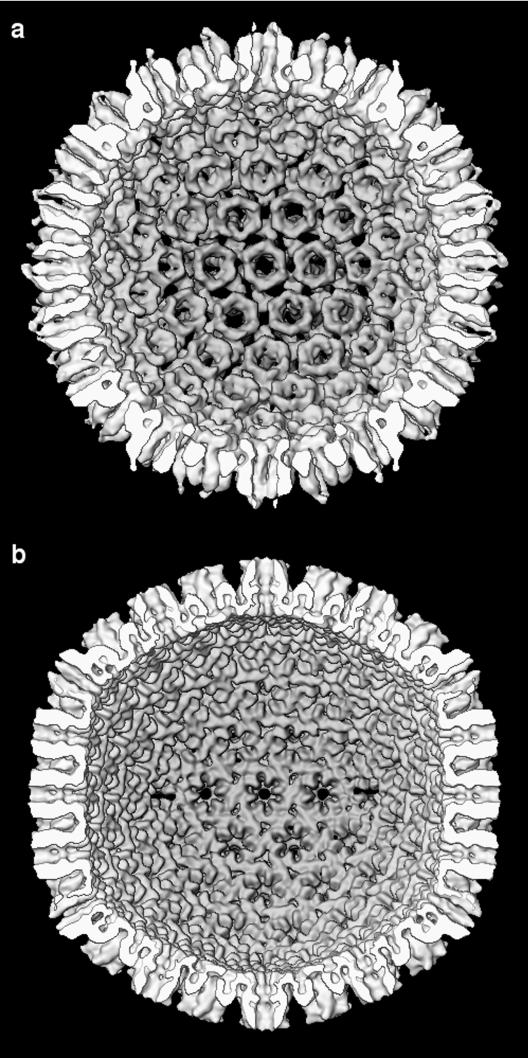
Inner surfaces of the HSV-1 procapsid (a) and mature capsid (b) with the correct handedness. The particles are viewed down an icosahedral twofold axis. The asymmetrical relationship of the triplexes to the hexons is evident on the procapsid but obscured in the mature capsid by the more continuous “floor.” The orientation of the sixfold orifice underlying the hexons (and pentons) exhibits handedness, particularly for the mature capsid.
References
-
- Baker, T. S., and R. H. Cheng. 1996. A model-based approach for determining orientations of biological macromolecules imaged by cryoelectron microscopy. J. Struct. Biol. 116:120-130. - PubMed
-
- Belnap, D. M., N. H. Olson, and T. S. Baker. 1997. A method for establishing the handedness of biological macromolecules. J. Struct. Biol. 120:44-51. - PubMed
-
- Booy, F. P., B. L. Trus, A. J. Davison, and A. C. Steven. 1996. The capsid architecture of channel catfish virus, an evolutionarily distant herpesvirus, is largely conserved in the absence of discernible sequence homology with herpes simplex virus. Virology 215:134-141. - PubMed
Publication types
MeSH terms
Substances
Grants and funding
LinkOut - more resources
Full Text Sources
