


Effects of varying sequence similarity on the frequency of repeat deletion during reverse transcription of a human immunodeficiency virus type 1 vector
- PMID: 12097604
- PMCID: PMC136404
- DOI: 10.1128/jvi.76.15.7897-7902.2002
Effects of varying sequence similarity on the frequency of repeat deletion during reverse transcription of a human immunodeficiency virus type 1 vector
Abstract
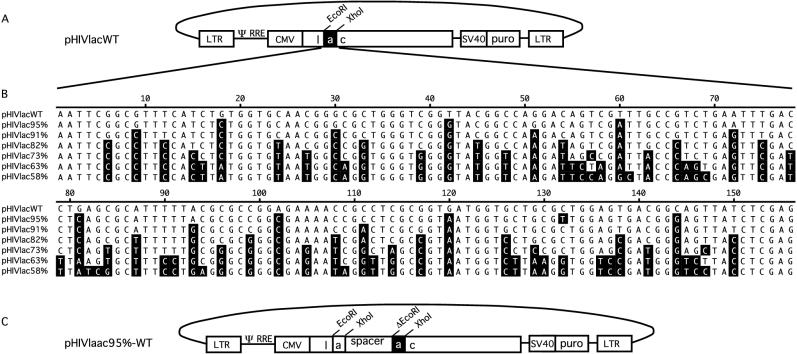
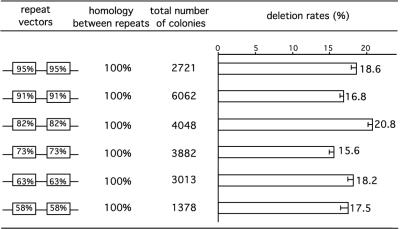
Genetic recombination contributes to human immunodeficiency virus type 1 (HIV-1) diversity, with homologous recombination being more frequent than nonhomologous recombination. In this study, HIV-1-based vectors were used to assay the effects of various extents of sequence divergence on the frequency of the recombination-related property of repeat deletion. Sequence variation, similar in degree to that which differentiates natural HIV-1 isolates, was introduced by synonymous substitutions into a gene segment. Repeated copies of this segment were then introduced into assay vectors. With the use of a phenotypic screen, the deletion frequency of identical repeats was compared to the frequencies of repeats that differed in sequence by various extents. During HIV-1 reverse transcription, the deletion frequency observed with repeats that differed by 5% was 65% of that observed with identical repeats. The deletion frequency decreased to 26% for repeats that differed by 9%, and when repeats differed by 18%, the deletion frequency was about 5% of the identical repeat value. Deletion frequencies fell to less than 0.3% of identical repeat values when genetic distances of 27% or more were examined. These data argue that genetic variation is not as inhibitory to HIV-1 repeat deletion as it is to the corresponding cellular process and suggest that, for sequences that differ by about 25% or more, HIV-1 recombination directed by sequence homology may be no more frequent than that which is homology independent.
Figures

References
-
- An, W., and A. Telesnitsky. 2001. Frequency of direct repeat deletion in a human immunodeficiency virus type 1 vector during reverse transcription in human cells. Virology 286:475-482. - PubMed
-
- Balakrishnan, M., P. J. Fay, and R. A. Bambara. 2001. The kissing hairpin sequence promotes recombination within the HIV-1 5′ leader region. J. Biol. Chem. 276:36482-36492. - PubMed
-
- Coffin, J. M. 1995. HIV population dynamics in vivo: implications for genetic variation, pathogenesis and therapy. Science 267:483-489. - PubMed
-
- Colicelli, J., and S. P. Goff. 1988. Sequence and spacing requirements of a retrovirus integration site. J. Mol. Biol. 199:47-59. - PubMed
Publication types
MeSH terms
Grants and funding
LinkOut - more resources
Full Text Sources
