


Genetic variation in the 6p22.3 gene DTNBP1, the human ortholog of the mouse dysbindin gene, is associated with schizophrenia
- PMID: 12098102
- PMCID: PMC379166
- DOI: 10.1086/341750
Genetic variation in the 6p22.3 gene DTNBP1, the human ortholog of the mouse dysbindin gene, is associated with schizophrenia
Erratum in
- Am J Hum Genet 2002 Oct;72(4):1007
Abstract
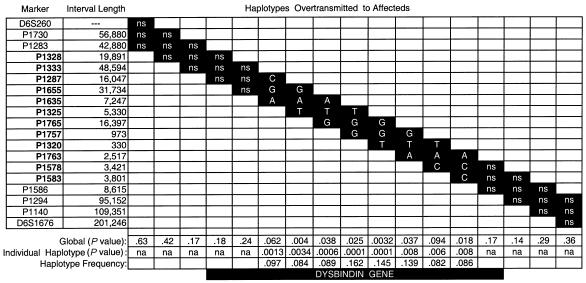
Prior evidence has supported the existence of multiple susceptibility genes for schizophrenia. Multipoint linkage analysis of the 270 Irish high-density pedigrees that we have studied, as well as results from several other samples, suggest that at least one such gene is located in region 6p24-21. In the present study, family-based association analysis of 36 simple sequence-length-polymorphism markers and of 17 SNP markers implicated two regions, separated by approximately 7 Mb. The first region, and the focus of this report, is 6p22.3. In this region, single-nucleotide polymorphisms within the 140-kb gene DTNBP1 (dystrobrevin-binding protein 1, or dysbindin) are strongly associated with schizophrenia. Uncorrected, empirical P values produced by the program TRANSMIT were significant (P<.01) for a number of individual SNP markers, and most remained significant when the data were restricted to include only one affected offspring per nuclear family per extended pedigree; multiple three-marker haplotypes were highly significant (P=.008-.0001) under the restricted conditions. The pattern of linkage disequilibrium is consistent with the presence of more than one susceptibility allele, but this important issue is unresolved. The number of markers tested in the adjacent genes, all of which are negative, is not sufficient to rule out the possibility that the dysbindin gene is not the actual susceptibility gene, but this possibility appears to be very unlikely. We conclude that further investigation of dysbindin is warranted.
Figures
References
Electronic-Database Information
-
- NCBI Single Nucleotide Polymorphism, http://www.ncbi.nlm.nih.gov/SNP/ (for reference identification numbers for SNPs)
-
- Online Mendelian Inheritance in Man (OMIM), http://www.ncbi.nlm.nih.gov/Omim/ (for SCZD3 [MIM 600511])
-
- UCSC Human Genome Project Working Draft, http://genome.ucsc.edu/ (for marker and SNP locations)
References
-
- Altshuler D, Daly M, Kruglyak L (2000a) Guilt by association. Nat Genet 26:135–137 - PubMed
-
- Altshuler D, Hirschhorn JN, Klannemark M, Lindgren CM, Vohl M, Nemesh J, Lane CR, Schaffner SF, Bolk S, Brewer C, Tuomi T, Gaudet D, Hudson TJ, Daly M, Groop L, Lander ES (2000b) The common PPAR Pro12Ala polymorphism is associated with decreased risk of type 2 diabetes. Nat Genet 26:76–80 - PubMed
-
- Anderson JL, Head SI, Rae C, Morley JW (2002) Brain function in Duchenne muscular dystrophy. Brain 125 (Pt 1): 4–13 - PubMed
-
- Antonarakis SE, Blouin JL, Pulver AE, Wolyniec P, Lasseter VK, Nestadt G, Kasch L, Babb R, Kazazian HH, Dombroski B, Kimberland M, Ott J, Housman D, Karayiorgou M, MacLean CJ (1995) Schizophrenia susceptibility and chromosome 6p24-22. Nat Genet 11:235–236 - PubMed
-
- Arolt V, Lencer R, Nolte A, Müller-Myhsok B, Purmann S, Schürmann M, Leutelt J, Pinnow M, Schwinger E (1996) Eye tracking dysfunction is a putative phenotypic susceptibility marker of schizophrenia and maps to a locus on chromosome 6p in families with multiple occurrence of the disease. Am J Med Genet 67:564–579 - PubMed
Publication types
MeSH terms
Substances
Associated data
- Actions
Grants and funding
LinkOut - more resources
Full Text Sources
Other Literature Sources
Medical
Molecular Biology Databases
Research Materials
Miscellaneous
