


E2F1 induces phosphorylation of p53 that is coincident with p53 accumulation and apoptosis
- PMID: 12101227
- PMCID: PMC133953
- DOI: 10.1128/MCB.22.15.5308-5318.2002
E2F1 induces phosphorylation of p53 that is coincident with p53 accumulation and apoptosis
Abstract
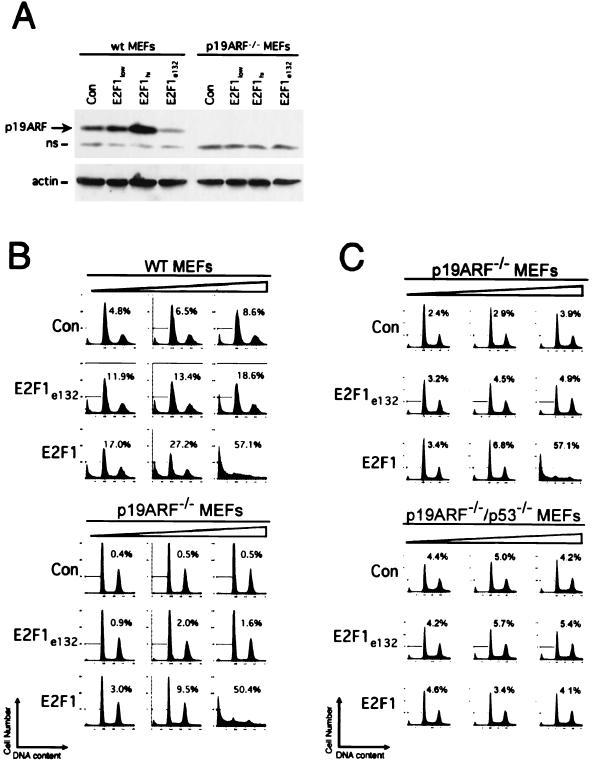
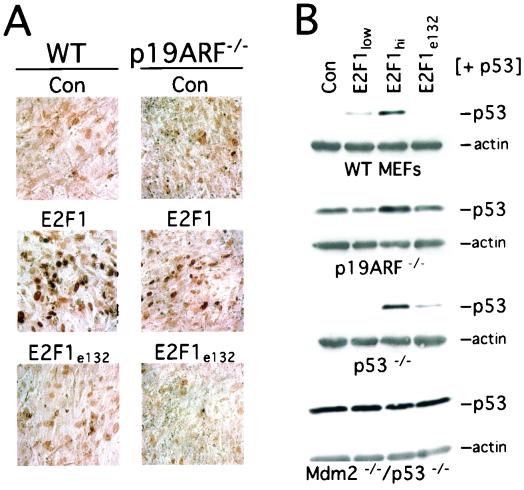
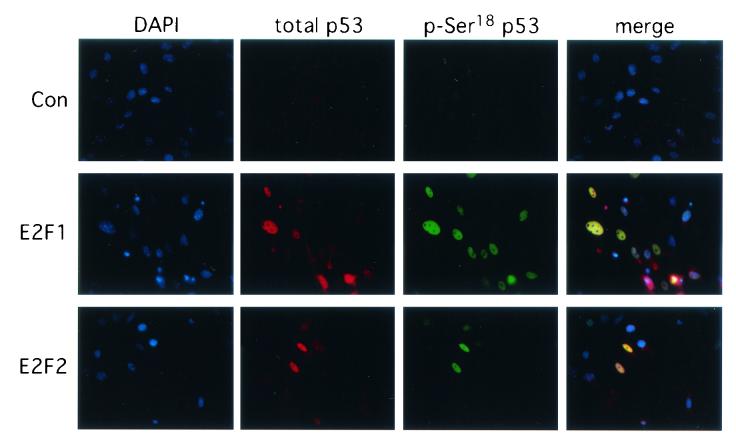
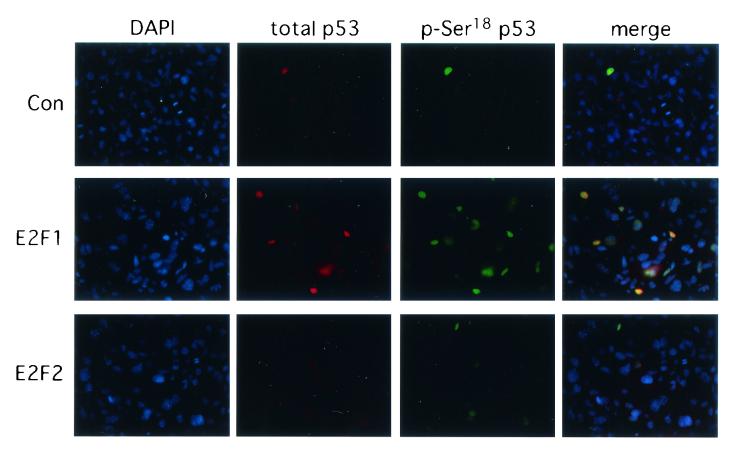
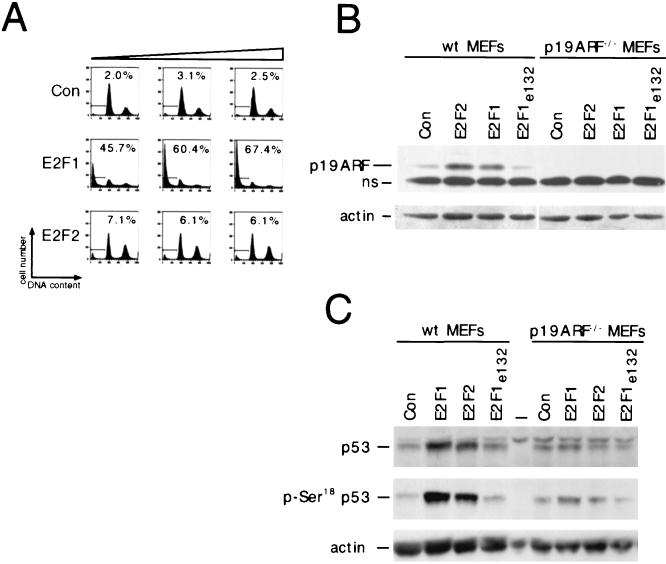
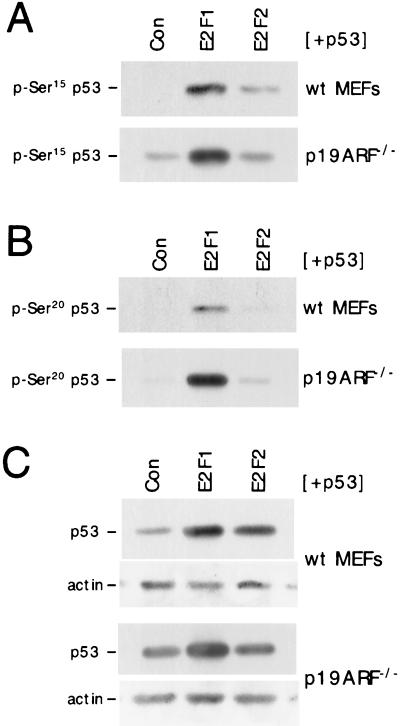
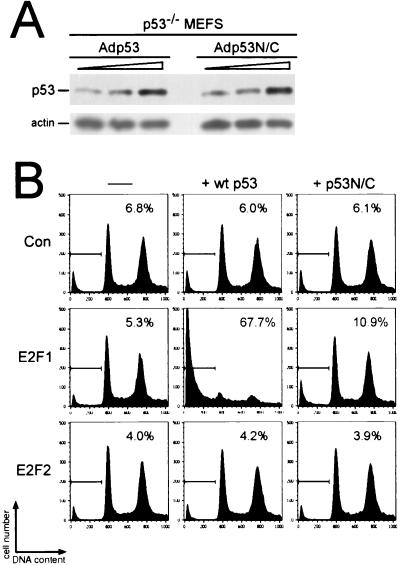
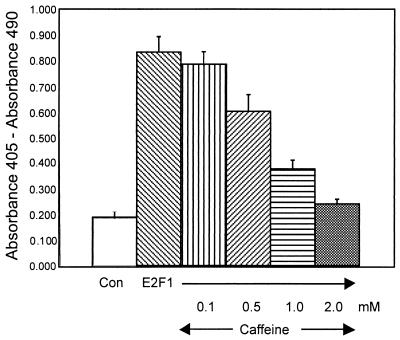
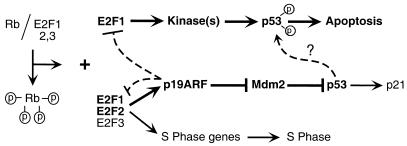
It has been proposed that the E2F1 transcription factor serves as a link between the Rb/E2F proliferation pathway and the p53 apoptosis pathway by inducing the expression of p19ARF, a protein that regulates p53 stability. We find that although p19ARF contributes to p53 accumulation in response to E2F expression, p19ARF is not required for E2F1-mediated apoptosis. E2F1 can signal p53 phosphorylation in the absence of p19ARF, similar to the observed modifications to p53 in response to DNA damage. These modifications are not observed in the absence of p19ARF following expression of E2F2, an E2F family member that does not induce apoptosis in mouse embryo fibroblasts but can induce p19ARF and p53 protein expression. p53 modification is found to be crucial for E2F1-mediated apoptosis, and this apoptosis is compromised when E2F1 is coexpressed with a p53 mutant lacking many N- and C-terminal phosphorylation sites. Additionally, E2F1-mediated apoptosis is abolished in the presence of caffeine, an inhibitor of phosphatidylinositol 3-kinase-related kinases that phosphorylate p53. These findings suggest that p53 phosphorylation is a key step in E2F1-mediated apoptosis and that this modification can occur in the absence of p19ARF.
Figures
References
-
- Appella, E., and C. W. Anderson. 2001. Post-translational modifications and activation of p53 by genotoxic stresses. Eur. J. Biochem. 268:2764-2772. - PubMed
-
- Banin, S., L. Moyal, S. Shieh, Y. Taya, C. W. Anderson, L. Chessa, N. I. Smorodinsky, C. Prives, Y. Reiss, Y. Shiloh, and Y. Ziv. 1998. Enhanced phosphorylation of p53 by ATM in response to DNA damage. Science 281:1674-1677. - PubMed
-
- Bates, S., A. C. Phillips, P. A. Clark, F. Stott, G. Peters, R. L. Ludwig, and K. H. Vousden. 1998. p14ARF links the tumour suppressors RB and p53. Nature 395:124-125. - PubMed
-
- Blasina, A., B. D. Price, G. A. Turenne, and C. H. McGowan. 1999. Caffeine inhibits the checkpoint kinase ATM. Curr. Biol. 9:1135-1138. - PubMed
Publication types
MeSH terms
Substances
Grants and funding
LinkOut - more resources
Full Text Sources
Research Materials
Miscellaneous
