. 2002 Jul 18;82(1):137-47.
doi: 10.1016/s0168-3659(02)00136-0.

Precise control of PLG microsphere size provides enhanced control of drug release rate

Affiliations

Precise control of PLG microsphere size provides enhanced control of drug release rate

Cory Berkland et al. J Control Release. .

Abstract

An important limitation in the development of biodegradable polymer microspheres for controlled-release drug delivery applications has been the difficulty of specifically designing systems exhibiting precisely controlled release rates. Because microparticle size is a primary determinant of drug release, we developed a methodology for controlling release kinetics employing monodisperse poly(D,L-lactide-co-glycolide) (PLG) microspheres. We fabricated 20-, 40- and 65-microm diameter rhodamine-containing microspheres and 10-, 50- and 100-microm diameter piroxicam-containing microspheres at various loadings from 1 to 20%. In vitro release kinetics were determined for each preparation. Drug release depended strongly on microsphere diameter with 10- and 20-microm particles exhibiting concave-downward release profiles while larger particles resulted in sigmoidal release profiles. Overall, the rate of release decreased and the duration increased with increasing microsphere size. Release kinetics from mixtures of uniform microspheres corresponded to mass-weighted averages of the individual microsphere release kinetics. Appropriate mixtures of uniform microspheres were identified that provided constant (zero-order) release of rhodamine and piroxicam for 8 and 14 days, respectively. Mixing of uniform microspheres, as well as control of microsphere size distribution, may provide an improved methodology to tailor small-molecule drug-release kinetics from simple, biodegradable-polymer microparticles.


Figures

Fig. 1
Fig. 1
Schematic of PPF apparatus for fabrication of single-wall microspheres (SWMS) (A) and double-wall microspheres (DWMS)/liquid-core microcapsules (MC) (B); PPF double nozzle system (C) and triple nozzle system (D).
Fig. 2
Fig. 2
Scanning electron micrographs of (A) 40 μm, (C) 20 μm rhodamine-loaded SWMS and (B) 50 μm and (D) 10 μm piroxicam-loaded SWMS and (E) their size distributions. Scale bar=100 μm; applies to panels A–D. Adapted from (Berkland et al., 2002)
Fig. 3
Fig. 3
Effect on SWMS size and drug loading on (A) rhodamine and (B) piroxicam release rates. Adapted from (Berkland et al., 2002)
Fig. 4
Fig. 4
Laser scanning confocal microscopy cross section through the midline of 10, 20, 40, 65 and 100 μm rhodamine-loaded PLG SWMS (top row), revealing increasing surface distribution of rhodamine as microsphere diameter increases. Cross section of 10, 50, and 100 μm piroxicam-loaded microspheres (bottom row) reveal increasing amounts of piroxicam in the microsphere interior as diameter increases. Adapted from (Berkland et al., 2003)
Fig. 5
Fig. 5
(A) Piroxicam release from 3:1, 1:1 and 1:3 (w/w) mixtures of 10 μm/15% SWMS and 50 μm/15% SWMS; (B) Piroxicam release from 1:6.1, 1:11.5 and 1:39 (w/w) mixtures of 10 μm/20% SWMS and 50 μm/10% SWMS. Adapted from (Berkland et al., 2002)
Fig. 6
Fig. 6
Size distributions of (A) DWMS with varying PLL shell thickness and (B) monodisperse PLG and PLL SWMS. Confocal fluorescence and SEM (insets) of (C) PLL:PLG 40:60 and (D) PLL:PLG 50:50 DWMS. In SEMs, PLG was selectively dissolved with EtAc to image the PLL. In vitro piroxicam release from uniform PLG, PLL SWMS and PLL(PLG) DWMS (E). Adapted from (Berkland et al., 2004a)
Fig. 7
Fig. 7
Scanning electron micrographs of piroxicam-loaded PDLL(PLG) DWMS after 90 days of in vitro release showing particle exterior morphology (first column), particle cross-section (second column), and wall cross-section (third column). PDLL:PLG ratios of (A–C) 0.5:1; (D–F) 0.75:1; (G–I) 1.5:1; (J–L) 2.25:1; and (M–O) 3:1. Scale bar=50 μm (first column), 20 μm (second column), 1.5 μm (C) and 5 μm (F, I, L and O). Adapted from (Pollauf et al., 2005)
Fig. 8
Fig. 8
(A) Size distributions of dextran and BSA-loaded PLG SWMS; (B) Confocal fluorescence micrographs of dextran and BSA within PLG SWMS. In vitro release of (C) dextran and (D) BSA from uniform PLG SWMS. (C): 31 μm (closed circles), 44 μm (open circles), and 80 μm (triangles). (D): 34 μm (closed circles), 47 μm (open circles), and 85 μm (triangles). Adapted from (Berkland et al., 2007a)
Fig. 9
Fig. 9
SEM images of SWMS prior to release: (A) 47 μm non-Mg(OH)2, (B) 80 μm non- Mg(OH)2, (C) 47 μm with 3% Mg(OH)2, (D) 80 μm with 3% Mg(OH)2 and pDNA in vitro release (E). Scale bar=10 μm, 2 μm on inset. Adapted from (Varde and Pack, 2007)
Fig. 10
Fig. 10
Confocal fluorescence micrographs (for each pair, left: fluorescence; right: merged fluorescence and transmitted light) of BSA-loaded SWMS (A, B) and BSA-loaded DWMS (C and D, EtAc(DCM), PLG Mw 4.2 kDa, PDLL Mw 43 kDa; E and F, EtAc(DCM), PLG Mw 4.2 kDa, PDLL Mw 106 kDa. In vitro release profiles of BSA from DWMS/shell-free SWMS control (G): DWMS, EtAc(DCM), PDLL 43, 106 kDa, PLG 4.2 kDa; SWMS PLG 4.2 kDa. Scale bar=50 μm. Adapted from (Xia et al., 2013b)
Fig. 11
Fig. 11
Confocal fluorescence micrographs of uniform BSA-loaded DWMS (for each pair, left: fluorescence; right: merged fluorescence and transmitted light): (A, B), EtAc(DCM), PDLL/PLG 1.09; (C, D), EtAc(DCM), PDLL/PLG 2.14; (E, F), EtAc(DCM), PDLL/PLG 3.04. In vitro release of BSA from DWMS with different PDLL shell thickness (G): PDLL/PLG=1.09, shell thickness=6.3 μm; PDLL/PLG=2.14, shell thickness=10.6 μm; PDLL/PLG=3.04, shell thickness=13.9 μm. Scale bar=50 μm. Adapted from (Xia et al., 2013a)
Fig. 12
Fig. 12
(A) Coulter Multisizer size distributions for different polymer, oil, and aqueous core MC; (B) Scanning electron micrograph depicting the uniformity and surface morphology of ~115 μm canola oil core/PLG shell MC (oil core not visible). (C) Optical micrograph of ~110 μm MC encapsulating an aqueous core containing 100 mg/mL dextran and 10 mg/mL BSA with a PLG shell. Adapted from (Berkland et al., 2007b)
Fig. 13
Fig. 13
In vitro release profiles of BSA from liquid-core MC of PLG shell flow rate at 30, 40 and 50 mL/h, (calculated PLG shell thickness: 14.7, 16.5 and 19.0 μm). Adapted from (Xia, 2013)
Fig. 14
Fig. 14
SEM images of microcapsules degradation/erosion study with different PLG (Mw 88 kDa) shell flow rate at 30, 40 and 50 mL/h (calculated PLG shell thickness: 14.7, 16.5 and 19.0 μm). Adapted from (Xia and Pack, 2014)
Fig. 15
Fig. 15
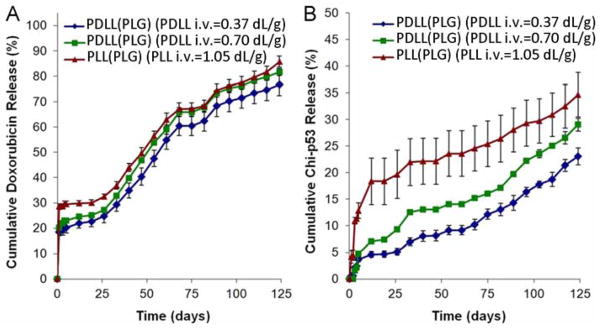
(A) Doxorubicin and (B) chitosan-p53 nanoparticles release rate from PDLL/PLL(PLG) DWMS. Adapted from (Xu et al., 2012)

References

    1. Almería B, Deng W, Fahmy TM, Gomez A. Controlling the morphology of electrospray-generated PLGA microparticles for drug delivery. Journal of Colloid and Interface Science. 2010;343:125–133. - PubMed
    1. Anderson JM, Shive MS. Biodegradation and biocompatibility of PLA and PLGA microspheres. Advanced Drug Delivery Reviews. 2012;64(Supplement):72–82. - PubMed
    1. Badri Viswanathan N, Patil SS, Pandil JK, Lele AK, Kulkarni MG, Mashelkar RA. Morphological changes in degrading PLGA and P(DL)LA microspheres: implications for the design of controlled release systems. Journal of Microencapsulation. 2001;18:783–800. - PubMed
    1. Batycky RP, Hanes J, Langer R, Edwards DA. A theoretical model of erosion and macromolecular drug release from biodegrading microspheres. Journal of Pharmceutical Sciences. 1997;86:1464–1477. - PubMed
    1. Berkland C. Control of micro- and nano- sphere size distributions: implications in drug delivery, Chemical and Biomolecular Engineering. University of Illinois at Urbana-Champaign; Urbana-Champaign: 2003.